
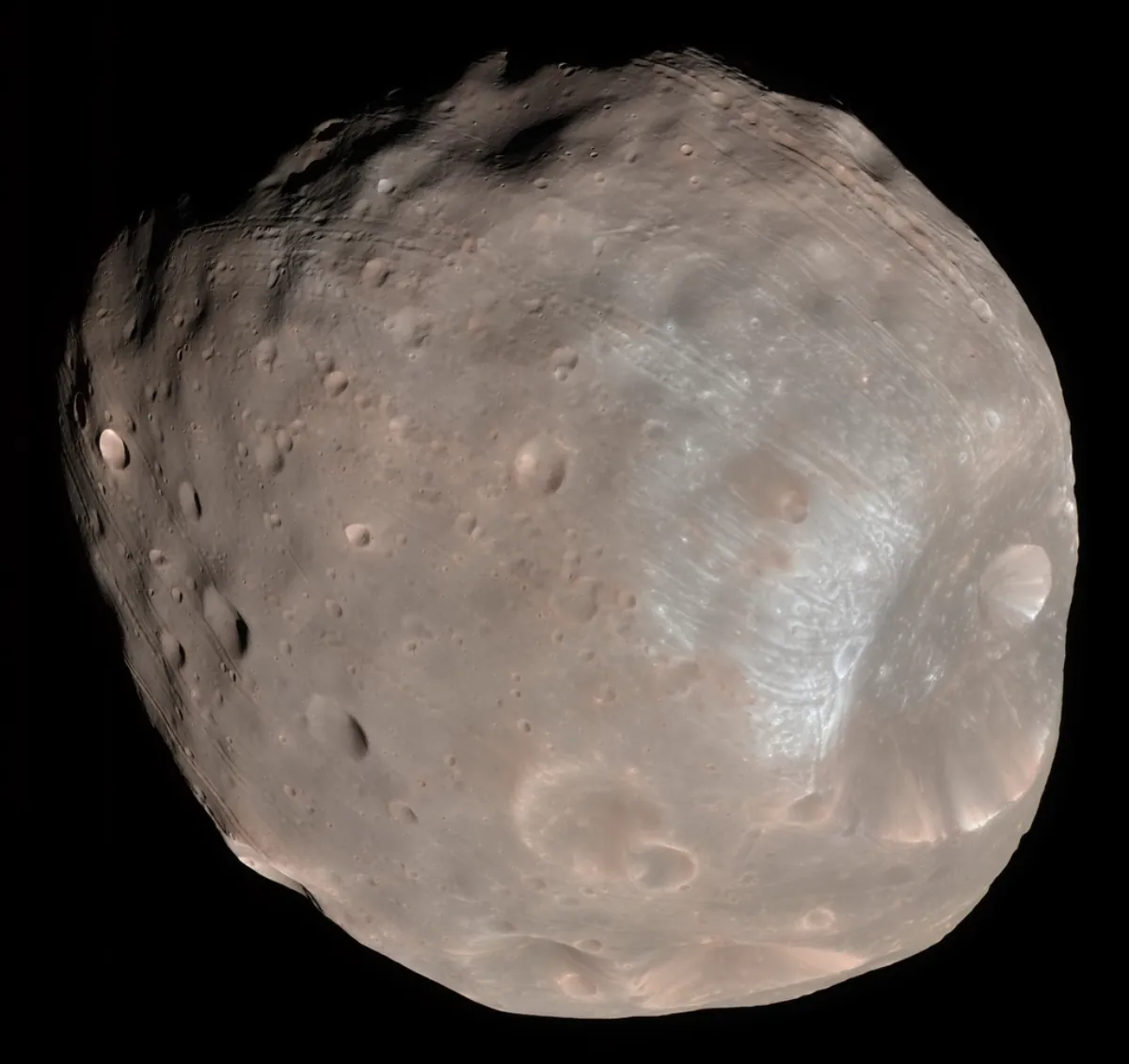
Mars has two small, lumpy moons that look more like potatoes than proper moons. Nobody knows for sure where they came from. Japan has now launched a spacecraft to settle the argument, and it plans to bring a pinch of one of them back to Earth.
The Japan Aerospace Exploration Agency (JAXA) launched its Martian Moons eXploration (MMX) probe on an H3 rocket from the Tanegashima Space Center in southern Japan at 4:41 am local time on October 20, 2026 (still October 19 in Europe and the Americas). The probe is now cruising towards Mars, where it will study the moons Phobos and Deimos, land on Phobos to collect soil, and carry that sample home by 2031. Space agencies and outlets across the world are still tracking what comes next.
Quick Facts
- Who: JAXA, with NASA, France’s CNES, Germany’s DLR and the European Space Agency (ESA)
- What: MMX, a mission to orbit, land on and collect samples from Mars moon Phobos
- When: Launched 4:41 am JST, October 20, 2026
- Where: Yoshinobu Launch Complex, Tanegashima Space Center, Japan
- Key number: At least 10 grams of Phobos soil, due back on Earth in 2031
MMX Launch: What Happened at Tanegashima
The launch was the 10th flight of Japan’s H3 rocket. JAXA had locked in the date back in August, with a backup window that ran into early November. In the end it did not need the spare days.
About an hour and 11 minutes after liftoff, the rocket placed MMX into its planned orbit, Jiji Press reported. From there the spacecraft set off on its long trip to Mars.
It has been a long wait. JAXA first wanted to fly MMX in 2024 but had to stand down because of problems with the H3 rocket. Since Earth and Mars line up for an easy trip only about once every 26 months, that slip pushed the mission back two years.
ESA’s Director of Science, Carole Mundell, congratulated “JAXA and the entire MMX team” on what she called a successful launch.
Why Phobos? The Mystery Behind Mars’ Moons
Earth’s Moon is big and round. Phobos and Deimos are tiny and oddly shaped, and scientists have argued about them for decades. There are two main ideas.
- Captured asteroids: they were passing rocks that Mars’ gravity grabbed and never let go.
- Giant impact debris: a huge object smashed into Mars long ago and the moons formed from the rubble thrown into orbit.
France’s space agency CNES says working out which story is true is a main goal of MMX. Having real Phobos soil in a lab should help. Rock from Mars itself would point to the impact idea, while material that looks like asteroids would favour the capture idea.
The answer also matters beyond Mars. It feeds into the bigger question of how rocky planets, including Earth, were built and how water and other ingredients moved around the early solar system.
MMX Mission Timeline: From Launch to Sample Return
Here is the plan as laid out by JAXA’s partners. Dates this far ahead can move, so treat them as targets.
- Next summer (2027): arrival at Mars, according to ESA project scientist Elliot Sefton-Nash. The spacecraft will then settle into orbit around Phobos.
- Late 2028: release of IDEFIX, a small rover built by CNES and DLR, onto the surface of Phobos.
- Sample collection: the main craft will touch down on Phobos to collect at least 10 grams of material from about 2 cm below the surface, per CNES. Space.com reports two separate touchdowns are planned.
- Deimos: the probe will fly past the smaller moon to observe it, without landing.
- 2031: the sample capsule returns to Earth and lands in the Australian desert, CNES says.
If it works, MMX will be the first spacecraft to orbit Phobos, the first to collect samples from it and the first to make a round trip to the Mars system, ESA says. Sefton-Nash said the team is “now even more motivated” ahead of next year’s arrival.
IDEFIX: A Rover Driving in Almost Zero Gravity
The most fun part of the mission might be the rover. IDEFIX is a small French-German machine with four instruments, designed to work on Phobos for about 100 days.
The tricky bit is gravity. CNES says gravity on Phobos is roughly 1,800 times weaker than on Earth. Picture trying to drive a car where a small bump could bounce you off the ground. The rover’s wheels have to grip a surface where almost nothing holds them down.
Europe is also helping in other ways. ESA supplied the probe’s deep-space communication equipment and its Estrack ground stations will help send commands and receive data. CNES built the MIRS infrared spectrometer, which will map minerals on the moons and help pick landing spots.
The India Angle: Mangalyaan and Japan’s Sample Record
Indian readers know Mars well thanks to the Mars Orbiter Mission, or Mangalyaan, which reached the Red Planet in 2014 and also photographed Phobos during its years in orbit. MMX goes a big step further by landing and bringing material home.
Japan has done this kind of thing before. Its Hayabusa and Hayabusa2 missions brought back samples from asteroids Itokawa and Ryugu. MMX takes that know-how much farther from home. For ISRO, which is planning its own deep-space missions, it is a useful case study in how international partners can share a big, risky project.
What We Don’t Know Yet
- The exact date MMX will enter Mars orbit has not been confirmed in public updates; ESA only says “next summer”.
- Where exactly on Phobos the probe will land is still to be chosen, using data gathered after arrival.
- How many of the later milestones hold depends on the spacecraft’s health during a long, complex mission.
Our Take
Most Mars headlines focus on the planet itself, so it is refreshing to see a mission chase its strange little moons. Ten grams sounds like nothing, about two teaspoons of sugar, but for scientists it is a treasure that can be studied for decades. After a two-year delay, Japan has the mission on its way. The hard part, landing and getting home, starts next year.
FAQs
What is the MMX mission?
MMX (Martian Moons eXploration) is a JAXA-led mission to study Mars’ moons Phobos and Deimos and bring a soil sample from Phobos back to Earth.
When did Japan launch MMX?
It launched at 4:41 am Japan time on October 20, 2026, on an H3 rocket from Tanegashima Space Center. In Europe and the US it was still October 19.
When will MMX reach Mars?
ESA says the spacecraft is due to arrive at Mars next summer, in 2027.
How much of Phobos will MMX bring back?
At least 10 grams, scooped from about 2 cm below the surface. The capsule is planned to land in Australia in 2031.
Is NASA part of the MMX mission?
Yes. JAXA leads it, working with NASA, CNES, DLR and ESA.
For official updates, see ESA’s MMX launch page and CNES’s MMX project page.
Based on reporting by ESA, JAXA, CNES, Astronomy.com, Jiji Press and Space.com.





Leave a Reply