Choose a hands-on creative diploma in a format that works for you. Explore your options and discover the program that matches your ambition.
At Toronto Film School, our goal is to provide you
with a seamless admissions experience—one that offers
personalized support should you need it.
We started by imagining what success looks like for our students; we envisioned them graduating not just skilled and confident, but connected and industry savvy too.
Industry News with Perspective
by Garry Murdock
IMAX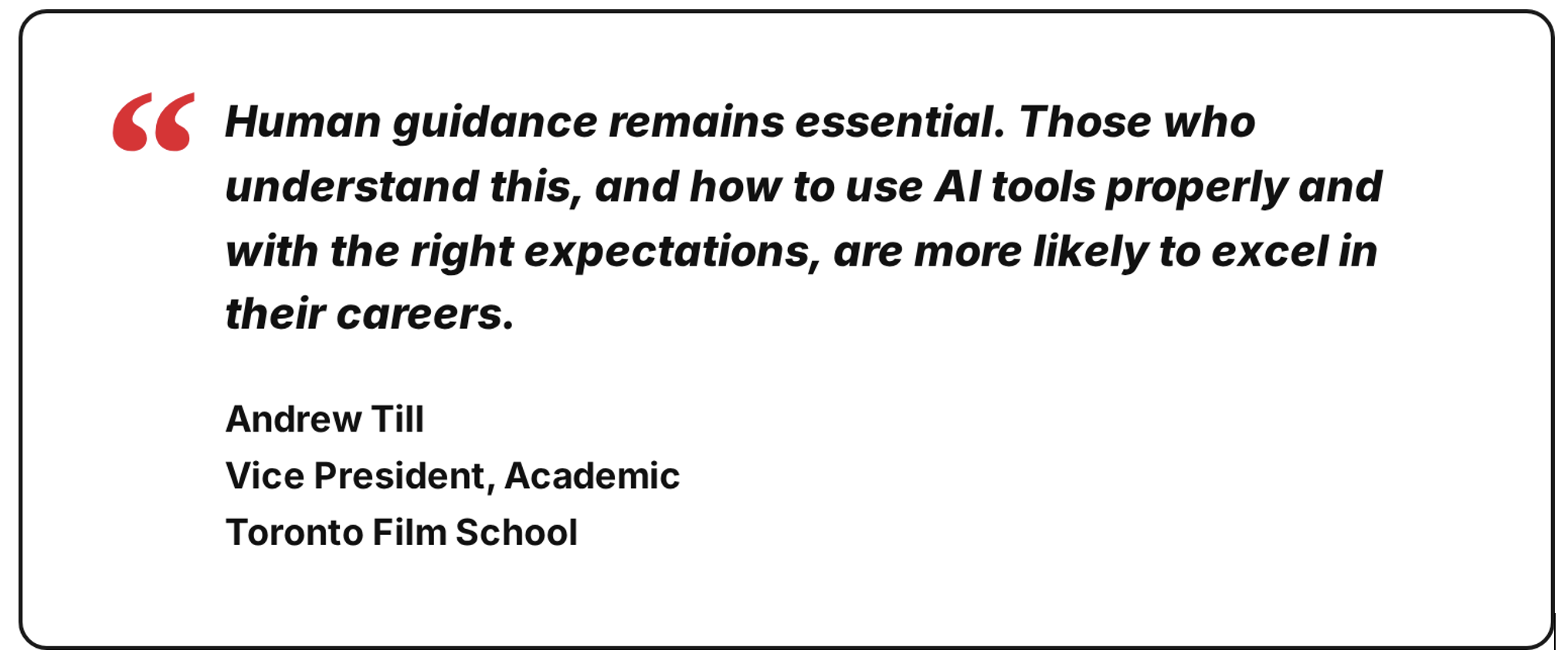
Will AI replace creative jobs? A recent Harris Poll found that 63% of Canadian workers surveyed fear that AI will significantly limit their job opportunities, while nearly half worry their jobs could be eliminated entirely. For students questioning the future of creative jobs in the age of AI, that sense of uncertainty is a shared one.
Yet, the conversation within the industry itself has taken a different turn.
“We should approach AI with the understanding that certain human capabilities remain irreplaceable,” Adam Till, Vice President, Academic for Toronto Film School, tells me. “AI can’t currently navigate tasks requiring genuine empathy, emotional intelligence, or refined judgement. It lacks the moral compass, contextual awareness, and lived experience necessary for true leadership in the workplace, as we define it today. Human guidance remains essential. Those who understand this, and how to use AI tools properly and with the right expectations, are more likely to excel in their careers.”
Andrew Barnsley, President of Toronto Film School, offers a historical lens on this latest technological shift.
“AI is far from the first disruptor the creative industries have faced,” Barnsley says. “We’ve been here before. We adapt, then we tend to forget what the business was like before. The internet was not only an invaluable research tool but allowed social media and streaming services to redefine how we reach audiences. The change from film and tape to digital technology meant that an edit became non-linear and was no longer permanent or tied to a fixed timeline. Creators could experiment freely and more often, always having the original source material to fall back on. Similarly, innovations like motion capture technology fundamentally shifted how we create movies and video games.”
IMAX
IMAX
According to 1,000 companies surveyed in the World Economic Forum’s The Future of Jobs Report, AI and information processing technologies will be the leading driver of business transformation by 2030, with Generative AI having already witnessed “a rapid surge in both investment and adoption across various sectors.”
The London School of Economics and Political Science report AI in the Creative Industries, notes: “Creative industry firms have long been the frontier adopters of new technology, and this is also the case with AI…two positive trends can clearly be seen. First, business dynamism, with each sub-sector of the creative industries developing its own tailored tools often built by start-ups who are creating new roles as they expand. Second, augmentation, with tools working alongside the human workforce to drive up their productivity.”
There is also a clear financial incentive emerging: LinkedIn’s Economic Graph of the global economy “currently tracks a wage premium of up to 30% for workers who list verified AI literacy on their profiles compared to those in similar roles without those skills.”
Rose Luckin, Professor Emerita at University College London and founder and CEO of Educate Ventures Research (a company that provides thought leadership and guidance on the ethical and effective uses of AI) provided me with this perspective: “AI is now a basic requirement of informed citizenship, not just a specialist technical skill. When AI is used as a collaborator rather than a substitute, it can expand what is possible…The goal is not to compete with AI. It is to do what AI cannot.”
IMAX
IMAX
“The creative industries are adopting AI as a useful tool in production cycles and workflows,” Till says. “TFS will always remain on trend with industry, for both creative and technical learning, to ensure our students are prepared for the careers of today.”
Emilija Davidovic, program director of Toronto Film School’s Film Production program, explains that although AI is part of the curriculum, the program’s ethos will remain craft first: “AI represents another step in technological transitions. However, students who understand both craft and technology will find themselves better equipped (for their careers). AI is positioned as a workflow tool, not an author.”
This means filmmaking students will continue to learn core skills, including scripting, directing, producing, cinematography, editing, and more.
“AI components do not replace these fundamentals,” says Davidovic. “Instead, students will be taught how to integrate AI responsibly within structured logistical and post-production workflows. Students will be graded on evidence of disciplined refinement and creative leadership.”
imax
This craft-first philosophy guides every one of Toronto Film School’s creative diploma programs.
“It goes without saying that you can’t replace an actor on stage with AI,” Hart Massey, program director of Acting for Film, TV and the Theatre tells me, “But I’d also argue that audiences watching at home also want to believe in someone who’s real. There’s a place for animation, robots and AI characters, but nothing will ever replace a real-life actor.”
Michelle Daly, the program director for Writing for Film and TV, puts it this way: “AI can never replace a writer’s voice. Their unique perspective and lived experience is what sets one writer apart from another.”
IMAX
IMAX
This same ethos weaves through the school’s video game and graphic design programs too.
“In the game industry,” JP Amore, program director for Video Game Design & Development, tells me, “AI is becoming an increasingly powerful set of tools that enhances—not replaces—the creative work our development teams do.”
For example, students will be using AI to speed up prototyping to assist with complex systems design.
“AI allows developers to focus more of their time on imaginative problem solving,” Amore continues. “By integrating AI literacy into our program, we are preparing students to collaborate with these tools effectively, strengthening both their technical abilities and their creative problem-solving potential.”
Rob Elsworthy, program director for Video Game Design & Animation, agrees, “AI is part of an emerging toolkit, not the foundation. In our program, we build strong fundamentals, clear thinking, and creative direction first, then use it to push ideas further. The future belongs to creatives with vision who know how to execute.”
“In Graphic Design & Interactive Media,” Pheinixx Paul, program director, tells me, “we treat AI the same way we treat any other technology: as a tool that supports visual communication, not as a substitute for the designer. Students learn craft first through concept, composition, and visual storytelling. And then they learn how to use AI responsibly, along with other technology, to streamline parts of the workflow, test ideas, and expand their exploration.”
Ultimately, the use of AI technology at Toronto Film School acts as an extension of the creative, not as a successor. This shift towards adaptation rather than replacement ensures that human expression remains at the core of every student project.
IMAX
IMAX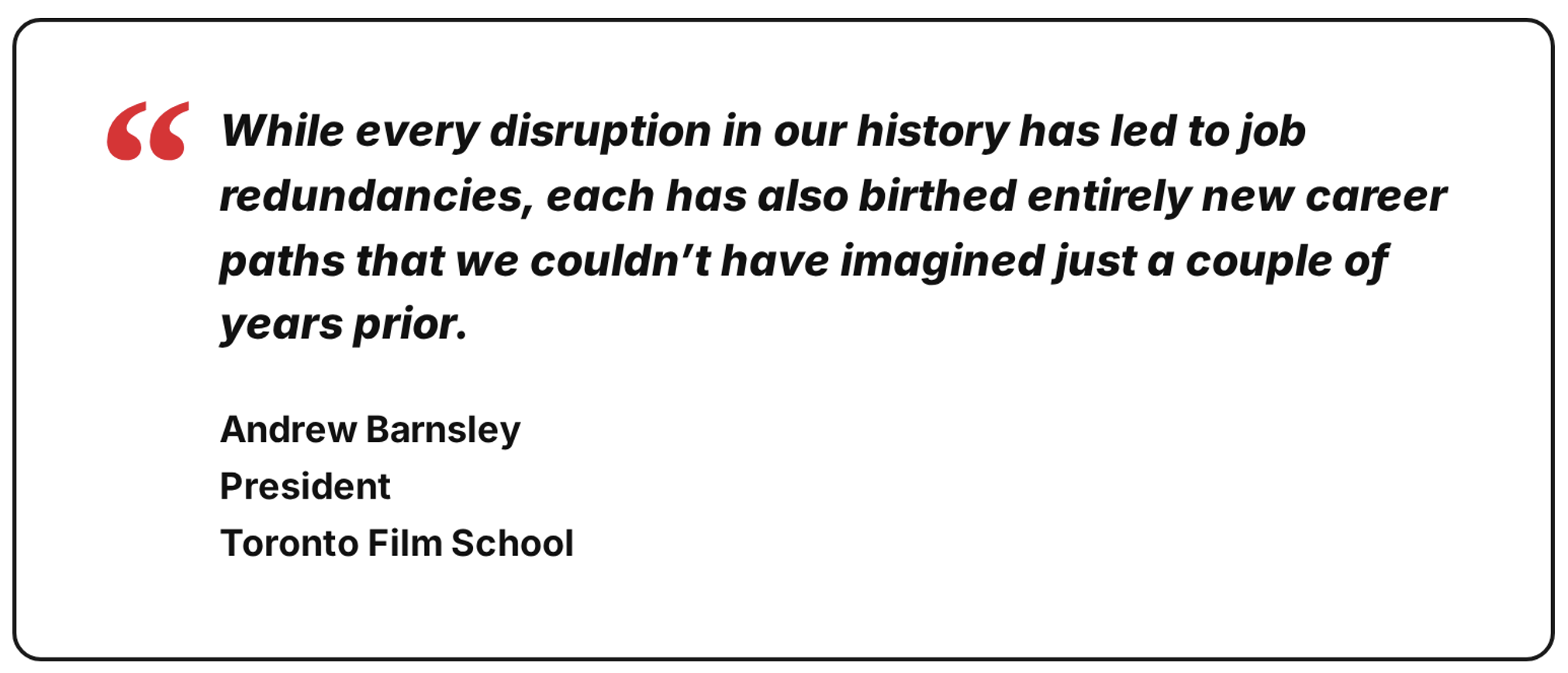
“We’ve always looked to industry to help shape what and how we teach,” Till says. “Our focus is on bringing current industry practices into the classroom in a practical, applied way. We’re not teaching AI for its own sake; instead, where it’s being used meaningfully, we reflect that in our programs so students graduate prepared not just for today’s jobs, but the opportunities of tomorrow.”
Barnsley closes with a thoughtful reflection on the intersection of craft and technology, as it relates to AI: “While every disruption in our history has led to job redundancies, each has also birthed entirely new career paths that we couldn’t have imagined just a couple of years prior. This is why creative agility—an approach that provides for multiple career paths and a deep understanding of the business—is essential in education today.
“At Toronto Film School, we teach both the foundational tools of the trade and the uniquely human skills of guidance and leadership, so that students can own their professional trajectory and truly call the shots in their careers.”
IMAX
About the Writer
Want more movie and TV show reviews?
Subscribe to the #1 newsletter for Canada’s creatives. Backed by the Toronto Film School, this free industry newsletter offers:
Join 10,000+ other creatives who rely on the Insider Advantage to stay ahead of the curve!
Subscribe Now
newsletter
Build expertise through access to our must-read newsletter for filmmakers and creative professionals. Discover your Insider Advantage.
Movie review on the film Project Hail Mary, starring Ryan Gosling. Read more
Film Production alums Fernanda Molina and Daria Lavrova took top honours home from North America’s biggest documentary festival From classroom project to festival winner, My Body Goes to Work has quickly become one of the documentary world’s most talked-about short films. The 12-minute doc – directed by Class of 2022 Film Production alumni Fernanda Molina …
Hollywood A-lister Josh Duhamel had a message for the press assembled at the TCL Chinese Theatre in Los Angeles for the red-carpet premiere of his latest film, Neglected, last week: Remember the name Adam G. Levine. “This is gonna be the biggest writer,” the Transformers star said of Levine – a Class of 2025 Toronto …
When the Writers Guild of Canada announced Kaveh Mohebbi’s name as the winner of the Best Short Series Screenwriting Award, he knew it wasn’t just his win to celebrate. The Writing for Film & TV instructor at Toronto Film School Online had the whole cast and crew of 18 to 35 beside him at Koerner …
For Ethan Dyer, the transition from student to professional actor was less a leap of faith than a running start. Just a few days after his final class at Toronto Film School, he signed with one of Canada’s top talent agencies – an important milestone every acting student is working toward, and one he was …
When Emilija Davidovic signed on as line producer for a series of social Kleenex commercials timed to the Olympic Games this winter, she didn’t need a casting directory. Afterall, the shoot was in Toronto, the brief called for young, emerging talent, and she just so happens to run the Film Production program at Toronto Film …
Four days before Indiana Jones and the Great Circle: The Order of Giants was released to the world, Matty McDonald walked up to legendary voice actor Troy Baker at the Fan Expo in Toronto and introduced himself as his idol’s newest castmate. Baker – whose lauded credits include the voice of Joel in The Last …
Be the first to receive news, events, and information relevant to your field of interest.
We acknowledge the land Toronto Film School operates on is the traditional territory of many nations including the Mississaugas of the Credit, the Anishnabeg, the Chippewa, the Haudenosaunee and the Wendat peoples and is now home to many diverse First Nations, Inuit and Métis. We also acknowledge that Toronto is covered by Treaty 13 with the Mississaugas of the Credit. We reaffirm our responsibility to increase awareness and understanding of First Nations, Métis and Inuit peoples and colonial legacy, and commit to strengthening our relationship with Indigenous peoples throughout Canada.
Leave a Reply