Introduction:
From embodied intelligence to AI for Science, from quantum computing to commercial spaceflight, brain-computer interfaces, and nuclear fusion, more and more technologies that once remained in laboratories are moving towards industrial reality. They may not yet be the focus of the era, but they are incubating new future industries and reshaping the underlying infrastructure of human society in the next few decades.
And AI is becoming one of the most important driving forces in this process. It is no longer just a basic technology but is reshaping key fields such as computing, energy, manufacturing, and life sciences, accelerating the transformation of future industries from scientific breakthroughs to real-world implementation.
Therefore, BV not only focuses on and invests in AI itself but also in the next-generation civilization infrastructure driven by original technological breakthroughs that can define the future industrial landscape. We believe that the birth of future industries often starts from technological directions that have not yet formed a consensus, and true world-changing innovations always occur quietly before being widely noticed.
“Prologue to the Future” is a series of future industry observations launched by BV. We focus on those important technological directions that are opening up the future, record the key nodes of scientific breakthroughs moving towards industrial implementation, explore how technological breakthroughs cross the boundary between the laboratory and the real world, and ultimately grow into new industrial forces driving the progress of the era.
Because the birth of every future industry starts from a prologue that has not been fully seen. 
First, let’s state the view:
Xie Siwei, Vice President of Investment at BV Baidu Ventures: “The rapid development of AI computing power is hitting the power ceiling, and nuclear fusion has become almost the only ultimate energy source that can simultaneously meet the requirements of cleanliness, stability, near-infinity, and intrinsic safety. As an early-stage investment institution, after intensive research, we judge that nuclear fusion is the underlying energy foundation in the AI era, and the industry is entering a critical window period from ‘scientific verification’ to ‘engineering implementation’.”
In the past decade, when people discussed AI, they focused on algorithms, models, and computing power. However, as the scale of models continues to expand, a more fundamental problem begins to emerge: The endgame of AI may not be a computing power problem but an energy problem.
Jensen Huang drew a diagram at the 2026 GTC, breaking down the industrial structure of the AI era into five layers: App → Models → Infra → Chips → Energy.
The bottom layer is energy.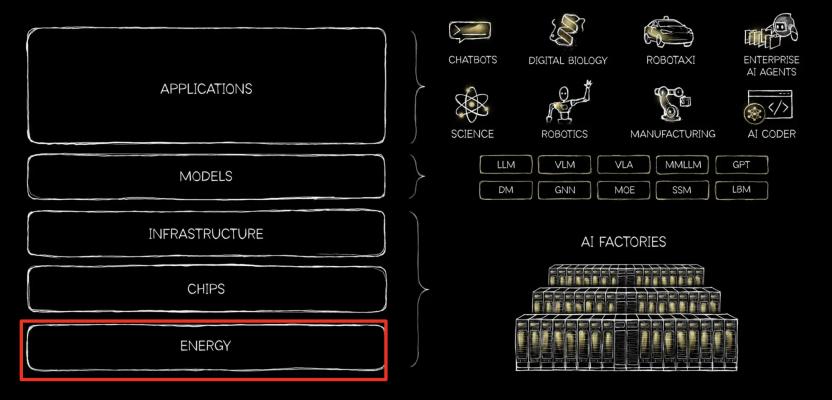
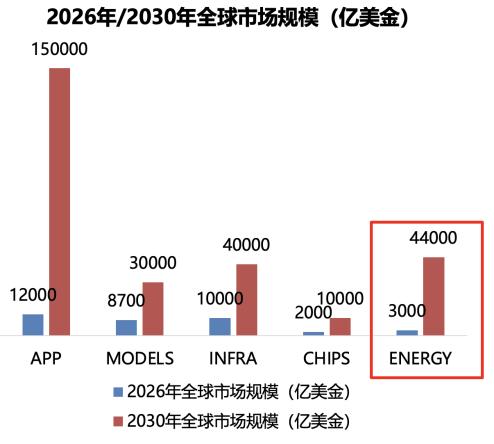
Deducing from the first principle – the essence of AI is to generate tokens, generating tokens requires computing power, and the ceiling of computing power lies not in chips but in electricity.
Let’s look at a few sets of numbers: 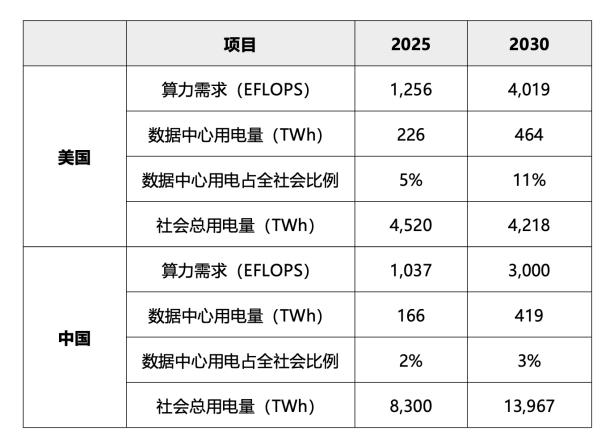
Data source: Goldman Sachs, Bernstein Research
The demand for electricity has shown an explosive growth:
• In the past 5 years, the average annual growth rate of electricity demand in Chinese data centers has been 24.1%;
• In the next 5 years, the average annual growth rate is still expected to reach 13.0%;
• Electricity costs account for more than 50% of the total operating costs of data centers.
In a broader picture, by 2030, the total electricity demand in China will increase to 13,500 TWh, and by 2050, it will reach 25,000 TWh.
So, who will generate this electricity?
Coal – the recoverable years are 47; oil – 97% was discovered in the 20th century; renewable energy – intermittent and requires energy storage; fission nuclear energy – the shadows of Chernobyl and Fukushima have not completely dissipated.
The sharp increase in electricity demand brought about by AI is not a long – term problem. Judging from the actions of large domestic and foreign companies, the industry estimates that training GPT – 6 consumes 72 million kWh of electricity per month. OpenAI plans to deploy at least 10 gigawatts of AI data centers, Alibaba plans to invest more than 380 billion yuan in building AI infrastructure in the next three years, Baidu has said that electricity is the core bottleneck of AI, and China’s electricity advantage can be transformed into an export of computing power.
Therefore, AI is forcing an energy revolution.
If nuclear fusion was more of a scientist’s dream in the past few decades, then today’s question has become: Does humanity have the ability to engineer this technology?
Nuclear fusion is not “another type of nuclear power.” Fission is about splitting atoms, while fusion is about combining atoms, and the physical processes are completely different.
A set of numbers can prove this: The energy released by the fusion of 1 kilogram of deuterium is equivalent to that of 7,000 tons of gasoline or 10,000 tons of coal. The weight of the fuel is only one – ten – millionth of that of coal.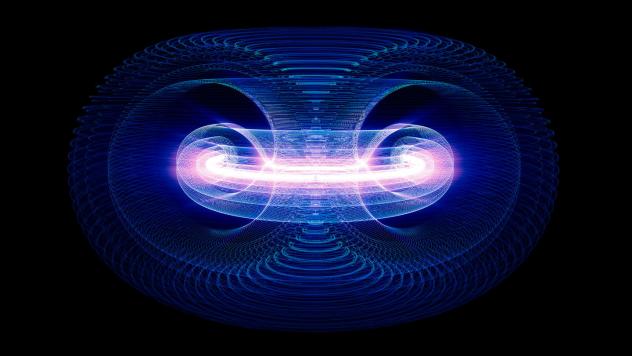
Conceptual diagram of a fusion device
Fusion has several unique features among energy solutions: zero carbon emissions, the half – life of tritium is only 12.43 years, and the radiation level is extremely low; the energy density is 4.2 times that of fission; deuterium comes from seawater, and the energy contained in 1 liter of seawater is equivalent to about 300 liters of gasoline, and the global reserves can support billions of years; a new reaction material, helium – 3, has the opportunity to be obtained in large quantities from the moon; it can operate continuously for 24 hours without being affected by the weather; the reaction requires extreme high – temperature and high – pressure conditions, and the device will automatically stop in case of a malfunction, without critical risks.
Theoretically, the cost per kilowatt – hour of nuclear fusion can be as low as 0.15 – 0.3 yuan/kWh, and may even approach zero in the long term.
Today, nuclear fusion is no longer science fiction but a possibility allowed by physical laws. The remaining question is: Can we build controllable nuclear fusion?
There is a famous joke about nuclear fusion: commercialization is always 50 years away. This joke was broken on December 5, 2022.
On that day, the Lawrence Livermore National Laboratory (LLNL) in the United States input 2.05 megajoules of energy in the National Ignition Facility (NIF) and produced 3.15 megajoules – for the first time in human history, a positive gain in fusion energy was achieved (Q≈1.5).
However, the NIF uses inertial confinement and is mainly for nuclear weapons research, and it is still far from power generation.
What is more worth paying attention to is the milestone of the magnetic confinement route: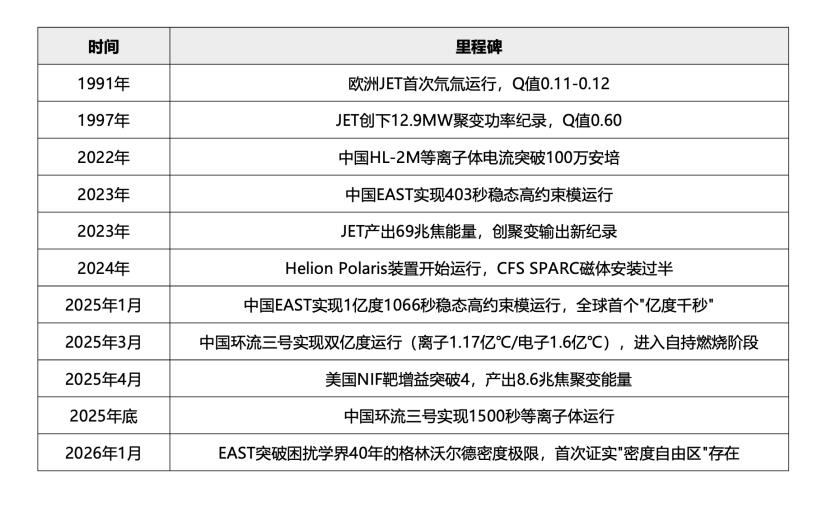
Here is a key concept – the Q value. When Q > 1, there is a net energy gain; when Q > 10, it has preliminary commercial value; when Q > 20 – 30, it meets the threshold for large – scale commercialization.
Currently, humanity’s position in terms of the Q value: it has just crossed 1, and there is still a long way to go to reach 30.
However, the general direction of nuclear fusion is no longer in doubt. Even in 2026, we are at a turning point from “scientific feasibility verification” to “engineering feasibility.”
The rapid development of AI computing power is hitting the power ceiling – this is not a prediction but an arithmetic problem that is happening. Nuclear fusion is not just one of many options but the only energy solution that can simultaneously meet the requirements of cleanliness, stability, near – infinity, and intrinsic safety. The joke of “always 50 years away” has been broken by the laser at LLNL. The question is no longer “can we” but “how fast.”
Nuclear fusion is not a single – track technology. Currently, there are three confinement methods, corresponding to completely different technological routes and commercialization rhythms:
1. Magnetic Confinement (mainly Tokamak) – The Most Mature and Heaviest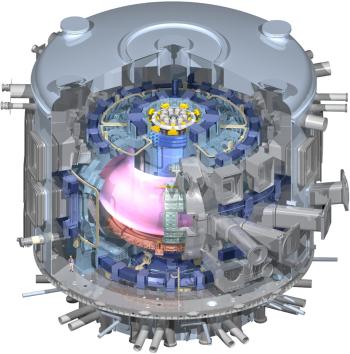
Tokamak device
It uses a toroidal magnetic field to “confine” the plasma at a temperature of 100 million degrees in a toroidal container. ITER, China’s EAST, and HL – 2M all follow this route.
It can generate electricity in a steady – state operation and has the thickest technological accumulation. However, traditional devices are huge in size and extremely expensive (ITER costs more than $20 billion). The inner wall material has a limited lifespan under the bombardment of high – energy neutrons, and the power generation efficiency is about 30% – essentially, it is still “boiling water.”
Here is a key variable: The significance of high – temperature superconductivity (HTS) for nuclear fusion is comparable to that of Moore’s Law for chips – REBCO tapes can achieve a strong magnetic field of over 20 Tesla in the liquid nitrogen temperature range, and the volume of the Tokamak can thus be reduced to 1/20 – 1/10 of the traditional one. The compact fusion reactor has changed from a dream to an engineering problem thanks to this technology.
2. Magneto – Inertial Confinement (Field – Reversed Configuration, FRC, etc.) – The Most Radical, Fastest, and Riskiest
The Field – Reversed Configuration (FRC) is an emerging route that combines the characteristics of magnetic confinement and inertial confinement: the nuclear reaction only occurs in the core area, operates in a pulsed manner, and does not require maintaining a steady – state plasma.
Its advantages are extremely low cost (only 1 – 1.5 billion RMB) and a short cycle (5 – 6 years), with a simple structure and convenient maintenance. However, the physical verification is the least sufficient, and the Q value has not been confirmed by a credible third – party.
Helion Energy in the United States is the flag – bearer of this route. It has raised over $1 billion in financing and has signed a bet – against – the – odds agreement with Microsoft, promising to supply 50 MW of electricity by 2028. This is the first commercial contract with a deadline in the history of nuclear fusion. In May 2026, Helion announced that the construction of its factory was ahead of schedule, and it was almost achieving fusion reactions every day, with the temperature reaching 150 million degrees.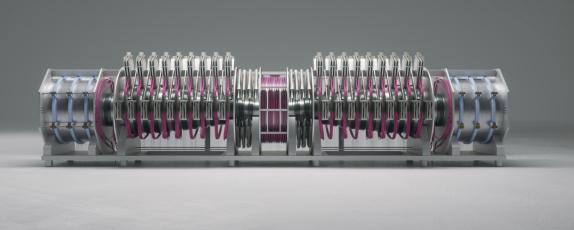
Schematic diagram of the Helion Energy device structure
3. Inertial Confinement – Can Ignite but May Not Be Able to Generate Electricity
It uses high – energy lasers or particle beams to instantly compress the fuel pellet to achieve fusion ignition. The Q > 1 breakthrough of the NIF occurred here.
There are precedents for achieving gain in physics, and there is no long – term material confinement problem. However, the energy output is pulsed, and the technical route for transferring it to the power grid is not mature, so it may be difficult to use for civilian power generation in the short term.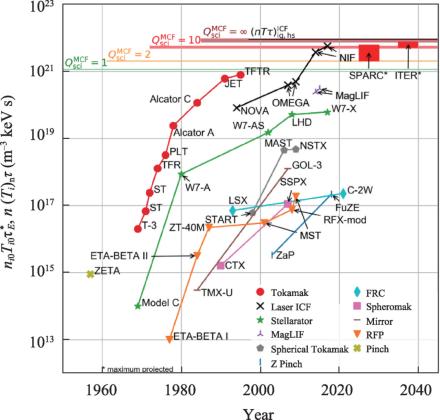
Plasma performance of mainstream global nuclear fusion devices
AI is not only a “customer” of fusion – requiring electricity but also an “accelerator” for fusion. Here are a few overseas examples:

该文观点仅代表作者本人,36氪平台仅提供信息存储空间服务。
36kr Europe (eu.36kr.com) delivers global business and markets news, data, analysis, and video to the world, dedicated to building value and providing business service for companies’ global expansion.
© 2024 36kr.com. All rights reserved.
Leave a Reply