Daily Mirror – Print Edition
Daily FT
Sunday Times
Mirror Edu
Tamil Mirror
Lankadeepa
Middleast Lankadeepa
Ada
Deshaya
Life Online
Hi Online
E-Paper
Home delivery
Advertise with us
Mobile Apps
feedback
Archive
Print Ads
Thu, 25 Jun 2026 Today’s Paper
25 Jun 2026 – {{hitsCtrl.values.hits}} 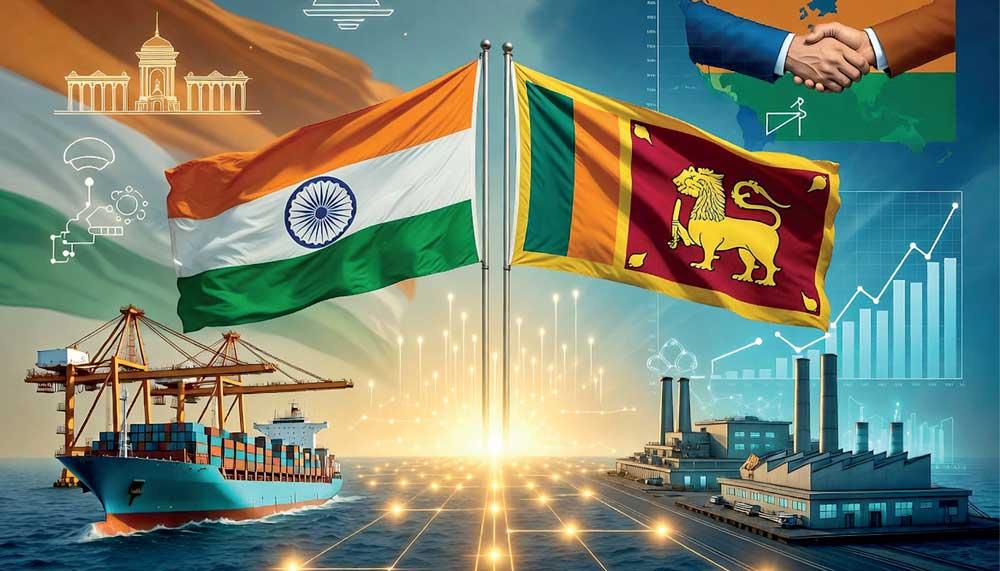
 With the World Trade Organization projecting global merchandise trade growth to slow sharply to 1.9% in 2026, economic alliances are no longer optional—they are central to sustaining growth and resilience. The global trade slowdown reflects shipping disruptions in the Straits of Hormuz, rising protectionism, geopolitical fragmentation, and weakened business confidence. Against this backdrop, South Asia stands out as a relative bright spot. India’s trade is at record highs, supported by a new generation of comprehensive trade agreements with partners including the European Union, the UK, the UAE, Oman, and Australia. Sri Lanka, meanwhile, urgently needs to expand trade and foreign exchange earnings to consolidate recovery from its 2022 debt crisis. As the India–Sri Lanka Free Trade Agreement (ISFTA) marks its 25th anniversary, it is clear that while the agreement has delivered tangible gains, it is no longer fit for purpose in today’s global economy. Implemented in 2000, the ISFTA was South Asia’s first bilateral free trade agreement and a decisive break from the region’s earlier inward‑looking trade regimes. It provided market access for goods through asymmetric tariff liberalisation, reflecting differences in economic size and industrial capacity. India liberalised tariffs on most Sri Lankan products within three years, while Sri Lanka was granted up to eight years for Indian imports, alongside extensive negative lists to protect sensitive sectors. Even today, India excludes 429 product categories, while Sri Lanka maintains over 1,100 exclusions—limits that increasingly constrain deeper integration.
Despite these constraints, the ISFTA has had a substantial economic impact. Bilateral trade expanded more than ten‑fold, reaching US$7.2 billion in 2025. India is now Sri Lanka’s largest trading partner, while Sri Lanka ranks among India’s leading partners in South Asia. Trade has also diversified beyond basic commodities. India’s exports now include refined petroleum, pharmaceuticals, textiles, vehicles, and processed foods, while Sri Lankan exports range from spices and boats to animal feed and consumer food products.
Although investment disciplines lie outside the ISFTA, improved business confidence and sustained economic diplomacy have encouraged significant Indian investment in Sri Lanka. Cumulative Indian FDI reached US$2.8 billion by 2025, anchored by projects such as IOC’s island‑wide fuel retail network, Ashok Leyland’s manufacturing operations, Adani Ports’s Joint Venture with leading Sri Lankan conglomerate, CEAT India’s acquisition of Michelin’s business in Sri Lanka and the ITC luxury hotel in Colombo. Sri Lankan firms—including Brandix and MAS Holdings—have likewise deepened their presence in India. Tourism represents another important spillover: Indian visitors accounted for 23% of Sri Lanka’s total tourist arrivals in 2025, supported by strong air connectivity, competitive hospitality offerings, and simplified visa procedures. In the ongoing West Asia crisis that has led to global travel disruptions, India has accounted for more than 40% of inbound tourism into Sri Lanka, providing much needed stability to the tourism sector.
However, the global trading system has changed fundamentally since the ISFTA was negotiated. Trade in intermediate goods and services within global value chains now accounts for roughly half of world trade. India has emerged as a key China+1 production hub, combining a large domestic market with skilled labour. It is also ramping up its own manufacturing capacities. Corporate derisking strategies are already reshaping production networks, exemplified by Apple’s shift of iPhone assembly to India, with Chennai and surrounding districts becoming a major centre for final assembly, testing, and packaging operations.
If Sri Lanka is to benefit meaningfully from India’s supply‑chain expansion, the ISFTA must be modernised. Priority reforms include updating rules of origin from simple value‑addition thresholds to product‑specific rules aligned with global production networks; liberalising trade in services—particularly IT, maritime logistics, and financial services—to enable Sri Lanka’s services sector to support regional supply chains; and reducing trade costs for SMEs through digitalisation and harmonisation of customs procedures. In addition, a robust investment agreement, whether within or alongside the ISFTA, is essential to provide predictability, transparency, and investor protection.
Looking ahead, a modernised ISFTA should be positioned not merely as a trade agreement, but as the institutional anchor of a deeper India–Sri Lanka economic partnership. If backed by political commitment and private‑sector support, ISFTA 2.0 can underpin rules‑based regional integration, crowd in investment, and embed Sri Lanka more firmly in India‑centred supply chains. Complementary measures—ranging from enhanced physical and energy connectivity to new export processing zones and stronger business‑to‑business linkages—can amplify these gains. With decisive action over the next few years, bilateral trade of US$10–12 billion by 2030 is not an aspiration but a realistic and achievable outcome.
[The author is Professorial Fellow in economics and trade Gateway House Mumbai and Senior Advisor Centre for Poverty Analysis Colombo.]
1
2
3
4
5
6
25 Jun 2026 19 minute ago
25 Jun 2026 39 minute ago
25 Jun 2026 58 minute ago
25 Jun 2026 1 hours ago
25 Jun 2026 1 hours ago
General :
+94 0115 335 731
+94 0112 304 545
Circulation :
+94 0112 479 611
Advertising :
+94 0112 479 561
Subscription :
+94 0112 479 626
Technical :
+94 011 538 3437
[email protected]
All the content on this website is copyright protected and can be reproduced only by giving the due courtesy to ‘dailymirror.lk’ Copyright © 2004 Wijeya Newspapers Ltd.
Sri Lanka Latest Breaking News and Headlines – Print Edition India- Sri Lanka FTA at 25 What Next? – Daily Mirror – Sri Lanka
Home
A Good Appetite
Sri Lanka Latest Breaking News and Headlines – Print Edition India- Sri Lanka FTA at 25 What Next? – Daily Mirror – Sri Lanka
Leave a Reply