It is said that AI is able to write code, and that this puts the jobs of programmers at risk. However, Boris Cherny from Anthropic says: What really matters is never the position, but the role one takes on at this moment.
The writing of code will be quickly overcome by AI.
The person who can best judge this matter is Boris Cherny. He also has a more famous name: the father of Claude Code. The well – known programming intelligence system in Silicon Valley was developed by him.
Just because he created Claude Code, he himself hasn’t written a single line of code in six months: In these more than six months, 100% of his code comes from Claude.
As early as February on the Lenny’s Podcast, Cherny made a bold statement: Within a year, the job title “software engineer” will gradually disappear and be replaced by a role more like a “builder”.
But the disappearance of the job title doesn’t mean that software engineers have to lose their jobs.
Four months later, on the Platformer Podcast, he didn’t retract this assessment but even pushed it further.
When asked whether there would be more or fewer engineers in three years, he gave a counter – intuitive answer: These people may no longer be called “engineers”, but the number of people who write code and use intelligence systems will be 100 times the current number.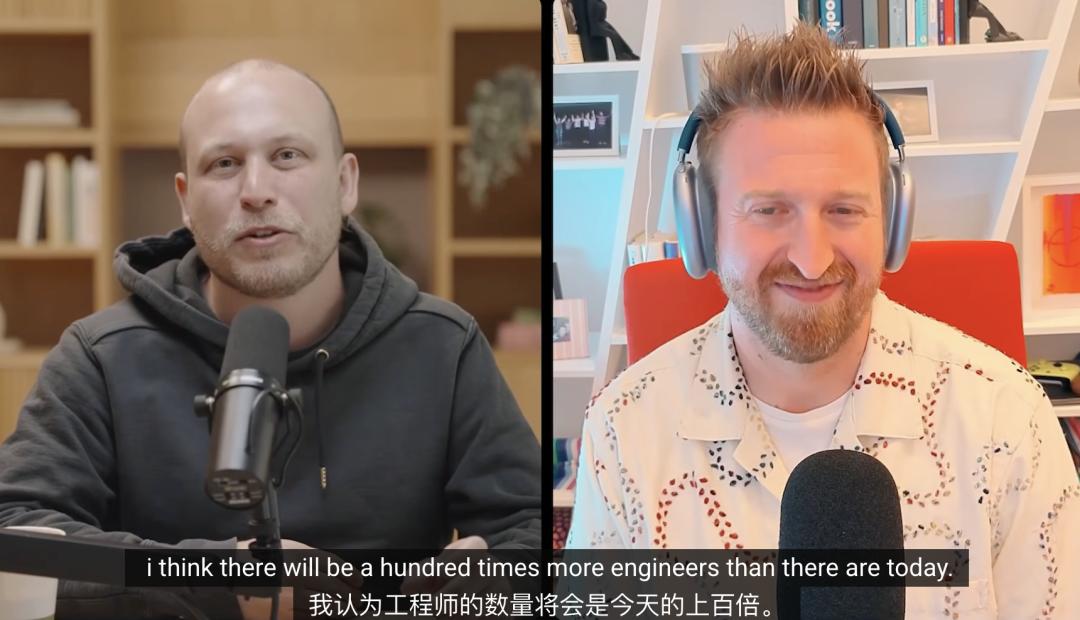
On the Platformer Podcast, Boris Cherny (left) predicted that the number of people who write code and use intelligence systems in the next three years will be 100 times the current number.
If they are no longer called “engineers”, then what should they be called? Recently, Cherny gave his answer on X.
He says that when the functions of engineering, product development, design, and data science start to “merge”, in his Claude Code team, he no longer sees “positions”, but five types of people.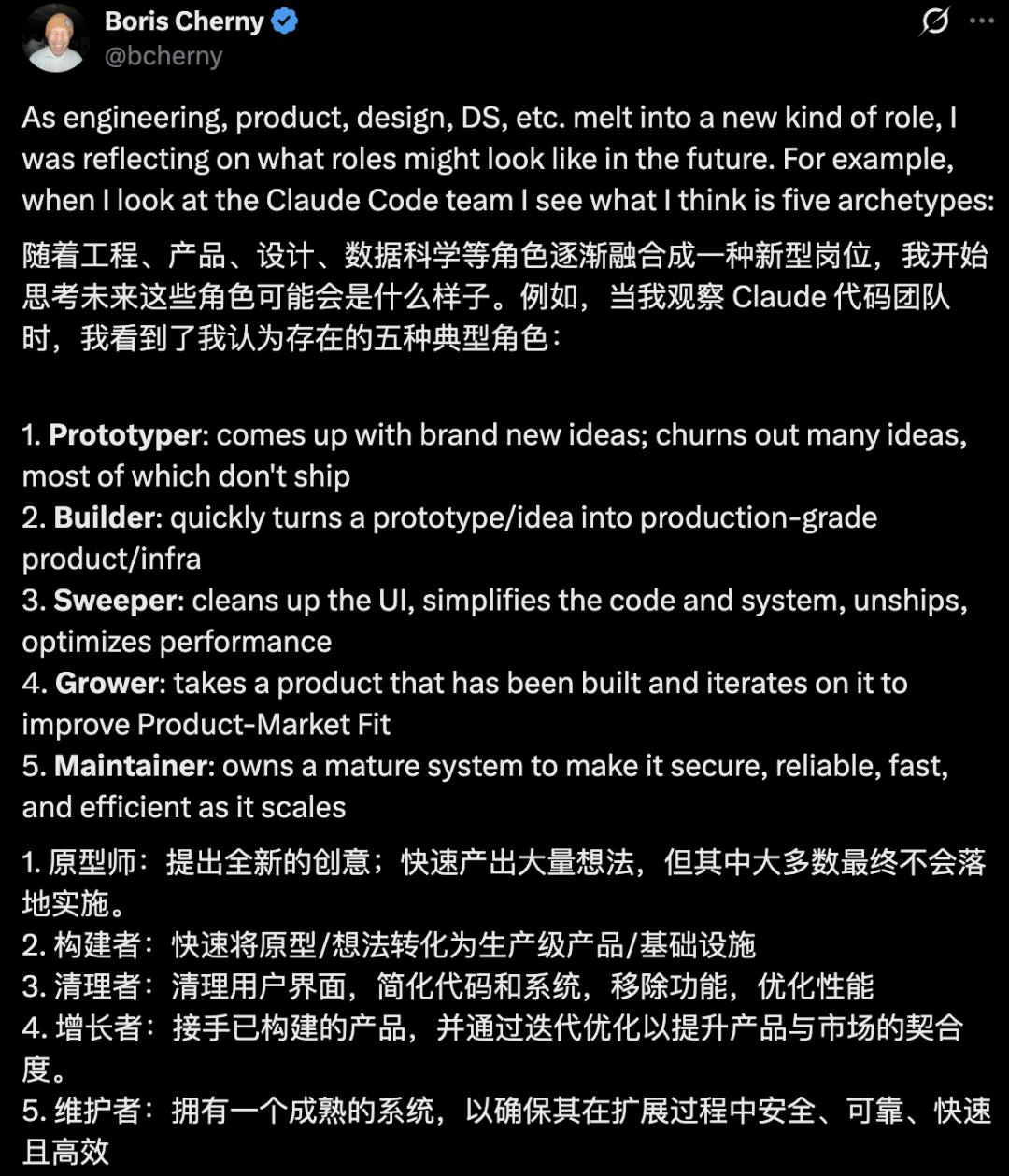
This list is valuable for every developer.
The experienced engineer Kun Chen, whose career includes Meta and Microsoft, replied that he never likes to label people with “roles” because it’s easy to classify oneself into a category and then stop thinking, “Oh, I do this.”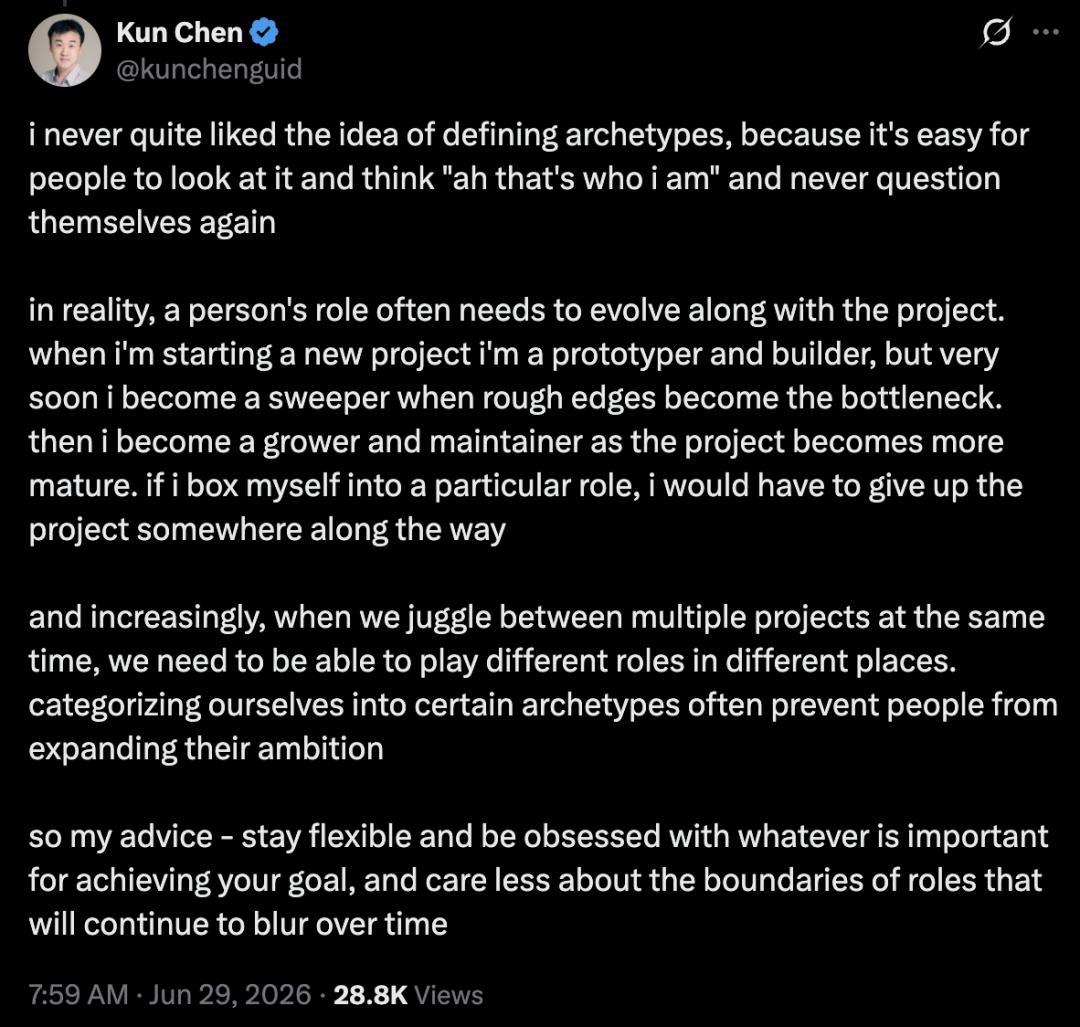
According to Kun Chen, the role should grow with the project:
At the start of a new project, he is a prototype developer and builder; as soon as details emerge, he immediately becomes a sweeper; when the project is mature, he becomes a grower and maintainer. Fixing oneself in a role means having to abandon the project in the middle.
Cherny completely agrees with Kun Chen: The role changes constantly with the project and time.
Both have observed the same thing: In the programming field, the boundaries between positions are blurring. A person’s position is no longer determined by the business card.
This is exactly the assumption behind Cherny’s list: The measure for developers has changed: From “What position do you have” to “What role do you play at this moment”.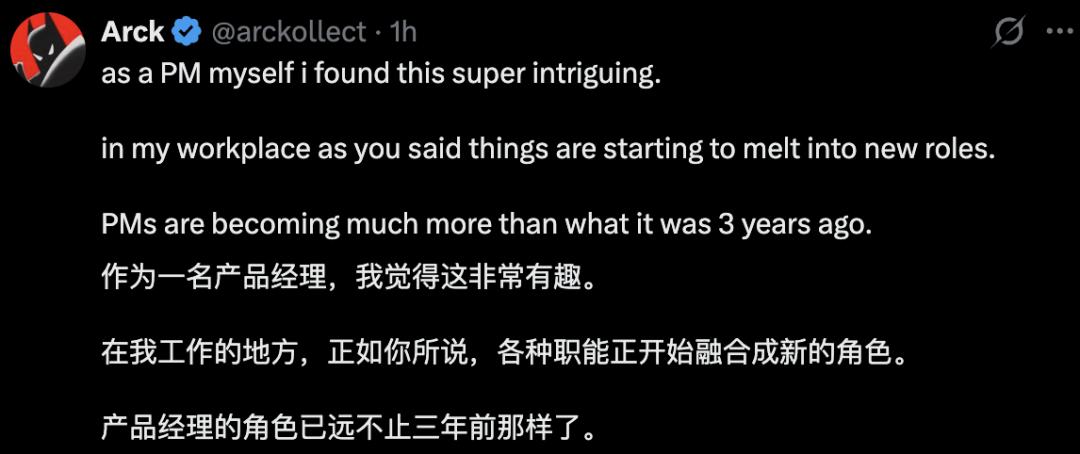
The changes don’t only affect engineers.
A product manager under Cherny’s post commented that this has also affected him: As Cherny said, in his team, the positions are merging into new roles. Today’s product manager is no longer the same as three years ago.
The same is true in reverse.
When Anthropic released Fable 5, the Claude Code team also mentioned a detail: After Fable 5, the developers were put into the position of product managers.
Previously, they paid attention to whether Claude wrote the code correctly. Now they pay attention to whether it does the right thing.
It’s not only programmers whose positions are blurring.
Cherny described these five roles individually.
Role 1, Prototyper.
The prototyper constantly has new ideas and throws out dozens of proposals in a short time. Most of them won’t end up in production.
Role 2, Builder.
The builder quickly turns a rough prototype into a product and infrastructure that can be used in the production environment.
Role 3, Sweeper.
The sweeper cleans up the user interface, simplifies the code, removes useless functions from use, and optimizes the performance step by step.
Role 4, Grower.
The grower takes over a finished product and polishes it repeatedly to improve the product – market fit (PMF).
Role 5, Maintainer.
The maintainer protects a mature system and ensures that it remains safe, reliable, and fast while constantly expanding.
Cherny especially pointed out: Many people take on two to three roles at the same time, and these roles have nothing to do with the position itself.
Within Anthropic, there are designers who take on the first role, others the second, and still others the third. The same goes for engineers, PMs, and data scientists. They are distributed across these five categories.
What defines you is not the title on your business card, but the work you do at this moment.
He also added a common role – combination formula:
A new product that hasn’t found its PMF yet most urgently needs people who are good at 1 + 2 + 3. A mature product that already works is more likely to be supported by 3 + 4 + 5.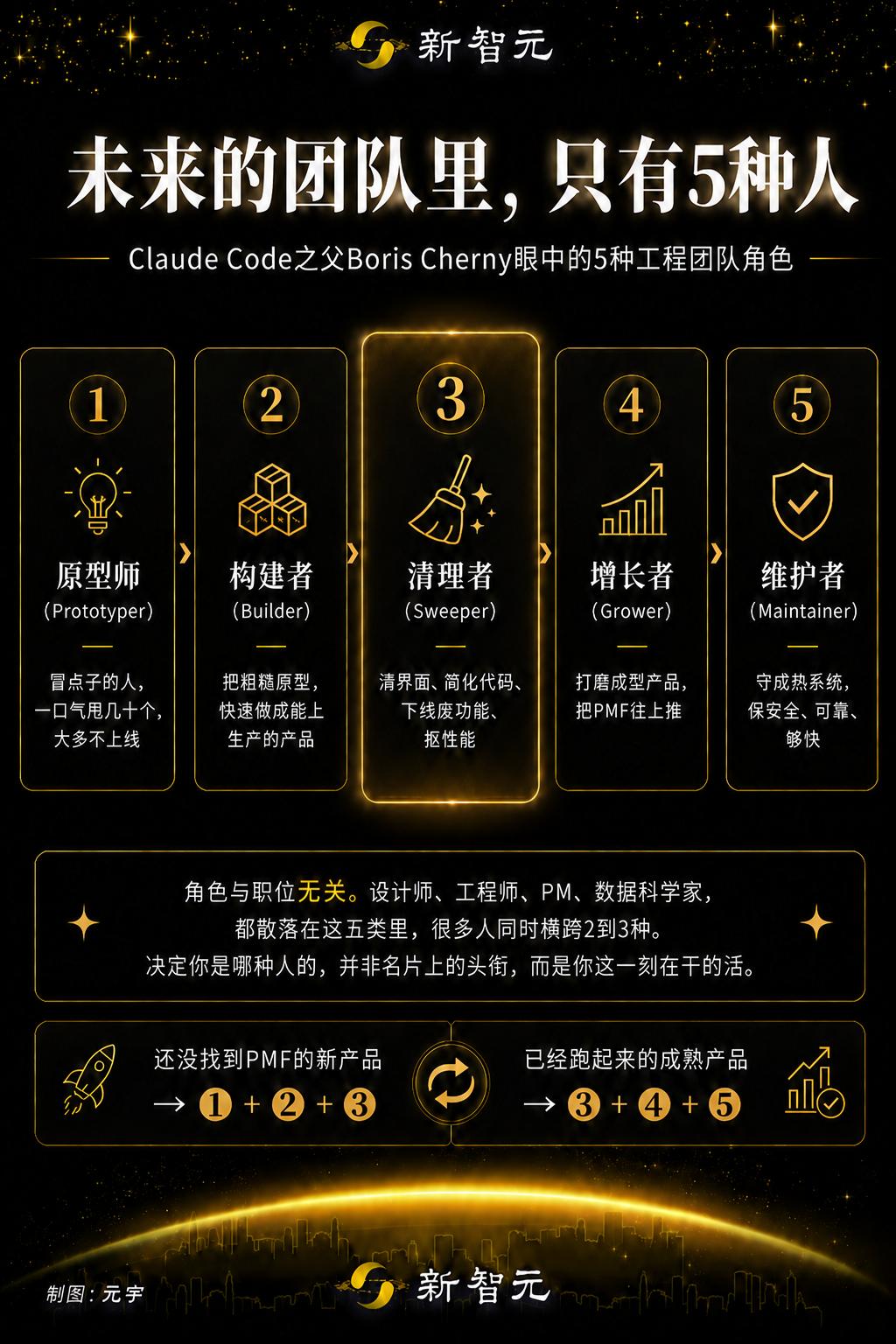
There is no ranking among these five roles, but they are treated differently in the developer community.
Prototype developers who have ideas seem intelligent; builders who can build something from the ground up seem strong. Therefore, in job postings and resumes, mainly these two categories are emphasized.
Someone commented under Cherny’s post: Sweepers are the most underestimated and least – hired positions. Every team collects prototypers like Pokemons.
Almost no one wants to be in one of the other three roles, especially a sweeper.
Deleting code, removing functions from use, cleaning up the mess of others, and speeding up slow parts – these jobs are neither sexy nor can they be presented as achievements at the weekly meeting. Even if one does it well, one only gets the comment “The system has no problems”.
A developer directly said that sweepers are the most underestimated and least – hired roles.
But AI programming has disrupted this ranking.
While everyone is still competing for who has the best ideas, the sweeper who finishes the work is actually the most sought – after.
The reason is actually very simple.
If a model can generate a prototype and write thousands of lines of code in a few minutes, “developing ideas” and “building from the ground up” are exactly the things that AI is best at and will take over first.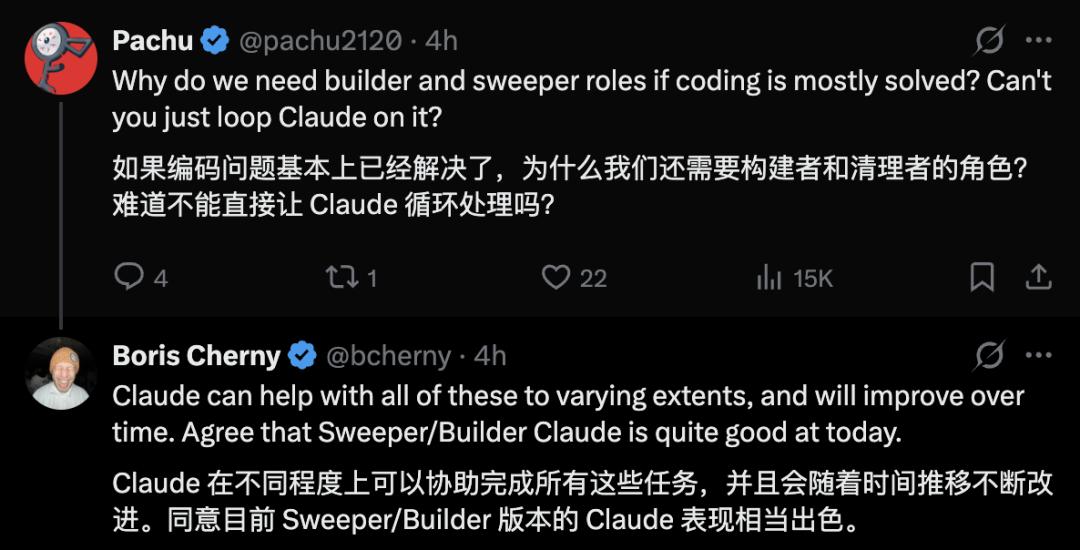
Someone asked under Cherny’s post: If programming is basically solved, why do we still need builders and sweepers? Just let Claude run in circles!
Cherny’s answer is very realistic: Claude can actually take over these jobs to varying degrees and will become stronger. Sweeper – Claude and Builder – Claude are already doing a pretty good job today.
But admitting that the machine works well doesn’t mean that humans can step aside. The machine can do the sweeper’s work, but it can’t take on the responsibility. Which line to delete, who can immediately recognize an AI error, and who takes responsibility in case of a problem – that still has to be done by humans.
The more AI takes over the dirty and strenuous work, the more valuable the sweeper who can make decisions and finish the work becomes.
Here is an easily overlooked detail: The productivity increase through AI mainly doesn’t lie in doing the same work faster, but in doing much more work.
More functions are launched, more code is pushed to the repository, more experiments are carried out. As soon as the generation speeds up, the chaos also increases. Who cleans it up? The sweeper.
What’s even worse is that code review is also visibly declining.
According to Business Insider, in the last six months, the proportion of AI – generated code that goes directly into production without separate manual review has increased significantly, and the survival rate of this code is even higher.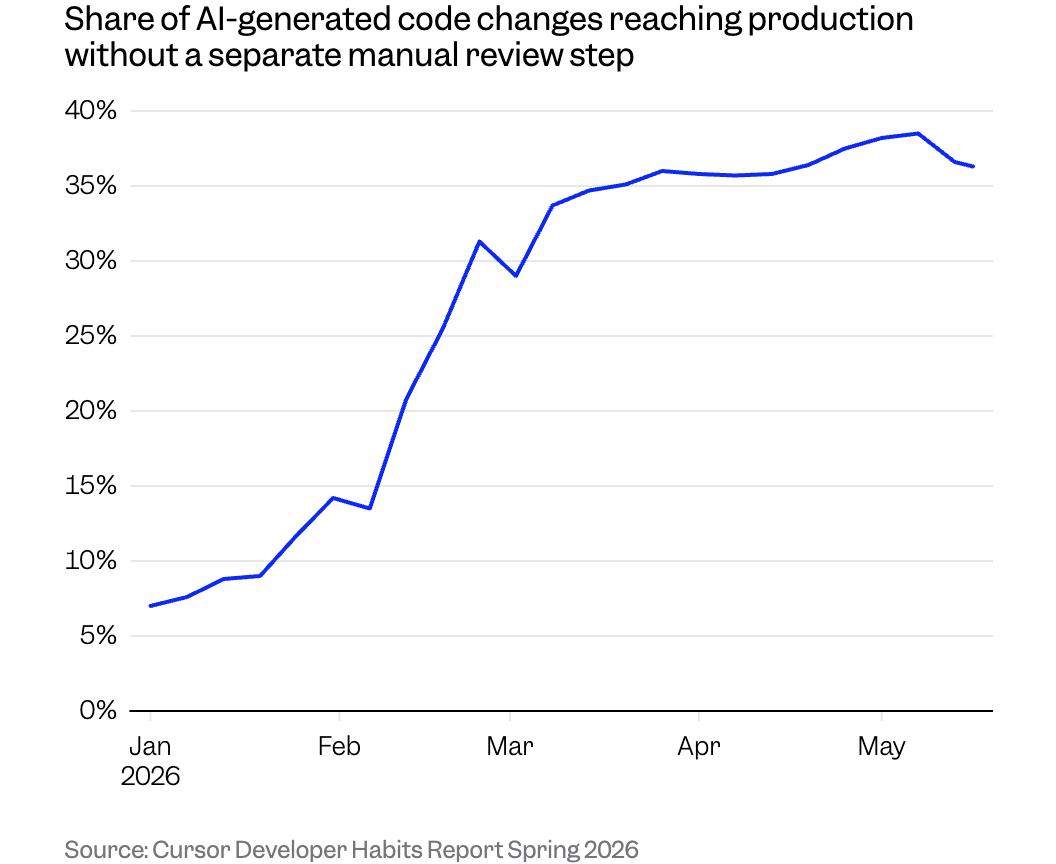
Since the beginning of 2026, the proportion of AI – code changes that go into the production environment without independent manual review has increased from about 7.0% to almost 38.5%, more than five times in six months. The human “review barrier” is being skipped more and more often. (Source: Cursor “Developer Habits Report” Spring 2026)
Developers are becoming more and more confident in handing entire processes over to the intelligence system.
After manual review is removed, the hidden bugs, performance weaknesses, and security vulnerabilities in the system still have to be taken care of by someone.
This is exactly the work of the sweeper.
Generation is becoming cheaper, and handling is becoming more valuable.
A widely – spread statement in the developer community expresses exactly this idea: The best engineer is not the one who writes code the fastest, but the one who best knows when not to trust AI.
If one follows this list further, the question becomes more pointed.
If programming is basically solved and prototypers and builders can be handed over to AI, can a person with a legion of intelligence systems then take over the entire role of a team?
Someone actually asked Cherny: What stops me from taking on all these five roles alone with an intelligence system?
Cherny’s answer is that Claude can cover these roles “to varying degrees” and “constantly improve”, but will not “completely replace”.
该文观点仅代表作者本人,36氪平台仅提供信息存储空间服务。
(eu.36kr.com) ist ein branchenspezifisches Medium, das sich auf internationale Märkte konzentriert und Unternehmen bei ihren grenzüberschreitenden Aktivitäten mit umfassender Beratung und professionellen Dienstleistungen unterstützt.
© 2024 36kr.com. All rights reserved.
Nach halbem Jahr Programmcode-Pause: Vater von Claude Code prophezeit 100-fache Steigerung der Programmiererzahl in 3 Jahren – 36Kr
Home
Technology
Nach halbem Jahr Programmcode-Pause: Vater von Claude Code prophezeit 100-fache Steigerung der Programmiererzahl in 3 Jahren – 36Kr
Leave a Reply