India’s geography is a thing of dreams. From snowy peaks to sandy deserts, the country has them all. However, with varying geological conditions come different restrictions. While one region struggles with minimal water, others might be suffering through floods. And each one of them has to come up with a solution of their own.Within this anomaly lies Ladakh. Nestled in the Himalayas, the state is home to an estimated 3 lakh people. In terms of its climate, the region is a cold high-altitude desert with annual precipitation usually below 100 millimetres. But since the region depends on agriculture, people depended on melting mountains to irrigate barley, apples, and other crops that sustain the village and business.However, the natural melting of glaciers only kicked in during the summer, while the seeds were sown in spring, meaning water arrived too late. With climate change adding to the equation, the Himalayan glaciers are shrinking, rains have become unpredictable and potable water has become a scarce resource, leaving agriculture dependent on a sensitive window.
The ice stupa
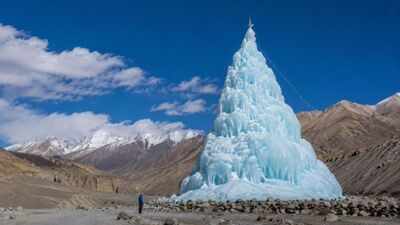
It is between this gap, water-wasting winter and thirsty spring that the region’s most famous engineer and activist, Sonam Wangchuk found a solution. Around 2014 and 2015, Wangchuk began to erect what he called an ice stupa, an artificial glacier in the shape of a tower that forcibly solves the water shortage during the most critical time of the year for the state.The logic is simple, to store the excess water going to waste in the winter and use it in summer. In winter, there is excess water flowing from the mountains which freezes or runs off unused. In spring, when the farmers need the water, they have to wait for the shrinking natural glaciers to melt.Wangchuk initially conducted tests with students from the school he founded in Ladakh. When the technique worked, it was replicated by villages, taught in the region and supported by organisations that contributed with pipes and labour.But now, the ice stupa stores this excess water in the form of a frozen tower that melts slowly, and provides a consistent supply to farmers during the planting months.
How does it work?
Well, water from a higher stream on the mountain is channelled down through the pipes to the village. In the cold of Ladakh, these jets freeze and stack layers of ice that grow in the form of a conical tower of 20 metres or higher.While one might think the cone shape is aimed at aesthetics, it is actually the heart of the engineering miracle. A conical structure has little surface exposed to the sun relative to the volume of ice it holds, so it melts slowly, over weeks, while a flat layer of ice would disappear in a few days. It also resembles the Buddhist stupas that form a major part of Ladakh’s landscape.How effective is the ice stupa? The first prototype erected at the end of the 2014 winter stored about 150,000 litres of meltwater. The version built shortly after provided around 1.5 million litres of water, enough to irrigate thousands of seedlings planted by the residents. The larger and taller the tower, the more water it retains, and project reports cite structures that managed to hold several million litres each. Since the first ice stupa, more than a dozen artificial glaciers have been erected in the region, totalling tens of millions of litres of water made available to communities.The invention came with recognition. In 2016, Wangchuk received a prestigious international award for the initiative, which helped bring the idea of the ice stupa to other mountains around the world facing similar dilemmas. His idea is a low-cost initiative that proves that creativity is just as valuable as cutting-edge technology. He ensured a consistent supply of water in one of the most inhospitable regions of the planet, without the use of energy or electricity, reminding all that working with nature is more beneficial than working against it.
Leave a Reply