On June 23, Superhuman announced the acquisition of the AI detection tool GPTZero.
What’s interesting about this?
The acquirer, Superhuman, is the parent company of Grammarly. Grammarly is one of the world’s largest AI writing assistance tools, helping 40 million people write more smoothly and fluently every day.
The acquired company, GPTZero, is an AI detection tool with 19 million users, specifically designed to determine whether an article is written by AI.
That is to say, Superhuman encourages AI writing with Grammarly on one hand, and uses GPTZero to detect AI writing on the other hand to “combat” AI writing. Isn’t this a typical case of self – contradiction? 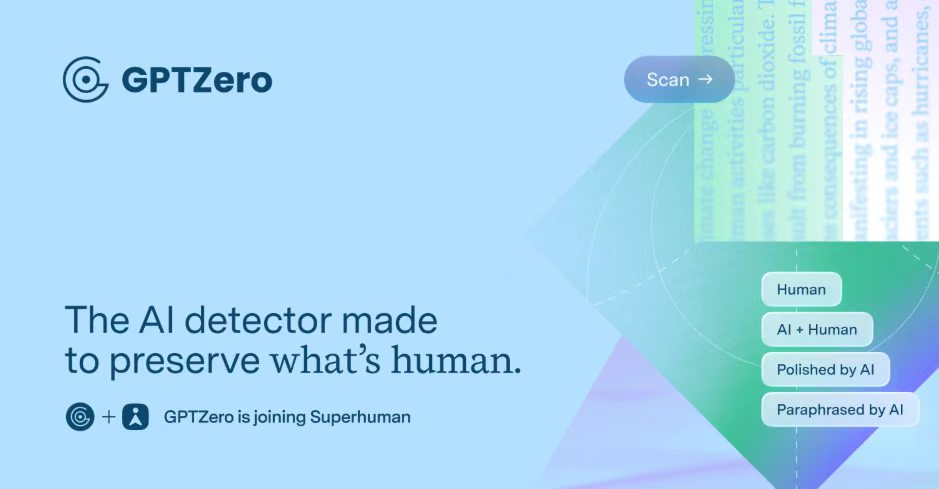
Using AI to detect AI, this logic has been twisted from the very beginning.
Both AI generation and AI detection are models trained based on a vast amount of human text, and they use the same type of technical approach: the set of human writing standards in the hands of detection tools is also available in generation tools. Since AI writing is essentially an imitation of human writing, using an AI detection tool to judge whether AI – written text resembles human writing and vice versa is inherently a paradox.
Moreover, there is a very fatal structural problem here: AI detection may never catch up with AI generation.
For a detection tool to recognize the output of a new model, it needs to obtain a sufficient number of samples, label data, and then train a classifier. This process can take as short as two or three months or even longer, but the speed of model iteration waits for no one. For example, GPT – 4 was released in March 2023, and GPT – 4 Turbo made its debut in November of the same year, with an eight – month interval. During these eight months, Anthropic released Claude 2, and Meta launched Llama 2. Each model was updated successively, with different output characteristics. By the time the detection tool finally completes training and is ready for deployment, a new and more powerful model has already been released. Using data from the previous generation to judge the output of the new generation will naturally reduce the accuracy. This rhythm problem will keep AI detection in a continuous dilemma of “chasing but never catching up”.
In addition, there is an unavoidable problem in this logic: AI hallucination.
AI writing sometimes produces hallucinations, fabricating some incorrect or completely non – existent information; similarly, hallucinations can also occur during the AI detection process, leading to misjudgments, marking human – written text as AI – generated or vice versa. Letting one error – prone thing judge another error – prone thing, but the ultimate consequences have to be borne by humans. This is also the root of the contradiction in AI detecting AI.
The real – world situation confirms this, and it is even more absurd than expected.
Some netizens once put the Declaration of Independence written by Thomas Jefferson in 1776 into an AI detection tool, and the system judged it as “99.99% AI – generated”. A historical document written more than two hundred years before the birth of AI has become a machine – made product in the eyes of the algorithm. Also, a paper written forty – five years ago by Paul Speck, a professor emeritus, was judged by a certain detection tool to have 77% of its content AI – generated. 
When these works were created, the very concept of large – language models did not even exist.
How could it be so absurd?
In fact, AI detectors do not understand the meaning of the text. They focus on the statistical characteristics of the text: the unexpectedness of word sequences, the variation range of sentence length and structure, and whether word collocations conform to common patterns. The more precise the wording, the more rigorous the logic, and the more standardized the sentence structure, the more likely the text is to be judged as AI – written; on the contrary, content with chaotic word order and awkward wording is more likely to pass the detection.
When writing well becomes a reason for AI suspicion, this is no longer just a technical defect, but rather a problem that requires a re – examination of the logic itself.
In addition to the logical paradox of AI detection tools themselves, in an era when everyone embraces AI, using AI to create content is already widely accepted. Now, using AI to detect the proportion of AI in content constitutes another development paradox.
However, despite the paradox, there is undoubtedly a real – world demand for AI detection tools.
After the release of ChatGPT, students’ classroom assignments and graduation theses have been impacted by AI. Teachers need to determine whether students’ assignments are written by AI and whether there are issues such as academic misconduct.
GPTZero was born in this context. In early 2023, affected by ChatGPT, the number of academic fraud cases gradually increased. The New York City Department of Education in the United States even directly announced a ban on ChatGPT to protect academic integrity. After identifying this educational pain point, Edward Tian, who was then a senior at Princeton University, spent a few days writing the prototype of GPTZero and posted it on Twitter. He thought only dozens of people would try it, but more than two thousand people flocked in within a few hours, crashing the hosting platform. Three years later, this project has achieved an annual revenue of $30 million.
The market demand is more real than expected.
But reality has taken another turn in the evolution of AI.
The ideal scenario is: students carefully write their theses, AI detection confirms that they are “human – written”, and then they submit them to their teachers.
The real scenario is: students write their theses, first pass them through AI detection – the AI ratio is too high – deliberately make the thesis worse – pass it through detection again – the AI ratio drops – then submit.
Thesis writing is no longer about thinking and expression, but has become a cat – and – mouse game with algorithms.
“I’m really laughed at by AI detection.” On Xiaohongshu, a student who wrote a graduation thesis this year said that during the period approaching graduation, she was trapped in a cycle of proving to AI that her thesis was human – created rather than AI – generated every day.
From March to May, as graduation approached, a large number of “tutorials on reducing the AI ratio” emerged online, with a similar logic to “reducing duplication”. Some people suggest deliberately making the text generated by AI less fluent; some people suggest deleting short phrases starting with words like “First” and “In conclusion” in batches because these structures are easily marked by the algorithm; others suggest using translation software for back – and – forth conversion. Although the output text may not be very smooth, the AI ratio can be reduced. 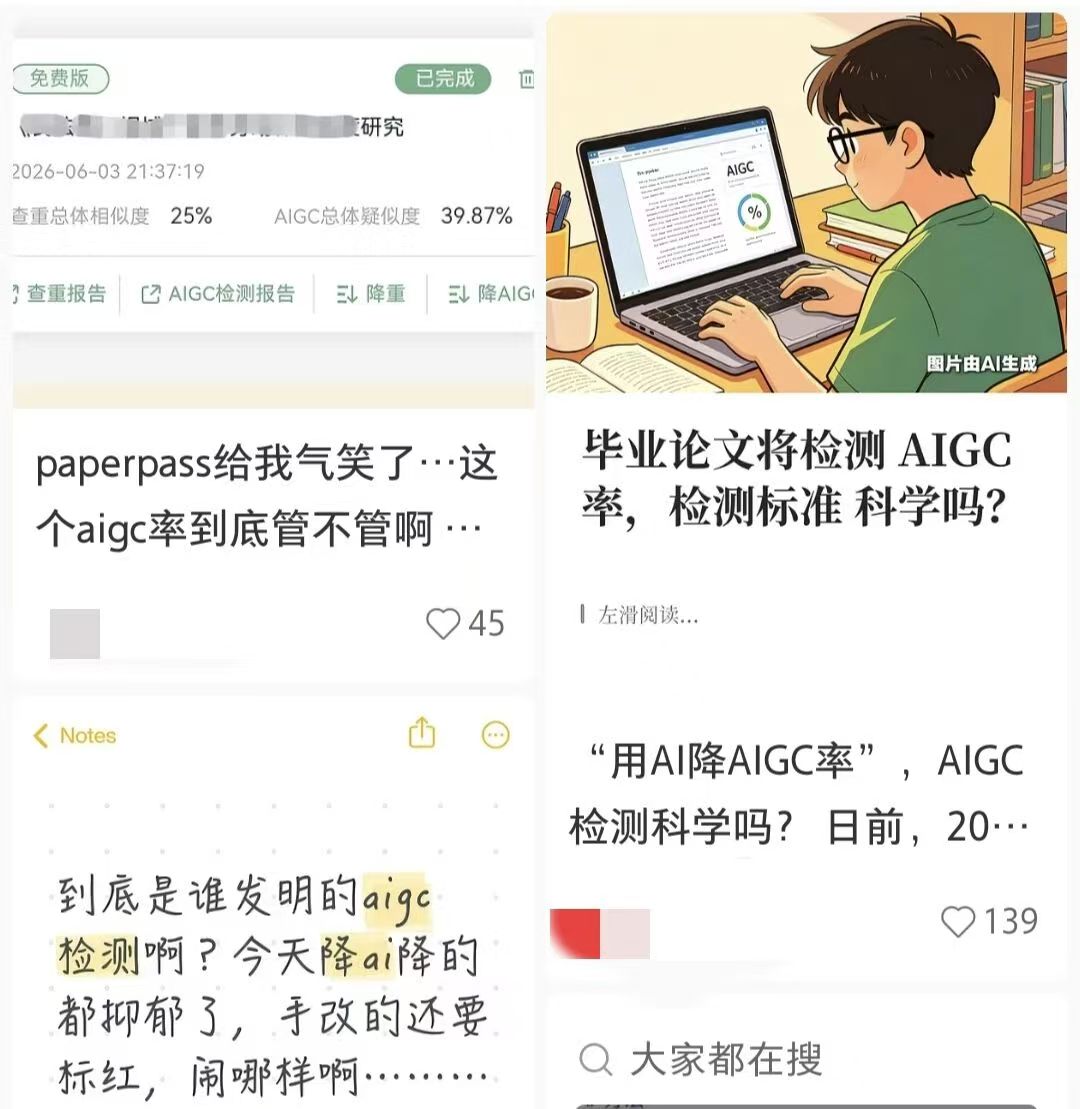
From March to May, a large number of posts about AI detection of theses and reducing the AI ratio appeared on Xiaohongshu
Some students sighed helplessly: “I feel that after the revision, the thesis can pass the AI detection, but not the tutor’s review.”
In fact, when students spend a lot of time on “reducing the AI ratio”, the value of thesis writing has already been hollowed out. The core part of developing writing ability has changed from repeated polishing and refining of expression to exploring algorithm preferences and creating artificial traces.
Moreover, even students who have never used AI have not escaped unscathed from this cat – and – mouse game.
William Quantman, a student at the University of California, Davis, once encountered a similar “AI detection mishap”. In 2023, Quantman was suspected by his professor of cheating with ChatGPT in a history exam, and his paper was also judged by GPTZero as “very likely to be AI – generated”. As a result, the professor gave him a failing grade and referred him to the school’s academic integrity investigation department. To prove his innocence, Quantman provided the school with the editing history of Google Docs, including the word – by – word modification records and the typing timeline, and only then was the accusation against him revoked by the school.
Once an AI detection makes a mistake and marks non – AI content as AI – generated, people will be trapped in endless self – proof. AI is supposed to serve humans, but now it requires humans to prove their credibility to the technology.
At this stage of AI development, an undeniable fact is that despite the contradictions and paradoxes in the AI detection field, related products will not only not disappear but will also increase in number, and the market will continue to expand.
In January 2026, the “2026 AI Detection Landscape Report” presented a set of figures: the number of global AI content detection platforms increased from about 85 in 2024 to 247 in 2026, a 190% increase in two years. The average accuracy of text detection also rose from 90.1% to 94.3%.
These AI detection tools are no longer just helpers for teachers to catch cheaters; they are constantly evolving and entering more unexpected areas.
In January 2026, Originality.ai released an Academic Model specifically designed for STEM disciplines to detect academic assignments containing codes and formulas. In June, the company also released a Moodle plugin, enabling educational institutions to seamlessly integrate its AI detection and plagiarism – checking functions into their teaching management systems.
Copyleaks, which previously focused on text detection and plagiarism – checking, also entered the AI detection field in June this year. It launched an enterprise – level AI video detection tool capable of simultaneously scanning the visual and audio tracks of video files to accurately identify the specific moments when AI – generated content appears.
The educational scenario is just the starting point, but by no means the end. Behind the iteration of these products, there is a deeper driving force at work – AI compliance.
As AI – generated content becomes more and more realistic, along with the improvement in efficiency, the risks are also increasing synchronously. In the past two years, the number of fraud cases using AI face – swapping and voice cloning has increased significantly. A business owner in Fujian was deceived out of 4.3 million yuan by a forged video of a “friend”. During this year’s Two Sessions, Jin Dong, a member of the National Committee of the Chinese People’s Political Consultative Conference, also disclosed that an elderly person was deceived out of 270,000 yuan of pension money by a forged face and voice created by AI.
The spread of fraud has accelerated the implementation of regulations. In March 2025, the “Measures for Marking Artificially Generated and Synthesized Content” were released, requiring all AI – generated text, images, audio, and video to be added with explicit and implicit marks. In June 2026, short – video platforms fully launched labels for AI – generated content, and unlabeled content will not be distributed. In the international market, the US Federal Trade Commission is currently enforcing regulations on AI deep – fake content based on the “TAKE IT DOWN Act”, and Article 50 of the EU “Artificial Intelligence Act” regarding the transparency obligation of AI marking will also come into effect on August 2, 2026.
And this is just the beginning. Future compliance regulations will surely be more specific and stricter – there will be clearer regulations on which scenarios must be marked, which scenarios prohibit the use of AI – generated content, and how much review responsibility platforms should bear. When these regulations are gradually implemented, AI detection will no longer be just a tool for schools, but an indispensable infrastructure for all industries such as content platforms, media organizations, advertising companies, and financial institutions. Banks need to confirm whether the person on the other end of the customer service call is a real person or a cloned voice. News media need to verify whether a live video has been tampered with by AI. Recruitment platforms need to verify whether the video introduction of job applicants is actually filmed by themselves.
On one hand, we encourage the use of AI to improve efficiency; on the other hand, we check which things use AI. AI detection may seem to run counter to the general trend of embracing AI, but in fact, it is not a regression in the traditional sense. When a technology can create fakes that are indistinguishable from the real, distinguishing the real from the fake is a responsibility to more people. Students can use AI to assist in learning, but they need to prove that their theses are written by themselves, which is related to educational fairness. Enterprises can use AI to generate marketing materials, but product promotion videos cannot deceive consumers by fabricating non – existent functions. Ordinary people have the right to know whether the content on their screens is real when browsing short – videos.
The more content is generated by AI, the more difficult it is to distinguish the real from the fake, and the clearer the role of AI detection tools becomes: they are not restricting the development of AI, but marking the necessary boundaries for this rapidly expanding world. Within the boundaries, AI can grow freely; outside the boundaries, some things must belong to humans. Although it seems contradictory, it is actually an inevitable counterbalance when technology evolves to a certain stage.
The world cannot do without AI, and it also needs people who can distinguish AI. This is why a field full of contradictions is expanding.
This article is from the WeChat official account “Xiaguang AI Laboratory”. Author: Xiaguang AI Laboratory. Republished by 36Kr with authorization.
该文观点仅代表作者本人,36氪平台仅提供信息存储空间服务。
36kr Europe (eu.36kr.com) delivers global business and markets news, data, analysis, and video to the world, dedicated to building value and providing business service for companies’ global expansion.
© 2024 36kr.com. All rights reserved.
Leave a Reply