
UPDATE: 9:30 AM CEST
On June 20, Paris could become the focal point of a major mobilization for human rights in Iran. More than 100,000 people are expected to take part in a demonstration organized by over 300 associations supporting the Iranian resistance. Participants are expected to travel from across Europe to deliver a simple and universal message: opposition to terror, executions, and all forms of dictatorship.
The slogan chosen for the rally encapsulates what organizers describe as the aspirations of a large segment of the Iranian people: “Neither Shah nor Mullahs.” The phrase rejects both the current theocratic system and any return to the former monarchical dictatorship. Supporters of the slogan argue that Iranians have not forgotten the repression carried out under the Shah, when the SAVAK imprisoned, tortured, and executed political opponents, intellectuals, and pro-democracy activists. Iran’s modern history, they contend, has been marked by the repeated denial of popular sovereignty.
Today, according to the article, the Iranian population finds itself caught between two threats: the continuing risk of renewed war and an intensifying domestic crackdown.
Read more
At noon on Wednesday, June 3, 2026, the Iranian regime’s judiciary announced the execution of 42-year-old Fathollah Avari, who was arrested during the massive January uprisings in Malard, southwest of Tehran.
The regime deliberately kept the exact date and location of the execution secret in its official announcements, though reports confirm he was hanged on Tuesday, June 2, in Hamedan Prison.
The judiciary and the Ministry of Intelligence charged Avari with punishing Mohammad Javad Bakhshian, a major in the repressive State Security Force (SSF). Bakhshian was killed in a confrontation with protesters while actively playing a role in suppressing the January uprising in Hamedan.
This secret hanging is part of a staggering, daily surge in state-sanctioned killings targeting participants of the recent uprisings. Just days prior, on June 1, the regime executed two rebellious youths, Mehrdad Mohammadinia and Ashkan Maleki. Labeled as leaders of the January uprising, they were sentenced to death by the notorious “hanging judge” Abolqasem Salavati in Branch 15 of the Tehran Revolutionary Court. They were convicted on heavily fabricated charges, including setting fire to the so-called ‘Imam Hadi’ seminary and the Basij center at the Jafari Mosque in Kuy-e Nasr (Gisha), western Tehran.
Read more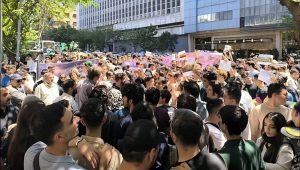
On Tuesday, June 2, 2026, a fresh wave of protests erupted across several major Iranian cities as students rallied against the regime’s discriminatory educational policies. In Tehran, large crowds of students gathered outside the Ministry of Education before launching a protest march toward the Supreme Council of the Cultural Revolution.
The youth were protesting sudden changes to university entrance exam laws, academic record policies, and hurdles to GPA remediation. The unrest was further fueled by Education Minister Alireza Kazemi, who blatantly ignored the severe crises students currently face—including widespread internet disruptions, crushing economic hardships, commuting difficulties, and intense psychological pressures stemming from societal instability. Instead of addressing these grievances, Kazemi explicitly declared that final exams must be held in person, claiming there is no option for remote testing.
Displaying incredible defiance, students in Tehran staged a sit-in on the ground, delivering a clear ultimatum to regime officials: “We are waiting for results, we won’t go anywhere and we’ll stay right here. This generation is not a generation that retreats with promises and repetitive words; it pursues its rights.”
Read more
After a long time of denial and downgrading the situation, a regime-affiliated political analyst publicly referred to the People’s Mojahedin Organization of Iran (PMOI/MEK) operation near Supreme Leader Ali Khamenei’s compound in Tehran days before the outbreak of war, offering one of the clearest acknowledgments by a figure linked to the Iranian establishment of the February 23 clashes.
After long time of denial and downplaying the news, a regime-affiliated political analyst has publicly referred to a PMOI/MEK operation near Iran's now-dead Supreme Leader Ali Khamenei’s compound in Tehran just days before the outbreak of war. The remarks amount to one of the… https://t.co/zHFgs9WoXz pic.twitter.com/tT8VAYvKy9
— SIMAY AZADI TV (@en_simayazadi) June 3, 2026
In remarks published in recent days on the Iran Talk channel, regime analyst Mehdi Kharatian referred to what he described as an operation carried out by the People’s Mojahedin Organization of Iran (PMOI/MEK) against Khamenei’s compound on February 23, 2026, just days before the start of the war.
Read more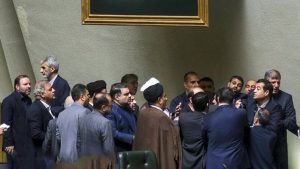
The latest round of infighting among Iran’s ruling factions over negotiations with the United States has entered a more volatile and revealing phase. What appears on the surface to be a dispute over diplomacy is, in reality, a struggle over power, resources, and political survival. The confrontation between hardline factions and the fragile coalition surrounding President Masoud Pezeshkian and Parliament Speaker Mohammad Bagher Ghalibaf has exposed the depth of the regime’s internal fragmentation at a time when it faces mounting economic pressure, diplomatic isolation, and widespread public discontent.
At the center of the dispute lies the possibility of a new nuclear agreement, relations with Washington, and the strategic future of the Strait of Hormuz. The intensity of the debate reflects not confidence within the ruling establishment but fear. Fear of concessions, fear of accountability, and above all, fear of the political consequences that any major policy shift could unleash.
Hardline figures have reacted aggressively to reports of possible understandings with the United States. Hossein Shariatmadari, editor of the regime-affiliated Kayhan newspaper, accused government officials of failing to adequately counter statements by U.S. officials regarding progress toward an agreement. He portrayed any movement toward accommodation with Washington as a surrender of national interests and expressed particular concern about discussions involving the Strait of Hormuz.
Read more
When Iranian regime authorities shut down international internet access on February 28, 2026, following the targeting of Ali Khamenei’s compound and the outbreak of war, the objective appeared clear: isolate the population, control the flow of information, and prevent public outrage from gaining momentum.
The regime may have assumed that a prolonged internet blackout, combined with the distractions of war, would push the memory of January’s bloody crackdown into the background. It likely also relied on its extensive propaganda apparatus, built over decades and financed with enormous resources, to shape public perception during the crisis.
Nearly three months later, that calculation appears to have failed.
Despite the continued filtering of online content and only limited restoration of international internet access, Persian-language social media platforms have been flooded with testimony, images, and personal accounts from survivors, victims’ families, and Iranians inside the country. Their message is remarkably consistent: life has been permanently divided into two periods—before January and after January.
Read more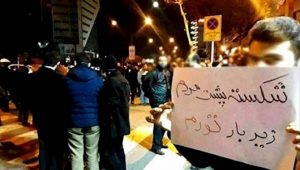
When even state-affiliated media begin sounding the alarm, it becomes increasingly difficult for Iran’s ruling establishment to conceal the depth of the country’s economic crisis. On May 31, the regime-linked outlet Khabar Fori published figures showing that Iran’s misery index has reached a staggering 61.3 percent—a level that reflects not merely economic weakness but a profound deterioration in the living conditions of millions of citizens.
According to the report, the figure is derived from an inflation rate of 53.7 percent combined with an unemployment rate of 7.6 percent. By international standards, such a number signals severe economic distress. Yet for many Iranians, even this alarming statistic may underestimate the hardship they face every day.
The misery index, calculated by adding inflation and unemployment rates, is widely used as a measure of economic pressure on society. It captures two of the most painful realities confronting ordinary households: the rising cost of living and the inability to secure stable employment.
A misery index above 60 percent suggests an economy struggling on multiple fronts simultaneously. Prices continue to rise while employment opportunities remain limited, creating a situation in which many families find themselves trapped between shrinking incomes and growing expenses.
Read more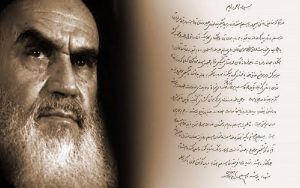
Every year, the anniversary of Ruhollah Khomeini’s death prompts renewed discussion about the founder of the Mullahs’ regime. Yet the central question is not how Khomeini died, but what he left behind. More than three decades after his death, the consequences of the system he created continue to shape Iran’s political, economic, and social realities.
At a time when many political actors remained captivated by the image of Khomeini as a revolutionary leader, a different assessment was already emerging from within the Iranian Resistance. In October 1981, the Swedish publication Proletären quoted Resistance leader Massoud Rajavi as warning that Khomeini stood at the center of the regime’s machinery of repression and executions, arguing that the Iranian people would one day seek to hold him accountable before history and the world.
Those words were spoken when challenging Khomeini publicly carried immense risks. The atmosphere of the early years of the Mullahs’ regime was dominated by a cult of personality that portrayed him as an unquestionable authority. Many political figures either remained silent or actively supported the consolidation of clerical power. Some even advocated expanding the regime’s coercive apparatus as dissent was increasingly suppressed.
Read more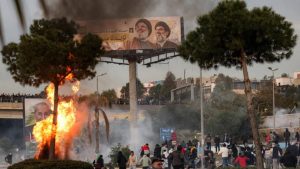
While in the early hours of Wednesday, June 3, local time, Kuwait reported intercepting missile and drone attacks, air raid sirens sounded in Bahrain and explosions were heard on Qeshm Island, Israel and Lebanon’s Hezbollah also carried out new attacks against each other despite U.S. President Donald Trump’s promise to reduce tensions.
The Islamic Revolutionary Guard Corps (IRGC) announced in a statement early Wednesday, June 3, that in retaliation for a U.S. attack on an Iranian oil tanker near the Strait of Hormuz, a vessel belonging to what it described as the American-Zionist enemy, named Panaya, was targeted by IRGC Navy missiles.
The statement said that U.S. forces targeted an IRGC communications tower in southern Qeshm Island with aerial munitions and that, in response, an American air and helicopter base located in a regional country, as well as the headquarters of the U.S. Fifth Fleet, were targeted by missile and drone attacks carried out by the IRGC Aerospace Force.
Read more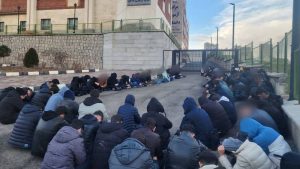
On March 31, the state-run ILNA news agency published a report on the dismissal of university professors across the country. The state-run outlet wrote that on Sunday, March 31, dismissed faculty members of Farhangian University from across Iran, who say they were unlawfully terminated, gathered in front of the Ministry of Education.
As professional protests continue in various sectors of Iran’s education and higher education systems, the gathering was held in protest against the continued dismissal of professors and the refusal of regime officials to implement legal rulings and directives issued by authorized bodies.
According to published reports, the professors participating in the gathering stated that they have been seeking reinstatement for months. They emphasized that the process of dismissing faculty members from Farhangian University was carried out in violation of laws and regulations. According to the protesters, the government’s legal affairs office and Mohammad Reza Aref, the first vice president under Iranian regime president Masoud Pezeshkian, have issued opinions and directives in recent months supporting the return of these professors, but the Ministry of Education and the management of Farhangian University have so far refused to implement those decisions.
Read more
Documented human rights reports indicate an alarming surge in the statistics of death penalty sentences, hunger strikes, and waves of arbitrary arrests across the country. The judicial and security apparatus of the Islamic Republic, exploiting the securitized environment, has launched a massive onslaught against various guilds and sectors of society—including academics, lawyers, artists, and former political prisoners. The unfolding trend demonstrates a strategy of public intimidation through the systematic violation of due process and an absolute disregard for international obligations; a mechanism of widespread repression that continues to be left without a material and deterrent response from the international community and human rights organizations.
Relying on vague case-fabrications and forced confessions, the judiciary has placed the issuance of the harshest punishments and the death penalty for activists on its agenda:
Yasin Shahbakhsh: This 22-year-old Baluch prisoner has been sentenced to the death and 10 years in prison by Branch 2 of the Zahedan Revolutionary Court. This severe ruling was issued based on charges such as “membership in armed groups” and “clashes with military forces,” while reports indicate severe torture and the extraction of forced confessions, and he has rejected all the charges.
Read more
Bremen, Germany — June 2, 2026 — Supporters of the People’s Mojahedin Organization of Iran (PMOI/MEK) gathered in Bremen to protest the execution of political prisoners and demonstrators. The event expressed solidarity with the “No to Execution Tuesdays” campaign, which opposes the Iranian government’s escalating use of executions and systemic repression.
Demonstrators condemned the executions and called for an end to the practice, before urging the establishment of a free and democratic republic in Iran. They rejected all forms of dictatorship—monarchical and theocratic alike. Participants held images of those killed and carried banners reflecting protesters’ demands inside Iran, including “Regime change in Iran by the people of Iran” and “No to the Shah! No to the Mullahs!”
Read more
Amsterdam, The Netherlands – June 2, 2026 – Supporters of the People’s Mojahedin Organization of Iran (PMOI/MEK) held a book table and photo exhibition in Dam Square to protest the execution of political prisoners and demonstrators following the January 2026 uprising. The event expressed solidarity with the “No to Execution Tuesdays” campaign, a movement opposing the Iranian regime’s escalating executions and systemic repression.
Organizers issued a clear call to action, urging freedom-loving Iranians and international supporters to join the major rally scheduled for June 20 in Paris under the slogan “A Democratic Republic for Iran.” The rally rejects both monarchical and theocratic dictatorships, emphasizing a third alternative rooted in democracy and popular sovereignty.
Read more
Paris, France – June 1–2, 2026 – Supporters of the People’s Mojahedin Organization of Iran (PMOI/MEK) held an exhibition protesting the execution of political prisoners and demonstrators following the January 2026 uprising. The event highlighted growing calls for freedom, justice, and the protection of human rights in Iran.
Organizers issued a clear call to action, urging freedom-loving Iranians and international supporters to join the major rally scheduled for June 20 in Paris under the slogan “A Democratic Republic for Iran.” The rally rejects both monarchical and theocratic dictatorships, emphasizing a third alternative rooted in democracy and popular sovereignty.
Read more
Vancouver, Canada – May 30, 2026: Supporters of the People’s Mojahedin Organization of Iran (PMOI/MEK) held a rally to condemn the execution of political prisoners in Iran, including members of the PMOI and protesters detained during the January 2026 uprising.
Demonstrators strongly condemned the actions of the mullahs’ regime, describing the executions as a blatant violation of human rights. Participants paid tribute to the victims by holding their photos and reaffirmed their commitment to continue the struggle until the overthrow of the regime and the establishment of peace, freedom, and justice in a democratic republic.
Read more
Also, read Iran News in Brief – June 3, 2026
Copyright © 2026 NCRI National Council of Resistance of Iran All Rights Reserved.
This website uses cookies so that we can provide you with the best user experience possible. Cookie information is stored in your browser and performs functions such as recognising you when you return to our website and helping our team to understand which sections of the website you find most interesting and useful.
Strictly Necessary Cookie should be enabled at all times so that we can save your preferences for cookie settings.

domainlabs8@gmail.com
Website: http://newsbunkers.in


Leave a Reply