UPDATE: 7:30 AM CEST
The latest reports emerging from Iran’s prisons expose more than individual cases of abuse. They reveal a political system that has become increasingly dependent on repression to preserve its grip on power.
From the women’s ward of Evin Prison to the overcrowded cells of Ghezel Hesar and the alarming disappearance of political detainees in Shiraz, a clear pattern is emerging. As the Iranian regime confronts deepening political, economic, and social crises, it is once again turning its prisons into laboratories of intimidation. This is not simply a human rights issue. It is a political strategy.
The authorities understand that despite years of executions, arrests, censorship, and intimidation, the spirit of protest inside Iranian society has not been extinguished. The nationwide uprisings of recent years demonstrated that millions of Iranians reject the status quo and continue to demand fundamental political change. Unable to address the causes of public anger, the regime has returned to the only tool it truly trusts: fear.
Read more
The clerical regime that has ruled the country for nearly five decades faces unprecedented political, social, and economic crises. Public trust has collapsed, nationwide protests have repeatedly challenged the foundations of the system, and an overwhelming majority of Iranians openly reject the doctrine of Velayat-e Faqih. At the same time, debates about Iran’s future have intensified. What kind of political system should replace the current dictatorship? What guarantees can prevent the emergence of another authoritarian order?
To answer these questions, Iranians do not need to look only toward the future. They must also revisit one of the most important and frequently misunderstood lessons of their recent past.
The tragedy of 1979 was not that Iranians lacked a democratic culture. The tragedy was that a rare opening for political pluralism was systematically destroyed by a movement determined to monopolize power.
This distinction is critical because the future of Iran will depend on whether the country embraces pluralism or repeats the cycle of replacing one form of authoritarianism with another.
Read more
For years, Iranian regime officials, state-affiliated economists, and government media have searched for explanations for the country’s economic collapse. They have debated inflation, sanctions, mismanagement, budget deficits, currency devaluation, and declining investment. Yet they consistently avoid confronting the central truth: Iran’s economic crisis is not merely an economic problem. It is the inevitable consequence of a political system built on repression, monopoly, and the denial of freedom. A sick political system produces a sick economy.
The cancer consuming Iran’s economy today is the direct result of decades of authoritarian rule under the doctrine of absolute clerical authority. When political survival becomes the state’s highest priority, economic prosperity becomes impossible. The death of freedom feeds the lifeblood of dictatorship, while the people are left to bear the costs through poverty, unemployment, and hopelessness.
This reality explains why no government over the past two decades has been able to rescue the economy. Every administration has inherited the same structural crisis and merely added another layer to it. None has addressed the root cause because the root cause lies at the very center of power itself.
Read more
In recent days, Iran has witnessed fundamental changes in the nature of popular protests. The movement has evolved from economic, and livelihood demands to direct political demands and then to widespread student protests involving both university and high school students, encompassing all of these grievances. The protests have spread across dozens of cities, from Tehran, the capital, to Mashhad, Ahvaz, Tabriz, and Isfahan. This movement, which reached its peak on June 6, 2026, is a real test of the cohesion of the educational system and the effectiveness of policies adopted by the body known as the “Supreme Council of the Cultural Revolution,” an institution responsible for setting cultural and educational policies in Iran. This reflects a structural gap in the development-oriented approach of Iran’s regime.
The essence of this crisis lies in the widespread perception of a “lack of justice” within educational institutions. Field reports and independent observers indicate that policies governing the national university entrance examination and university admissions have entrenched a clear class divide in education, with private schools and social groups connected to government circles monopolizing most seats at the country’s top universities. This discrimination is not merely an administrative failure but reflects a structural breakdown in “equality of opportunity.” As a result, students from disadvantaged and marginalized backgrounds increasingly feel that educational and career paths have been closed to them in advance, a sentiment reflected in the slogan of protesting students: “We saw no justice, we only heard promises.”
Read more
While Iran’s regime has spent much of its resources and capabilities over more than four decades suppressing opponents, silencing advocates of freedom, executing critics, and demonizing the opposition, the consequences of these policies are now visible not only in the political sphere but also in social and criminological indicators. Rising theft, expanding social harms, increasing divorce rates, weakening social cohesion, and deepening economic crises are not phenomena that can be attributed solely to the individual behavior of citizens.
For years, social sciences and criminology have emphasized that crime and social harms are less the product of individual morality and more a direct reflection of governing structures and the social relations they create. In this context, legal expert Kambiz Norouzi, in an article published on June 10 in the state-run Shargh newspaper, warned about the social consequences of accumulated economic and political crises and wrote: “Data from criminology and criminal sociology show that this situation is extremely fertile ground for the growth of weeds called crime and social harm.”
Read more
Iranian prisoners in war conditions face simultaneous and escalating dangers: threats resulting from military strikes near prisons and detention centers, heightened securitization of detention facilities, the cutoff or restriction of access to food, water, medical treatment, and communication with family, undisclosed transfers, and pressure on certain prisoners to register for deployment to war zones such as Kharg Island and Hormozgan Province. This situation demonstrates that prisoners, particularly political prisoners, death-row inmates, protest detainees, sick prisoners, and individuals lacking effective access to a lawyer, have been placed in one of the most vulnerable human rights positions.
According to reports received from inside prisons, authorities in certain facilities, including Kerman Prison, have in recent weeks visited wards and requested prisoners to sign up for deployment to war zones. These requests have been accompanied by promises of monetary payment, improvement of prison conditions, administrative privileges, and in some cases, threats of harsher treatment, restriction of facilities, difficulties regarding furlough, or security pressures. Although these deployments are presented by officials as “voluntary,” the concept of free consent is severely compromised under conditions of confinement and the prisoner’s total dependence on the decisions of prison authorities.
Read more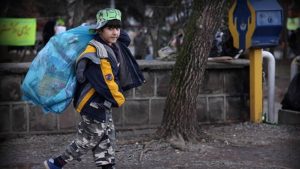
NEW YORK — As the World Day Against Child Labor is marked globally, field reports and documents published in Iran’s domestic media reveal a profound structural crisis. In this crisis, the phenomenon of child labor is no longer an individual or behavioral deviation but the direct product of flawed government policies, the collapse of social welfare, and the prioritization of economic survival over children’s most basic rights.
The growing Iran child labor crisis has become one of the clearest manifestations of the economic and social pressures facing vulnerable families across the country.
The state-run newspaper Jahan-e Sanat, in a detailed report titled “Little Breadwinners,” explicitly revealed that, according to statistics from government institutions themselves, there are currently around 2 million child laborers in Iran. Although government officials repeatedly claim that extensive measures have reduced their numbers, field evidence from major squares, streets, and metro networks in large cities demonstrates the opposite. Domestic experts emphasize that the root of these two million human tragedies lies not in the absence of laws but in the government’s structural incapacity and the ruling establishment’s economic policies.
Read more
LOS ANGELES – June 10, 2026 – On the eve of the 2026 FIFA World Cup, a photo exhibition, public rally, and press conference were held in Los Angeles to expose the Iranian regime’s systematic repression of athletes and its interference in sports institutions. The event brought together former Iranian national team players, champion athletes, and members of the National Council of Resistance of Iran (NCRI) to call attention to decades of human rights violations against Iranian sports figures.
Participants included Hamid Azimi, member of the NCRI; Asghar Adibi, former Iranian national football player at the 1970 Asian Games and NCRI member; Bahram Mavaddat, member of Iran’s 1978 FIFA World Cup squad and NCRI member; footballers Yousef Mahdavi and Shahram Homayounfar; Solmaz Abouali, U.S. and world karate champion; and Milad Sharif, a champion wrestler from Los Angeles.
Read more
Also, read Iran News in Brief – June 12, 2026
Copyright © 2026 NCRI National Council of Resistance of Iran All Rights Reserved.
This website uses cookies so that we can provide you with the best user experience possible. Cookie information is stored in your browser and performs functions such as recognising you when you return to our website and helping our team to understand which sections of the website you find most interesting and useful.
Strictly Necessary Cookie should be enabled at all times so that we can save your preferences for cookie settings.
Leave a Reply