Daily Mirror – Print Edition
Daily FT
Sunday Times
Mirror Edu
Tamil Mirror
Lankadeepa
Middleast Lankadeepa
Ada
Deshaya
Life Online
Hi Online
E-Paper
Home delivery
Advertise with us
Mobile Apps
feedback
Archive
Print Ads
Tue, 30 Jun 2026 Today’s Paper
30 Jun 2026 – {{hitsCtrl.values.hits}} 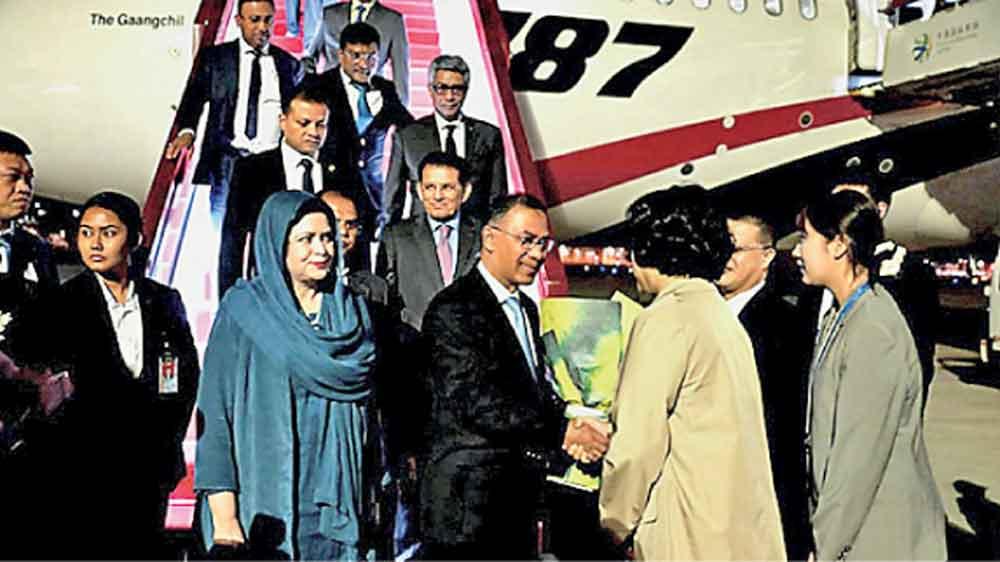
Bangladeshi Prime Minister Tarique Rahman’s visit will strengthen existing ties  Bangladeshi Prime Minister Tarique Rahman’s five-day visit to China last week was of considerable strategic significance not only for the two countries, but also for India.
The visit was primarily aimed at expanding and facilitating Chinese investment in Bangladesh to increase employment and to enlarge Bangladesh’s basket of exportable goods. Bangladesh urgently needs financial support as the economy is in poor shape due to two years of political turmoil.
In 2024, the then-Prime Minister, Sheikh Hasina, went to Beijing seeking US$ 5 billion in budget support. But the Chinese did not agree on the grounds that the economic conditions in Bangladesh did not justify it. Even today, the economy is in the same condition, if not weaker.
Bangladesh is hungry for Chinese investment, because employment is among Bangladesh’s most serious problems with millions of Bangladeshis ending up as legal or illegal migrant workers in other countries.
Bangladesh is craving for infrastructure, and China is already Bangladesh’s foremost partner in this area. Dhaka is seeking around USD$ 6 billion in infrastructure support. This is an area where Beijing is most likely to respond positively, because it has surplus capacities that could be profitably transferred to Bangladesh. China would like Bangladesh to be more deeply integrated into its Belt and Road Initiative (BRI) across infrastructure, finance, agriculture, and renewable energy. Beijing also wants Bangladesh to be part of its Global Development Initiative (GDI).
China has world-leading capacity in semiconductors, electric vehicles and solar power, and can support Bangladesh in these areas. Bangladeshis have noticed that Nepal is now the largest market for Chinese electric vehicles in South Asia. Bangladesh might want to emulate Nepal in this respect. The Tarique Rahman government has just earmarked a dedicated Chinese Economic and Industrial “Free Trade Zone”.
During his visit, Tarique Rahman met Chinese President Xi Jinping and held bilateral talks with Premier Li Qiang. After the meetings, Bangladeshi Foreign Minister, Dr. Khalilur Rahman, said that Bangladesh and China had agreed to institutionalise a strategic dialogue at the foreign minister level and to launch a “2+2” dialogue mechanism covering diplomacy and defence. He also said that both sides reaffirmed their commitment to deepen cooperation under the Belt and Road Initiative, covering large infrastructure projects as well as people-centric development initiatives. Bangladesh has joined the China-sponsored Global Development Initiative (GDI).
Teesta River Basin Development
According to Dr. Khalilur Rahman, there was “significant progress” on the Teesta River Comprehensive Management and Restoration Project, with China pledging support and both sides agreeing to speed up the project’s feasibility study.
The Teesta flows from the eastern Himalayas through Sikkim and West Bengal before entering Bangladesh, where it is a key source of irrigation and livelihoods for millions. The river basin is near India’s “Siliguri Corridor”, a 22-km narrow strip linking mainland India with its northeastern states.
But Chinese involvement in Bangladesh’s Teesta project is viewed with some trepidation in India,
as per news reports.
Foreign Minister Dr. Rahman also said that Bangladesh and China had agreed to expedite the Mongla Port Modernisation and Expansion Project and the Chinese Economic and Industrial Zone Development Project in Chattogram. Through Mongla port, China would get an entry into the Bay of Bengal, which India has traditionally considered an “Indian lake”.
According to China’s “Global Times”, Prime Minister Tarique Rahman and Chinese leaders agreed to execute the Bangladesh-Myanmar-China (BMC) connectivity project. But there is a hitch here. The project area includes large tracts of insurgency-hit places in North West and North East Myanmar. The insurgent groups have kept the Myanmar government forces at bay.
The BMC project is akin to India’s Kaladan project, a multimodal transport corridor connecting West Bengal, Myanmar and Mizoram in North-East India. But Kaladan is held up by the insurgencies in North-Western Myanmar. It remains to be seen if the diplomatic heft of India and China will help the military-backed regime in Yangon to
control the insurgents.
The Teesta is a cross-border river in which any development on the Bangladeshi side will have economic and strategic implications for India. Given its constant clashes with India over the sharing of the river Ganges (or Ganga), Bangladeshis have been wary about getting India involved in the Teesta River Basin project and had sought China’s help instead.
But this set off alarms in India and the Sheikh Hasina government had to stall the project. But now, after Tarique Rahman’s visit, China is well and truly in the Teesta project.
Defence Cooperation with China
Bangladesh’s defence cooperation with China is another problematic area for India. Bangladesh has been among the largest buyers of Chinese military equipment for decades, and China would like to build on that. But India’s offer of equipment had not elicited much interest from the Bangladeshi armed forces, which prefer Chinese equipment for whatever reason.
With Tarique Rahman’s visit, Bangladesh and China have become strategic partners with China saying that it will help Bangladesh maintain its territorial integrity and sovereignty. But closer defence relations with Beijing can set off alarm bells in New Delhi.
India is already seeing a Bangladesh- China-Pakistan axis that it fears could threaten its hold on the “Siliguri Corridor” up in North Bangladesh, which links mainland India with its North-Eastern States. The corridor called the “Chicken’s Neck” is at the junction of India, Nepal, Bhutan and China and is very narrow.
Last year, the Indian media sounded alarms when a top Pakistani military delegation visited Bangladesh’s Lalmunirhat airbase in North Bangladesh near the Chicken’s Neck. Some Bangladeshi strategic experts had proposed a Bangladesh-Pakistan Defence Pact, including a nuclear pact to contain India.
According to media reports, Bangladesh is now accelerating negotiations to acquire between 20 and 24 Chinese-made J-10CE multirole fighter jets in a move that could fundamentally alter the military balance in India’s eastern flank and the Bay of Bengal.
The aircraft’s compatibility with the PL-15 beyond-visual-range missile represents the most strategically important aspect of the proposed acquisition because the missile dramatically expands Bangladesh’s capability.
The Sino-Bangladeshi package is reportedly valued at approximately US$ 2.2 billion, including aircraft, training, logistics infrastructure, spares, maintenance support and long-term sustainment. Chinese defence and diplomatic delegations reportedly visited Dhaka recently to accelerate negotiations.
Recommended Pathways
A former Bangladeshi Ambassador to the US, M. Humayun Kabir, has suggested that Bangladesh should pursue its interests “within the regional geopolitical framework,” apparently hinting at accommodating Indian sensitivities.
He also warns that China is not an easy partner. If the US and India are transactional; so is China, he said. In a piece in “The Daily Star”, Kabir recalled that China had declined Sheikh Hasina’s request for financial help because the Bangladeshi financial system offered no assurance that the money could be repaid. Bangladesh’s current position is as gloomy.
Bangladesh’s capacity to absorb is also limited, its processes are bureaucratic, and its ability to turn MOUs into delivered projects is limited, Kabir said. No agreement, whether with China, India, or the United States, will deliver its full potential if the system continues to be wanting in these
areas, he wrote.
An Indian analyst said that the appropriate Indian response to Sino-Bangla closeness should not be alarmist or confrontationist. “It should recognise that strategic competition in South Asia increasingly unfolds through speed and quality of delivery. India’s long-term strengths in the neighbourhood remain real, but those strengths must be reinforced through visible responsiveness and credible implementation.”
On the Teesta river project, he said that India could offer a package that is practical, time-bound, and responsive to Bangladesh’s developmental concerns. Flood moderation, sediment management, embankment strengthening, irrigation support, and data-sharing are precisely the areas in which trust can be built through performance, he pointed out.
“Water cooperation carries a wider political value. Where trust is strong, technical cooperation becomes easier and strategic anxieties are easier to manage. Where trust is weak, even routine development activity acquires political overtones. A sustained Indian role in Teesta management would therefore do more than address local riverine concerns,” the Indian analyst said.
1
2
3
4
5
6
30 Jun 2026 6 minute ago
30 Jun 2026 9 minute ago
30 Jun 2026 12 minute ago
30 Jun 2026 16 minute ago
30 Jun 2026 33 minute ago
General :
+94 0115 335 731
+94 0112 304 545
Circulation :
+94 0112 479 611
Advertising :
+94 0112 479 561
Subscription :
+94 0112 479 626
Technical :
+94 011 538 3437
[email protected]
All the content on this website is copyright protected and can be reproduced only by giving the due courtesy to ‘dailymirror.lk’ Copyright © 2004 Wijeya Newspapers Ltd.
Geopolitical significance of Bangladeshi PM’s visit to China – Daily Mirror – Sri Lanka
Home
A Good Appetite
Geopolitical significance of Bangladeshi PM’s visit to China – Daily Mirror – Sri Lanka
Leave a Reply