Daily Mirror – Print Edition
Daily FT
Sunday Times
Mirror Edu
Tamil Mirror
Lankadeepa
Middleast Lankadeepa
Ada
Deshaya
Life Online
Hi Online
E-Paper
Home delivery
Advertise with us
Mobile Apps
feedback
Archive
Print Ads
Tue, 23 Jun 2026 Today’s Paper
23 Jun 2026 – {{hitsCtrl.values.hits}}
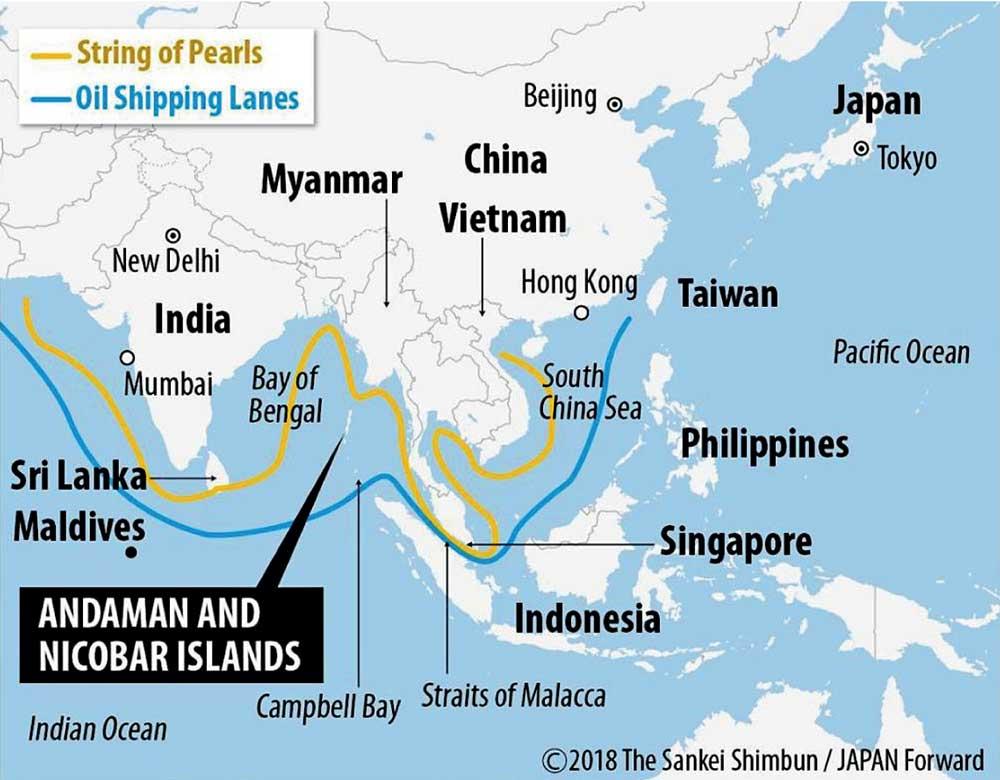
 The Indian government is abandoning a five-year-old project to extend the runway at the naval air station “INS Baaz” on the Car Nicobar Islands in the Bay of Bengal, in view of local environmental and socio-economic issues.
However, the government has decided to proceed with a new INR 130,000 million greenfield civil-cum-military airport at Chingen in Galathea Bay, further South (see map).
According to the Indian media, studies have found that lengthening the existing 4,500-foot runway at INS Baaz to around 10,000 feet would be difficult due to terrain limitations, navigational challenges, and the need for extensive supporting infrastructure.
Officials also concluded that a runway expansion could have an adverse impact on tribal settlements, forests and wildlife habitats more than the proposed greenfield airport.
Strategic Loss
If fully developed, INS Baaz would have been India’s southernmost full-fledged naval air base, serving a wide strategic arc that would overlook the Malacca Strait, one of the world’s busiest maritime chokepoints.
Commissioned in July 2012, INS Baaz is presently used by Dornier 228 maritime reconnaissance aircraft. It can also accommodate the IAF’s C-130J Super Hercules transport aircraft. The plan was to enable it to take long-range surveillance assets such as the Boeing P-8I maritime patrol aircraft. At present, these aircraft operate from distant Port Blair in the Andaman Islands. The expansion is also aimed at accommodating fighter aircraft such as the Navy’s MiG-29K and the IAF’s Sukhoi Su-30MKI fighters.
The base was due to have modern airfield Instruments and navigation aids, essential for all-weather, day and night operations and upgraded logistical infrastructure.
The expanded base would have projected India’s naval power, reinforcing its role as a net security provider and a responsible stakeholder in global maritime governance.
Economic Dimension
The Car Nicobar Island is located 1,190 km from Chennai and 1,255 km from Kolkata, and is about 1,200 km away from the Strait of Malacca. Nearly 60% of global maritime trade passes through the East-West sea lanes of the Indian Ocean. The Strait of Malacca is especially crucial, as a large portion of energy supplies to countries like China, Japan, and South Korea pass through it.
If India develops a transhipment hub, an airport, industrial zones, and logistics hubs here, it will not only boost its commercial standing but also enable it to become a logistical powerhouse. INS Baaz would have contributed to the hub’s security significantly by enhancing India’s capacity to police the maritime trade route through intelligence gathering, surveillance, and reconnaissance across vast areas of the Indian Ocean.
Civilian Concerns
However, issues relating to land acquisition, deforestation, environment preservation, and the displacement of tribal communities have been delaying the commencement of the project. Problems for the base essentially stem from the proposed US$ 7.6 billion transhipment port and the associated township development. Apart from civil society groups, Congress leaders Sonia Gandhi and Rahul Gandhi have written and spoken against the port and other civilian development projects, leaving the airbase untouched because its development enjoys general consensus.
The project requires diverting substantial forest land, potentially felling one million trees and clearing 244 sq. km of forests, threatening habitats and biodiversity. Concerns exist regarding the impact on the indigenous Shompen and other Nicobarese tribes which are hunter-gatherers.
The region is prone to seismic activity, and critics argue the Environmental Impact Assessment (EIA) report downplayed risks of earthquakes and tsunamis.
Accusations of incorrect or incomplete information and procedural failures in the draft EIA report have led to calls for review. The National Green Tribunal has ordered a review of the project’s environmental aspects. Activists have labelled the project an “ecocide” and urged the suspension of clearances.
The Car Nicobarese were forced to evacuate their villages during the Indian Ocean tsunami of 2004. This present project will permanently displace this community.
Sonia Gandhi’s Objections
In an article in “The Hindu” newspaper, Congress Party President Sonia Gandhi pointed out that the island’s Shompen Policy, notified by the Union Ministry of Tribal Affairs, specifically requires the authorities to prioritise the tribe’s welfare and integrity when considering largescale development proposals. Instead, the project de-notifies a significant part of the Shompen tribal reserve, destroys the forest ecosystems where the Shompen live, and cause a large-scale influx of people and tourists on the island, she said. Constitutional and statutory bodies set up to preserve tribal rights have been sidestepped throughout this process, she added. As in Article 338-A of the Constitution, the Government should have consulted the National Commission for Scheduled Tribes. The Government should have consulted the Tribal Council of Great Nicobar and Little Nicobar Island, she said. The Government’s solution to this indiscriminate tree felling is ‘Compensatory Afforestation’, a rather poor substitute for the loss of natural, old-growth forests. Inexplicably, the planned afforestation is in Haryana, a State that is thousands of kilometres away in North India.
The Calcutta High Court subsequently suspended the civilian development project on environmental grounds.
1
2
3
4
5
6
23 Jun 2026 33 minute ago
23 Jun 2026 42 minute ago
23 Jun 2026 52 minute ago
23 Jun 2026 55 minute ago
23 Jun 2026 58 minute ago
General :
+94 0115 335 731
+94 0112 304 545
Circulation :
+94 0112 479 611
Advertising :
+94 0112 479 561
Subscription :
+94 0112 479 626
Technical :
+94 011 538 3437
[email protected]
All the content on this website is copyright protected and can be reproduced only by giving the due courtesy to ‘dailymirror.lk’ Copyright © 2004 Wijeya Newspapers Ltd.
Forest cover and tribal groups affected: India gives up critical naval airbase under environmentalists’ pressure – Daily Mirror – Sri Lanka
Home
A Good Appetite
Forest cover and tribal groups affected: India gives up critical naval airbase under environmentalists’ pressure – Daily Mirror – Sri Lanka
Leave a Reply