
Dyna Software builds artificial intelligence and continuous governance solutions for the ServiceNow platform, helping enterprises manage platform complexity, minimize technical debt, and automate IT infrastructure configurations. Pulse 2.0 interviewed Dyna Software co-founder and CEO Ron Browning to learn more.
Ron Browning’s Background
Could you tell me more about your background? Browning said:
“I started my career in operations during the height of the ITIL and Service Management boom in North America. After working in a variety of ITIL-related roles, I eventually left the corporate world and entered independent consulting. It was there that I recognized an opportunity to build a larger consultancy focused on helping organizations design, implement, and manage enterprise service management programs, while also identifying the best technologies to support them.”
“In 2021, my business partner and I stepped away from consulting to focus entirely on our software company. While the business evolved, my core mission remained the same: helping customers maximize the value of their technology investments. My goal has never been simply to sell software, but to help organizations achieve meaningful outcomes from the solutions they choose.”
Formation Of The Company
How did the idea for the company come together? Browning shared:
“My business partner, Dyna Wang, and I first met while working together on a client engagement. Our friendship grew through countless conversations about the challenges organizations faced with ServiceNow and the complexities of managing the platform at scale. In 2018, while working on one of our largest client engagements, we realized that instead of solving the same problems one client at a time, we could build software that addressed them at scale. Dyna developed the initial GuardRails prototype over a single weekend, and today it has evolved into a highly profitable, enterprise-grade software platform used by many of the world’s largest companies and government organizations.”
“We have intentionally remained a small company to stay agile and keep overhead as lean as possible. In the early days, I wore nearly every business hat, including operations, marketing, sales, and finance. Today, my focus is centered on the strategic aspects of growing the business, developing partnerships and alliances, expanding sales opportunities, and driving our go-to-market strategy. I spend much of my time evaluating the bigger picture, identifying opportunities to increase revenue, and exploring new avenues for capital and growth that can help accelerate the company’s long-term vision.”
Favorite Memory
What has been your favorite moment working for the company so far? Browning reflected:
“There are two that come to mind. First and ultimately most important, when we first decided to participate in internships and student co-op programs it filled an important and meaningful piece of puzzle for me. I have always been interested in sharing my learnings and my failures with younger generation and finding ways to give them an opportunity to learn and grow. As a leadership team we were easily sold on the idea that we could create a really great learning and experience opportunity for students. The first moment that this relates to is when we heard back on the rating from the program and our first students had amazing comments that placed us higher than some major organizations. That let like a major win. The second was when we gained our first customer. I cannot name names but I can say they are a major global network related provider out of San Francisco. This was amazing to my business partner and I. At that time it was just the two of us and had built something from our own ideas that a company of this size not only wanted but needed. I share the story of their demo to this day as it remains so impactful and relatable to all of out prospect and current customers.“
Favorite Moment
What has been your favorite moment working for the company so far? Browning reflected:
“There are two moments that immediately come to mind.”
“The first, and ultimately the most meaningful, relates to our internship and student co-op programs. When we first decided to participate, it filled an important gap for me personally. I have always been passionate about sharing both my successes and failures with the next generation and creating opportunities for young professionals to learn and grow. As a leadership team, we quickly embraced the idea that we could provide a truly valuable learning experience for students.”
“The moment that validated that belief was when we received feedback from the program and learned that our first group of students had given us exceptional reviews, ranking us above several much larger organizations. That felt like a significant accomplishment and reinforced that we were making a positive impact.”
“The second moment was when we landed our first customer. While I cannot disclose the company’s name, I can say that it is a major global networking provider based in San Francisco. For my business partner and me, this was an incredible milestone. At the time, the company consisted of just the two of us. We had taken an idea, built a solution from the ground up, and demonstrated that a company of that size not only wanted what we had created but genuinely needed it.”
“I still share the story of that first demo today because it remains one of the most impactful moments in our journey. It resonates with both prospective and existing customers, serving as a reminder that some of the biggest innovations begin with a simple idea and the determination to solve a real problem.”
Main Products
Can you tell us about the company’s main products and features? Browning explained:
“Our flagship product, GuardRails, is software built specifically for the ServiceNow platform to help enterprise customers govern, automate, and improve how development and configuration changes move through their environments. It brings together source code management, technical debt management, automated deployment, environment management, forensic analysis, and AI-enabled capabilities to help customers move faster while reducing risk.”
“As AI-generated development becomes more common, GuardRails provides the structure organizations need for proper review, approval, traceability, and human oversight before changes move into production. Its AI-enabled features help identify risks, support remediation efforts, and provide developers and platform teams with deeper visibility into best-practice issues, upgrade concerns, ServiceNow support issues, and potential configuration problems.”
“At its core, GuardRails helps ServiceNow customers increase delivery speed, improve compliance readiness, reduce technical debt, and protect the long-term health of their platform.”
“Our second product is Platform Copilot, an agentic AI solution built specifically to help customers configure and build on the ServiceNow platform using natural-language requirements. The simplest way to describe it is ‘requirements to completed configuration.’ A user can describe what they need, and Platform Copilot helps translate that intent into working ServiceNow outcomes.”
“What makes Platform Copilot especially powerful is that it moves the build process much earlier in the conversation. Rather than waiting until discovery is complete, requirements are documented, designs are reviewed, and work is handed off to technical teams, business analysts and process consultants can use Platform Copilot during live business conversations and requirements workshops to create visual prototypes, validate workflows, refine requirements, and move toward real configuration in real time.”
“This allows customers to move from idea to visual build, to modification, and then to finalized configuration within a single working session without immediately committing to a traditional implementation cycle. Once validated, those outputs can become production-ready configurations, dramatically reducing the time, cost, and friction normally associated with ServiceNow delivery.”
“For customers, Platform Copilot helps accelerate platform adoption, reduce dependency on constrained development resources, and unlock greater self-service configuration capabilities. For partners, it provides a way to deliver outcomes faster, support more customers, and improve the economics of ServiceNow implementation and managed services engagements.”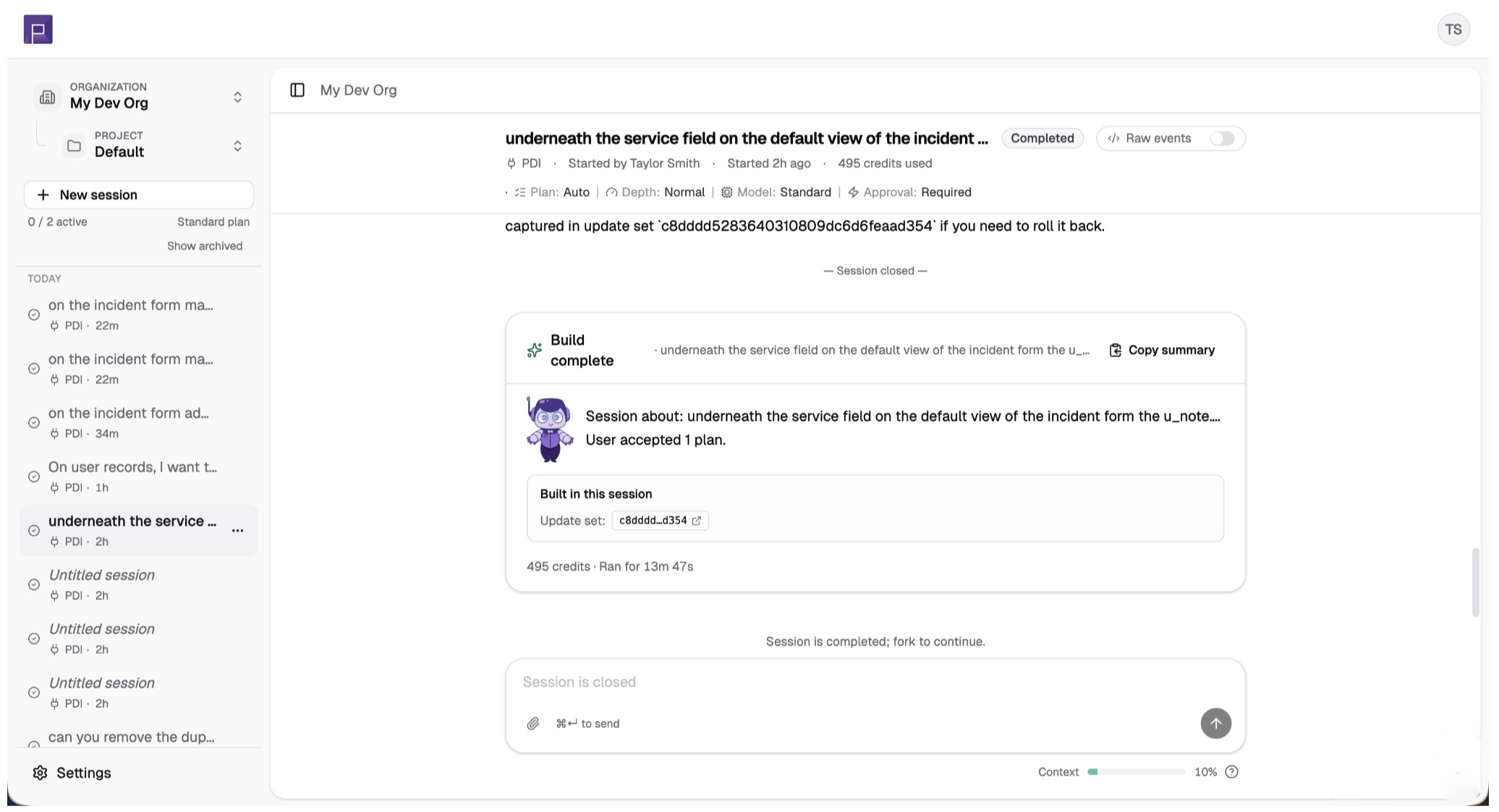
Hurdles To Overcome
What hurdles have you had to overcome in your industry? Browning acknowledged:
“As a smaller company working to build a global customer base, we rely heavily on strategic partnerships. Determining which partners to focus on, evaluating their size, and understanding the unique capabilities they bring to the relationship has been one of the more challenging aspects of growing our business.”
Evolution Of The Company’s Technology
How have you evolved your technology since you first started? Browning noted:
“For every software product we bring to market, we design with two things in mind: practical value today and where technology is heading tomorrow. Our own experience owning and operating software platforms has had a major influence on what we build, how we design it, and how we believe customers will use it.”
“We have always tried to stay close to emerging technology trends, and AI has proven to be a wild stallion: powerful, fast-moving, and difficult to fully harness. Because of that, we have focused on adaptability, safety, and building software that can evolve as quickly as the market around it.”
“GuardRails has evolved from primarily identifying risk to supporting AI-driven analysis, automated remediation, and stronger governance over how ServiceNow development progresses. Platform Copilot has already undergone five major version iterations, with only Versions 1, 2, and 5 ultimately being commercialized, largely because the underlying foundation models and technical capabilities have advanced so rapidly.”
“If there is something that sets Dyna Software apart, it is our ability to adapt our technology quickly to meet emerging customer needs and take advantage of new capabilities as they enter the market.”
Milestones
What milestones is the company proud of? Browning cited:
“In 2026, we were selected to present alongside Bell Canada at the ServiceNow Knowledge Conference and discuss how they use our software to operate ServiceNow at true enterprise scale. Over the past year and a half, ServiceNow has referenced Bell Canada in numerous media interviews as one of its strongest examples of enterprise platform adoption. In 2024, Bell Canada was even recognized as ServiceNow’s Most Innovative Customer of the Year. For us, it was especially rewarding to demonstrate that many of the successes ServiceNow highlighted were supported by our GuardRails platform.”
Success Story
What is a success story that you’ve seen with your product? Browning highlighted:
“Bell Canada is one of our strongest success stories. Bell Canada is a large North American telecommunications company providing business and residential internet services, programming services, streaming offerings, and more. The company operates a large and complex ServiceNow environment spanning multiple production instances that support field operations, corporate services, and customer service functions for nearly 40,000 end users.”
“Using GuardRails, Bell Canada gained centralized visibility across its entire ServiceNow ecosystem and automated many of its manual deployment and governance processes. As a result, the organization has been able to accelerate development across teams and scale ServiceNow adoption without sacrificing platform resilience.”
“At this year’s Knowledge Conference, Bell Canada shared significant improvements in both time savings and risk reduction as a direct result of its GuardRails implementation.”
Funding/Revenue
Can you share any funding or revenue information? Browning revealed:
“Over the past three years, we have consistently doubled our revenue year-over-year. The company remains self-funded by Dyna Wang and myself.”
“Our average deal size is approximately $240,000 USD in annual contract value (ACV), with a typical total contract value (TCV) of approximately $720,000 per customer.”
“In parallel, we have invested heavily in our managed service provider and partner programs, enabling ServiceNow partners to use our software in their delivery practices. This initiative is significantly accelerating both customer acquisition and revenue growth in 2026. Between our expanding partner ecosystem and the introduction of Platform Copilot V5, we believe we are positioned for substantial growth.”
Total Addressable Market
What is the total addressable market (TAM) you are pursuing? Browning assessed:
“For GuardRails, North America remains our primary target geography due to the concentration of large enterprise ServiceNow customers, continued platform growth, and overall market maturity. We estimate our North American TAM at approximately $565 million, with a global TAM of roughly $1 billion. Asia-Pacific represents our secondary geographic focus, with an estimated TAM of $145 million, driven in part by the strength of our regional partner ecosystem.”
“Our TAM methodology focuses on the top 30% of ServiceNow ACV customers. These organizations have the scale, platform complexity, governance requirements, and ServiceNow investment levels where GuardRails delivers the strongest commercial value. While GuardRails can benefit virtually any ServiceNow customer, organizations with less than approximately $2 million in ServiceNow ACV are generally less likely to justify a full GuardRails deployment.”
“Platform Copilot has a very different market profile. Its pricing model aligns with standard AI consumption and credit-based approaches, creating a much lower barrier to entry and making it accessible to a much broader segment of the ServiceNow customer base. Over time, Platform Copilot also creates expansion opportunities beyond the ServiceNow ecosystem as we extend its capabilities to additional platform technologies. This provides a significantly larger long-term market opportunity while strengthening its near-term value as an accessible entry point for customers and partners.”
Differentiation From The Competition
What sets you apart from your competitors? Browning affirmed:
“I believe there are two primary differentiators. First, we are former practitioners building software for challenges we have personally experienced. Too often, we encounter competitive products that overlook critical requirements or take approaches that do not align with how customers actually implement software or manage risk. We design our solutions to deliver real value while aligning with practical customer expectations. Surprisingly often, we see ServiceNow products marketed in ways that do not reflect how customers truly operate.”
“Second, we genuinely care about customer success. During my consulting career, I often encountered software vendors that focused almost exclusively on closing deals and celebrating revenue milestones. Our team takes pride in helping customers succeed and openly shares the lessons and experience we gained from years of consulting. We celebrate customer outcomes, not sales transactions.”
“Our definition of success is when customers tell other organizations they had a great experience with Dyna Software and that we genuinely helped them achieve their goals. We help customers first and sell software second.”
“I would also be remiss if I did not mention that we believe our software is simply better designed and more thoughtfully engineered. We do not take shortcuts. We build solutions to the standards we would expect ourselves if we were the customer.”
Future Goals
Where do you see the company in five years? Browning concluded:
“It is both a good question and a difficult one to answer with certainty.”
“Our mission will not change. We will continue building innovative software that helps customers become more successful while reducing risk, cost, and complexity. What will change is where the greatest value emerges, particularly within GuardRails. We are already seeing source code management become increasingly important as organizations seek stronger governance, traceability, approval workflows, and human oversight for ServiceNow development.”
“As AI becomes more capable of building, configuring, and writing code, I believe we will be at the forefront of helping regulated industries and enterprise organizations adopt these capabilities safely. The opportunity extends beyond AI-enabled development. It is about governing and optimizing an AI-enhanced workforce that is delivering software and configured solutions at an unprecedented pace.”
“From a financial perspective, I believe our original five-year outlook is becoming achievable much faster because the need for what we provide is rapidly becoming normalized. AI governance, development controls, source code management, and safe automation are evolving from emerging concerns into core enterprise requirements.”
Additional Thoughts
Anything else you would like to share? Browning concluded:
“I think it is worth emphasizing that the need for proper source code management within ServiceNow has increased dramatically. At the recent Knowledge Conference, many of our GuardRails discussions centered around source code management, traceability, human review, and governance over how development moves toward production.”
“All of this is directly connected to AI governance. As organizations increasingly use AI to build, configure, and write code, the question is no longer whether AI can accelerate delivery. The real question is how enterprises control it, validate it, approve it, and create objective evidence that appropriate human oversight occurred.”
“We were fortunate to anticipate this shift early and have a solution available at precisely the moment when market demand became much more urgent. That reflects how we intend to continue growing and creating value for customers: staying close to market trends, remaining nimble enough to respond quickly, and delivering practical solutions that help organizations adopt new technology safely, not just faster.”

domainlabs8@gmail.com
Website: http://newsbunkers.in






Leave a Reply