A ceasefire can be negotiated in conference rooms. Peace cannot.
Diplomats may end the exchange of weapons, but only ordinary people can end the cycle of fear, resentment, and dehumanization that makes violence return. Lasting peace is sustained not by signatures on paper, but by the quality of relationships—between neighbors, families, communities, and even former enemies. Every act of honest listening, mutual dignity, and shared humanity strengthens the fragile fabric that political agreements alone cannot hold together.
If we want peace to endure, we must become as committed to building relationships as we are to negotiating treaties.
What families can teach societies about living with an Israel–Lebanon ceasefire framework
Every language has a grammar. It determines how words relate to one another, how meaning is formed, and whether communication becomes possible or breaks down.
Peace has a grammar, too.
It is not written only in treaties, borders, forces, verification mechanisms, and diplomatic communiqués. It is written in the way human beings carry fear, protect dignity, respond to humiliation, repair injury, and decide whether another person’s pain can be acknowledged without diminishing their own.
Diplomacy describes what leaders sign.
Peace preparation describes what people must become ready to live.
The emerging Israel–Lebanon ceasefire framework, backed by American diplomacy, points toward a different future along a border that has known far too much fear. Its promise is serious: greater security for Israelis, restored sovereignty for Lebanon, stronger state institutions, and the reduction — ultimately the removal — of armed non-state power that has repeatedly dragged civilians into war.
None of that is simple. None of it can be wished into being.
And nothing in this essay is meant to replace hard security arrangements, disarmament, deterrence, accountability, sovereignty, intelligence, or political courage. A relationship lens is not a substitute for statecraft. It is the human layer without which statecraft often fails.
Paper is the beginning, not the peace.
Agreements are tested not only in the signing ceremony, but in the months and years that follow — in living rooms, classrooms, congregations, group chats, newsrooms, and political speeches. They are tested in how quickly people reach for humiliation when something goes wrong, and how often they reach for repair.
The harder question is whether Israelis and Lebanese — families, communities, schools, congregations, journalists, and civic leaders — can develop the human habits needed to inhabit any ceasefire framework without tearing it apart.
This essay makes a modest claim with radical implications: the capacities that help couples and families survive conflict are also capacities societies need when peace is fragile.
Not because nations are marriages.
They are not.
States carry history, power, violence, territory, security dilemmas, and political obligations that no family analogy can contain.
But human beings populate both families and nations.
The scale changes the complexity. It does not remove the human process.
Fear that cannot be named often becomes aggression. Humiliation that finds no legitimate expression often finds illegitimate ones. Grief that has no witness becomes hardness. Low self-worth, when organized collectively, becomes the need to prove that only our pain matters.
In families, this creates distance, contempt, and rupture.
In societies, it can destroy the emotional ground on which any agreement depends.
Conflict is the surface. Worth is underneath.
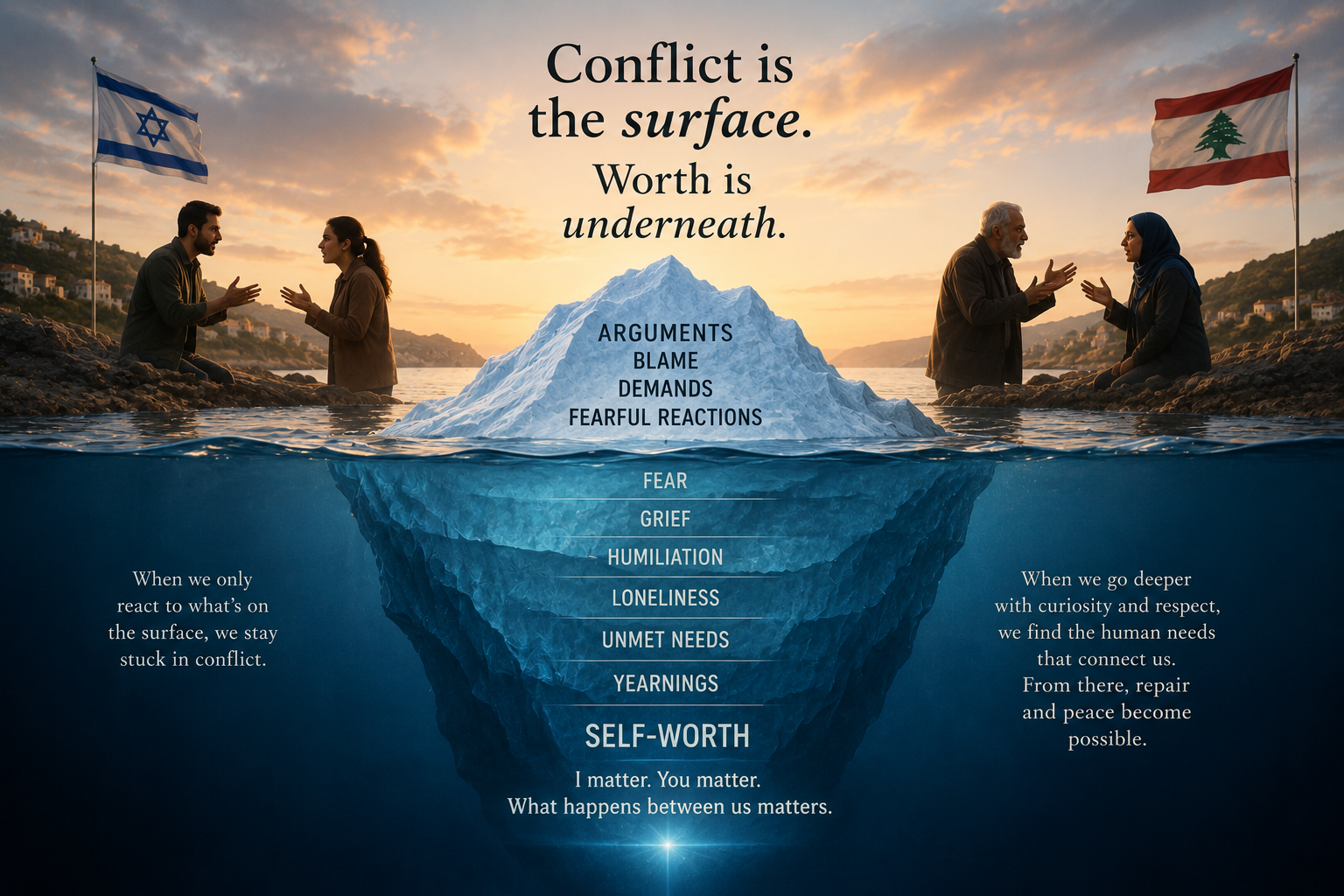
In a marriage under strain, the content of the argument is rarely the deepest issue.
Couples may fight about dishes, money, in-laws, sex, silence, or who forgot to pick up the children.
Underneath, the questions are often more basic:
Do I matter to you?
Can I trust you not to humiliate me?
Will you still see me when I am afraid?
Do I have to disappear for you to feel safe?
Societies in conflict are not so different. Israelis and Lebanese argue about borders, rockets, refugees, sovereignty, occupation, militias, security, and the legitimacy of force. These are real issues. They must not be sentimentalized away.
But beneath them live human questions:
Do our lives matter as much as theirs?
Can we trust you not to humiliate us again?
Will anyone stand with us when we are afraid?
And beneath even these:
Can your people exist without erasing mine?
That question does not sit alongside the others. It underlies them. Until communities can begin to answer it — not only in treaties, but in daily choices about whose humanity they are willing to hold — the other questions cannot be fully reached.
A framework can address borders and forces.
It cannot, by itself, answer the deeper human question.
That work belongs to people.
Self-worth is the foundation of healthy human interaction. It is learned early, in specific moments: whether a parent stayed in the room when you were frightened, whether your pain was taken seriously or waved away, whether the adults around you could say “I was wrong” without the sky falling.
Children who grow up in homes where worth is modeled — where feelings are named, repair is possible, and love does not depend on performance — carry something into public life that cannot be legislated or negotiated. They carry the interior knowledge that they do not need another person’s diminishment to remain intact.
Communities learn the same lesson, or fail to.
A community grounded in worth can acknowledge another community’s suffering without surrendering its own. It can hear “we were also harmed” without experiencing that acknowledgment as erasure. It can mourn its own losses without requiring that the other side’s losses be proven lesser.
A community that has confused worth with pride cannot do these things. Pride is comparative and fragile; it requires someone beneath it. Worth is steadier. It does not need another group’s humiliation to remain standing.
This distinction matters enormously in a conflict where the temptation on both sides is to prove that our suffering is greater, our grievance more legitimate, our need for security more urgent.
That competition does not resolve conflict.
It organizes it into permanence.
A community that has organized itself primarily around its wounds will experience every gesture toward repair as a threat to its identity. Acknowledgment of the other’s pain feels like betrayal. Movement toward compromise feels like annihilation.
This is not always manipulation or bad faith. Often, it is what happens when the experience of being unrecognized runs deep enough and long enough that the wound becomes the only reliable proof of worth.
Communities in this condition do not need to be argued out of their pain. They need to be witnessed in it — and then offered a different basis for standing.
That basis can be stated simply:
I matter.
You matter.
What happens between us matters.
These three statements are not a slogan. They are a sequence.
Knowing that I matter requires an interior security that does not depend entirely on your acknowledgment. Accepting that you matter requires enough of that same security to hold your humanity without feeling erased by it. Believing that what happens between us matters requires something harder still: the conviction that relationship is possible at all — that the distance between us is not the permanent truth, but a condition human choices can change.
Peace preparation must begin not only with trust-building, but with worth-building.
Without worth, nothing else holds.
From “You are the problem” to “Here is my pain”
One of the clearest signs of worth is congruent communication: speech that aligns inner experience with outward expression.
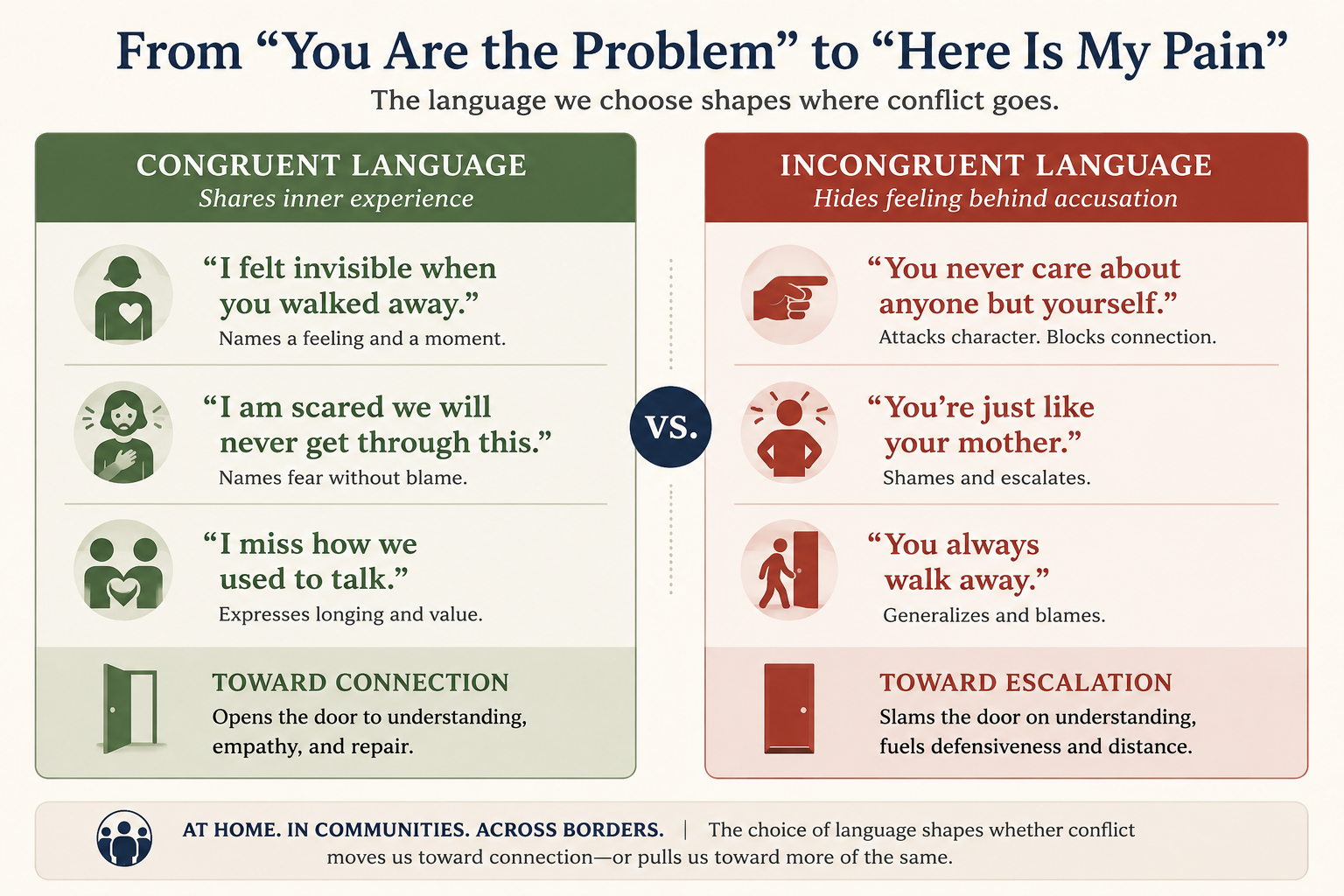
Congruent communication says:
“I am afraid.”
“I felt humiliated.”
“I do not yet know how to trust.”
“I want safety, and I do not want to become cruel.”
Incongruent communication hides those feelings behind accusation:
“You are evil.”
“You only understand force.”
“You always lie.”
“Your suffering is nothing compared to ours.”
Both kinds of speech carry real feeling.
The difference is where the feeling goes.
Congruent speech opens a door.
Incongruent speech arms the room.
In societies under strain, this distinction matters enormously. An emotionally congruent political culture would make room for Israelis to say, “We are still terrified by rockets, tunnels, kidnappings, and abandonment.”
It would make room for Lebanese to say, “We carry humiliation, displacement, bombardment, occupation, state collapse, and the suffocating power of armed factions speaking in our name.”
It would allow both to say:
“We do not yet know whether we can trust one another, but we are willing to test whether something different is possible.”
That is not weakness.
That is congruence.
A grievance-driven culture reaches instead for certainty: “You are the enemy.” “Your children must suffer.” “Our pain entitles us to whatever we decide to do.”
No ceasefire framework will survive for long if public conversation is dominated by that second kind of sentence.
Peace preparation means creating spaces where people can say, “Here is my pain,” without being told that their pain cancels another’s.
Listening is not agreement. It is contact.
In couples’ work, one of the simplest and hardest exercises is structured listening.
One person speaks in the first person about an experience or feeling. The other does not debate, correct, defend, or explain. The listener reflects back what was heard and asks:
“Did I get that right?”
On paper, this sounds trivial.
In practice, it is a discipline.
It asks people to slow down the impulse to rebut. It asks them to treat another person’s experience as real, even when it is uncomfortable. It asks them to understand that listening is not surrender.
Listening does not mean agreeing.
Listening means making contact.
A ceasefire framework may create formal structures for military coordination and verification. What it does not automatically create are structures for civic contact between the people who must live under it.
If the only amplified voices are those who describe compromise as surrender, restraint as betrayal, or the other side’s pain as propaganda, the emotional ground beneath the agreement will erode quickly.
Structured listening — in schools, clergy networks, professional forums, local civic initiatives, trauma-informed journalism, and carefully designed dialogue circles — is not a sentimental luxury.
It is emotional infrastructure.
It does not replace observation posts or security arrangements.
It helps prevent every incident from becoming proof that peace was foolish from the start.
The full jug
One useful image is the emotional jug: the inner container where unspoken feelings accumulate until they spill over.
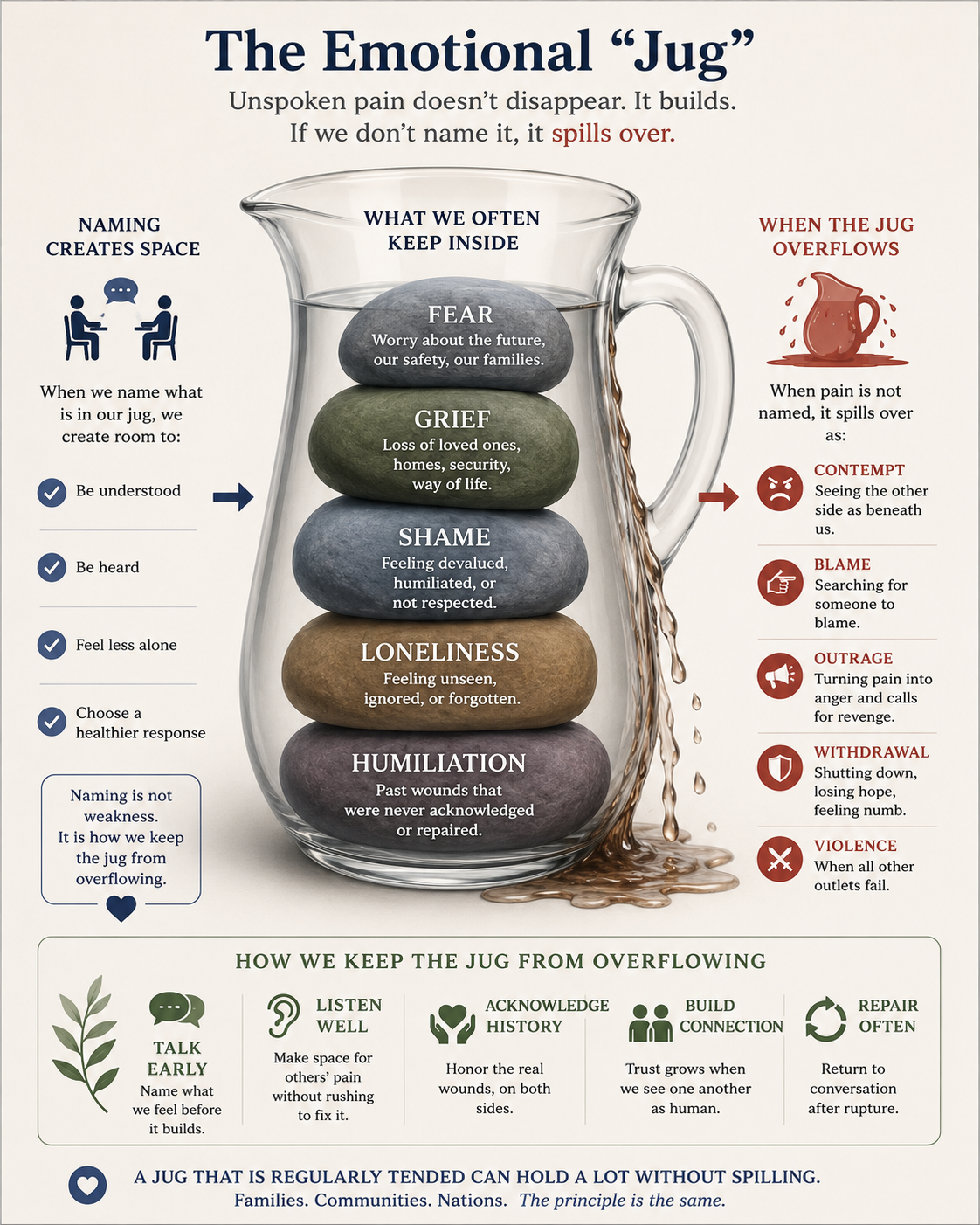
What fills the jug?
Fear.
Grief.
Shame.
Loneliness.
Humiliation.
Helplessness.
When these feelings are not named, they do not disappear. They spill over as contempt, blame, withdrawal, numbness, and violence.
The communities along the Israel–Lebanon border have jugs that are already full.
Israeli families in the north carry years of sirens, shelters, funerals, evacuations, uncertainty, and the feeling that their suffering has too often been background noise to the rest of the country.
Lebanese families in the south carry memories of occupation, bombardment, displacement, state neglect, and the suffocating presence of militias that claimed to defend them while pulling their villages into war.
A new framework may move soldiers, strengthen institutions, and reduce the power of armed groups outside the state. It cannot automatically empty these jugs.
The question is: where will people pour what they carry?
If all the pressure is routed through talk shows, party platforms, rumors, and social media, the overflow will appear as moral certainty, dehumanizing slogans, and permanent accusation.
If communities create spaces for grief, lament, witness, and repair — local memorials, joint vigils, school programs, clergy initiatives, trauma-informed journalism — they are doing something essential.
They are acknowledging what is in the jug before it explodes.
Naming pain is not weakness.
It is how the jug becomes able to hold more without spilling.
From survival stances to civic congruence
Under stress, people often fall into survival stances.
They blame.
They placate.
They become coldly super-reasonable.
They distract.
These patterns begin as protection. Over time, they become prisons.
Societies have survival stances, too.
Blaming says: “Everything is your fault.”
Placating says: “We will pretend nothing is wrong to avoid conflict.”
Super-reasonable speech says: “Only facts matter; grief is irrelevant.”
Distraction says: “Look anywhere except at what hurts.”
A congruent society does something harder. It tells the truth at several levels at once.
It can say:
“We need security.”
“We need dignity.”
“We have caused harm.”
“We have been harmed.”
“We are afraid.”
“We still have choices.”
This is not moral equivalence. It is emotional honesty.
Congruence does not flatten responsibility.
It makes responsibility possible.
Practices that translate
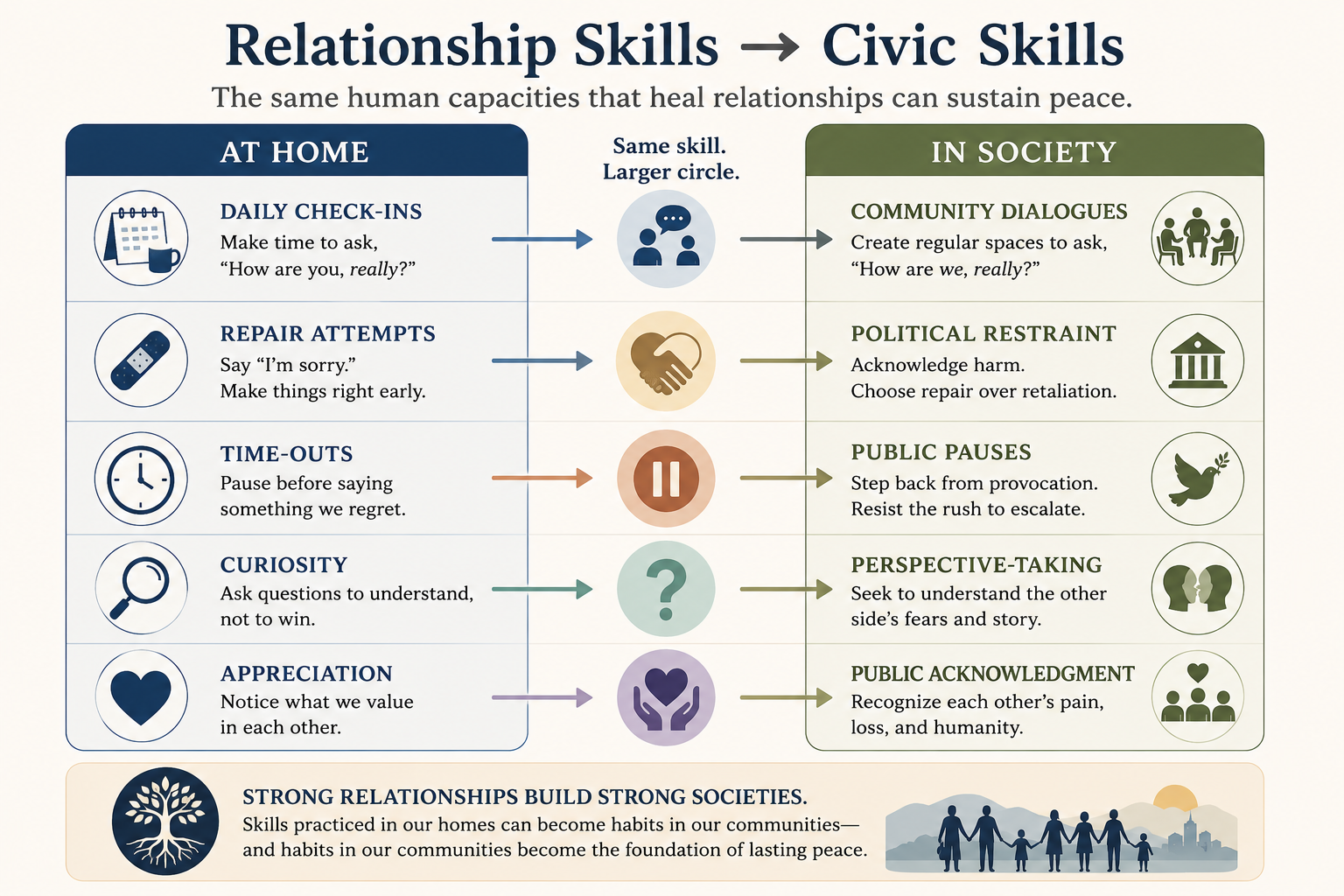
In relationship programs, people often ask: “What do we actually do when we go home?”
The answer is never one technique. It is a set of repeatable practices that build emotional muscle over time.
Daily check-ins help people name what they are carrying before it accumulates.
Time-outs allow people to pause conflict with a commitment to return.
Repair attempts interrupt the slide toward contempt.
Curiosity keeps conversation from hardening into verdict.
Appreciation reminds people that the relationship is more than the current conflict.
Each has a civic equivalent.
Municipalities, schools, synagogues, churches, mosques, journalists, and civil society groups can create regular spaces where people name hopes and fears before pressure builds.
Political leaders can practice public time-outs: pausing before declaring every incident proof that the entire framework has failed.
Journalists can ask at least one sincere question about how events look from the other side before settling into accusation.
Educators can teach children that conflict is not failure. Conflict is what happens when different realities meet.
When mistakes occur — a stray shell, a coordination failure, a political provocation, a rumor that spreads faster than truth — rapid acknowledgment and concrete repair can send a powerful message:
The relationship matters more than the temptation to score points.
These practices will not, by themselves, dismantle Hezbollah, rebuild Lebanon’s economy, resolve Israel’s security concerns, or answer every question of justice and sovereignty.
But they can change the emotional climate in which those larger tasks are attempted.
And emotional climate is not a soft variable.
It determines whether hard decisions are made in a spirit of problem-solving or punishment.
Home as the training ground
There is a temptation to treat families and politics as separate worlds.
They are not.
Families are where human beings first learn whether feelings may be named, whether conflict can be repaired, whether difference is dangerous, whether apology is humiliation, whether love survives truth.
Children who grow up in homes where people can say “I was wrong,” “I am scared,” “I need help,” and “Let us try again” enter public life with different instincts than children who grow up where silence, intimidation, contempt, or emotional exile rule.
The patterns learned at the kitchen table travel into the classroom, the army unit, the office, the newsroom, the town hall, and the parliament.
This does not mean families are to blame for war.
It means families are one of the places where peace becomes thinkable.
As Israelis and Lebanese adjust to the possibility that armies may pull back rather than advance, and that the border may become less a front line than a shared horizon, there is a rare opportunity to teach different instincts.
Adults who practice congruence, listening, repair, and self-worth in their closest relationships carry those capacities into every civic space they inhabit.
A society that invests in relational capacity is not only improving marriages.
It is forming citizens who can live under fragile peace without destroying it at the first rupture.
What peace preparation is — and is not
Peace preparation is not a substitute for justice, security, political courage, or structural repair.
No amount of listening can replace the need to stop rockets, prevent terror, dismantle militias, protect vulnerable communities, restore sovereignty, rebuild institutions, and tell the truth about harm.
Relationship practices do not dissolve power imbalances.
They do not erase history.
They do not make dangerous actors harmless.
Anyone who suggests otherwise offers comfort the situation does not permit.
What they can do is change the human grammar in which necessary debates take place.
They can make it harder to demonize entire communities.
They can make it easier to admit fear without converting it into hate.
They can make acknowledging harm a sign of strength rather than surrender.
Relationship capacity cannot remove irreconcilable interests. But it can change how societies respond when those interests collide.
It can help people ask, in the first moments of crisis:
What happened?
What is needed?
What must be repaired?
What must be protected?
Who is missing from the conversation?
The framework will not be tested only at checkpoints and in security annexes.
It will be tested in living rooms, classrooms, congregations, newsrooms, and group chats.
It will be tested in whether people reach first for humiliation or for repair.
A modest and radical invitation
The framework is an achievement if it reduces violence, protects civilians, strengthens legitimate institutions, and opens space for a different future. It reflects the recognition that the status quo has been unbearable for Israelis and Lebanese alike.
But a ceasefire is an invitation, not a conclusion.
The invitation now is to treat every home, classroom, congregation, workplace, and civic institution as a small laboratory for what any agreement requires emotionally.
Not as a replacement for political work, but as the human substrate beneath it.
Every time someone says, “I am afraid,” instead of “You are the enemy,” peace preparation has taken a step.
Every time someone listens without surrendering judgment, the emotional infrastructure shifts.
Every time a leader admits uncertainty without inflaming panic, the public learns a new possibility.
Every time children see adults repair after rupture, they learn that conflict does not have to end in exile.
No one can promise this framework will hold.
What communities can promise is that they will not make its failure more likely by defaulting to the emotional habits that have already cost both sides so much.
Peaceful societies are not societies without grief, anger, memory, or conflict.
They are societies that have learned, in countless small interactions, how to stay human while telling the truth about pain.
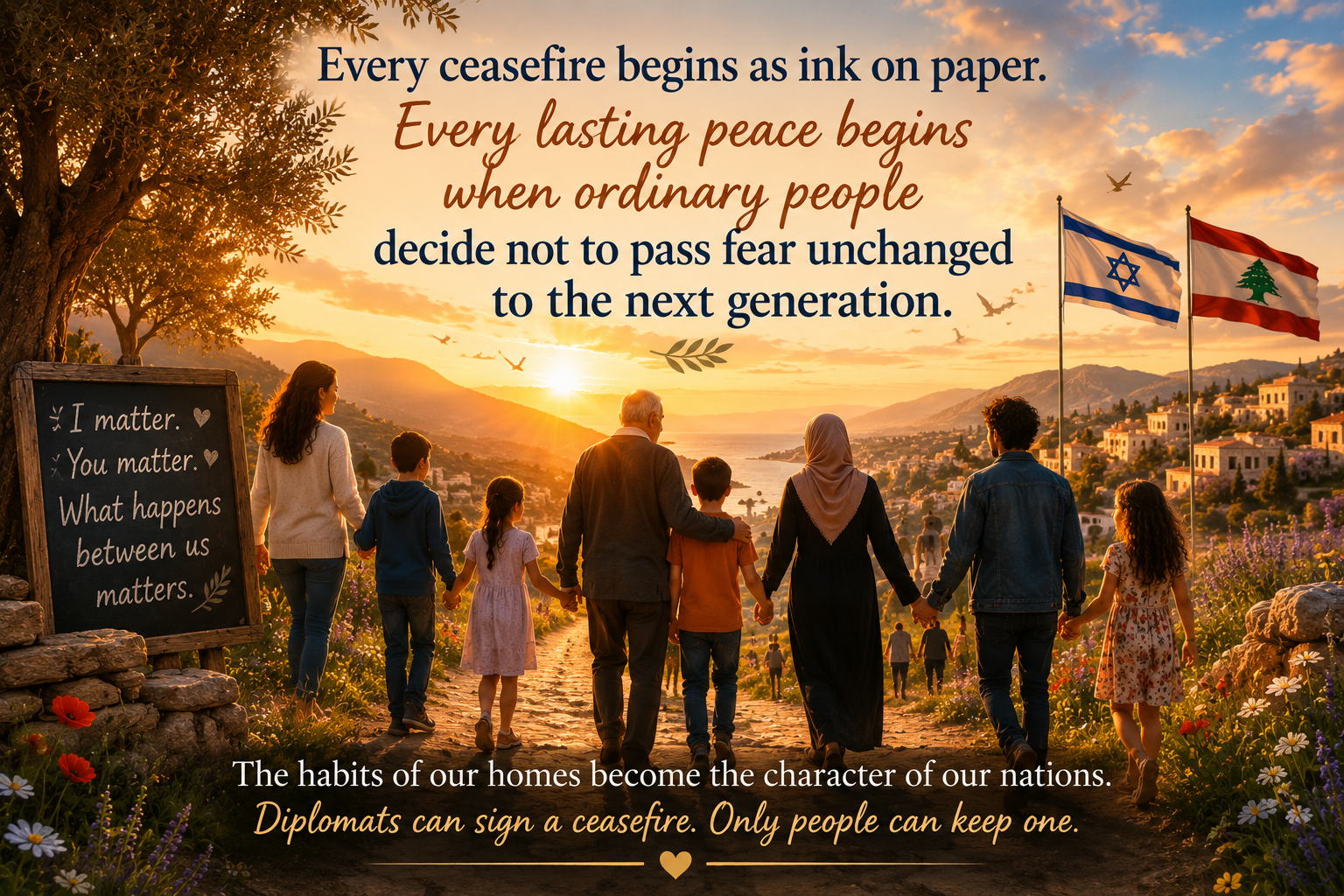
Every ceasefire begins as ink on paper.
Every lasting peace begins when ordinary people decide not to pass fear unchanged to the next generation.
That is how the habits of homes become the character of nations.
Diplomats can sign a ceasefire.
Only people can keep one.
A Note on Virginia Satir
Many of the ideas in this essay are drawn from the pioneering work of Virginia Satir (1916–1988), one of the founders of modern family therapy and among the twentieth century’s most influential teachers of human communication, self-worth, and relationship development.
Satir served as the Honorary Founding Chair of PAIRS Foundation, where her work profoundly influenced the organization’s approach to emotional literacy and relationship skills. She was also the most important mentor of Lori Heyman Gordon, Ph.D., founder of PAIRS Foundation, whose decades of work translating relationship science into practical education were deeply shaped by Satir’s vision.
Concepts throughout this essay — including self-worth, congruent communication, repair after conflict, and the understanding that the emotional habits learned in families become the character of communities — are rooted in Satir’s teachings and their continued development through the PAIRS tradition.
Readers interested in learning more about Virginia Satir’s life, work, and enduring global influence can visit the Virginia Satir Global Network.
© 2026 The Times of Israel, all rights reserved
Leave a Reply