This article cuts through the 90,000 options to the seven models worth your time in 2026. 
A quick search on Hugging Face returns over 90,000 text-to-image models alone. That number is useful context, not a shopping list. Most people who want a free AI image generator end up on Midjourney or DALL-E without realizing that Hugging Face hosts the actual models powering those tools — the same architectures, sometimes the same weights — available free through browser-based Spaces demos or available to download and run locally.
This article cuts through the 90,000 options to the seven models worth your time in 2026. The selection criteria: output quality that competes with paid tools, genuinely free access (browser or download), active maintenance, and real-world usefulness across different skill levels. For each model, you get the Hugging Face link, the license and what it actually permits, what the model is distinctly good at, and honest trade-offs.
The first thing to understand about Hugging Face is that there are two distinct ways to use it, and they suit different people.
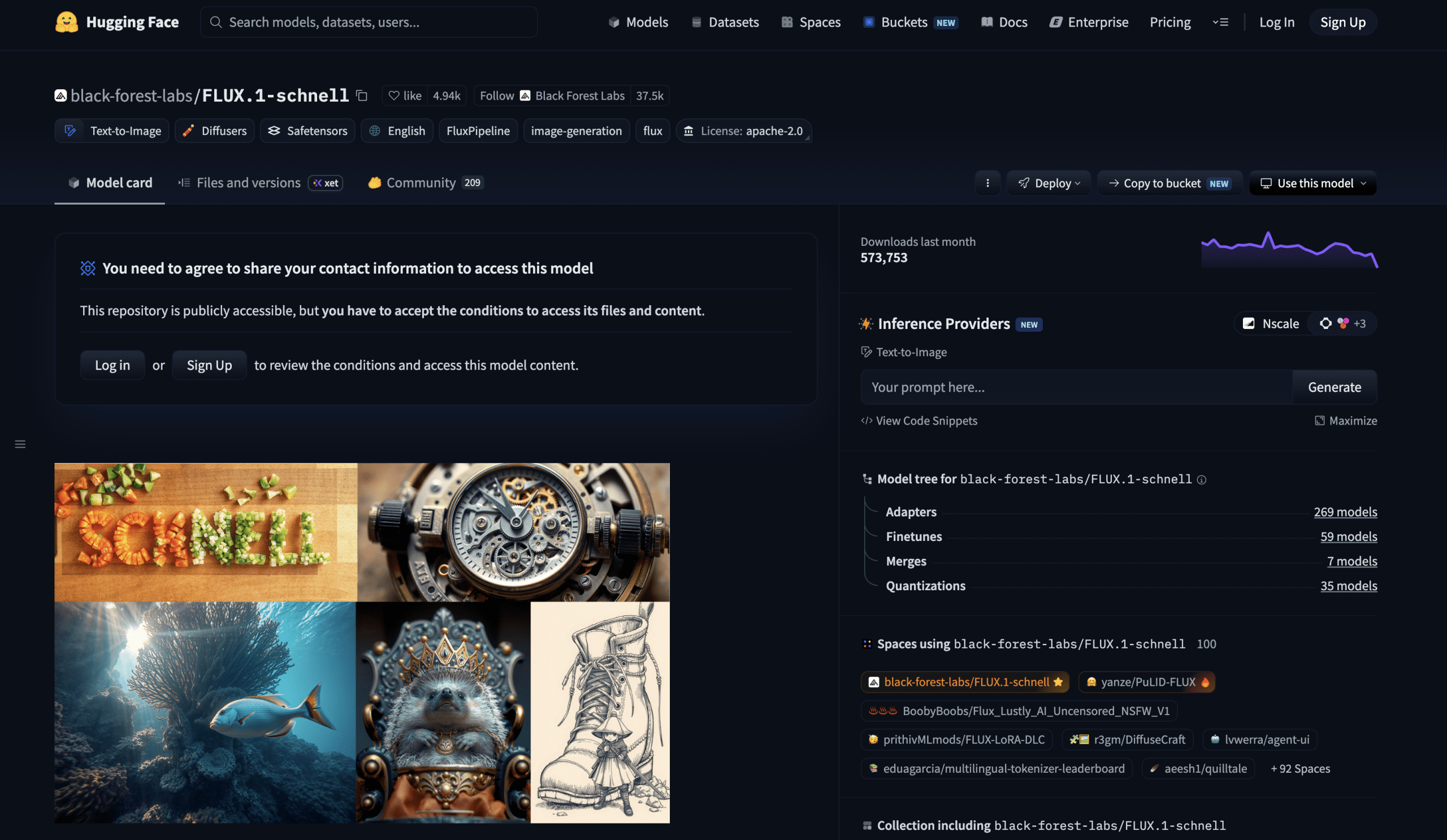
FLUX.1 Schnell Dashboard
FLUX.1 Schnell is released under the Apache 2.0 license, which means it can be used for personal, scientific, and commercial purposes. That single fact separates it from every other flagship-quality model on this list. Apache 2.0 is as permissive as open-source licensing gets — you can build a product, ship it commercially, integrate it into a pipeline, and do it all without licensing negotiations or usage fees.
Schnell was trained using guidance distillation to generate in 1–4 inference steps rather than the 20–50 that traditional diffusion models require. The quality-per-step is exceptional. It is not the highest-quality model Black Forest Labs makes — that is FLUX.1 Dev or FLUX.2 — but it produces output that beats most models from a year ago, at a generation speed that is genuinely fast even on consumer hardware.
What it is not ideal for: scenes that require the absolute maximum photorealistic detail, where no other constraint matters. For those, FLUX.1 Dev delivers a higher ceiling but without the Apache 2.0 commercial freedom.

FLUX.1 Dev Dashboard | Image by Author
FLUX.1 Dev is a 12 billion parameter rectified flow transformer. Distilled directly from FLUX.1 Pro, it achieves similar quality and prompt adherence while being more efficient than a standard model of the same size. For non-commercial use, it is the highest-quality freely available model on the platform right now.
The photorealism in portrait and product photography prompts is categorically superior to what other free tools produce. Portrait consistency, fine fabric texture, architectural detail, and text-in-image rendering are all noticeably better than the generation-earlier models it has replaced as the community benchmark.
License clarity is important here. The model weights themselves are for non-commercial use — you cannot take the model and build a paid product on top of it without contacting Black Forest Labs. But the images you generate with FLUX.1 Dev can be used for personal, scientific, and commercial purposes as described in the license. The distinction matters: using the model to generate images for your own commercial work is generally permitted. Using the model itself as the engine of a commercial product or API is a separate conversation with Black Forest Labs.
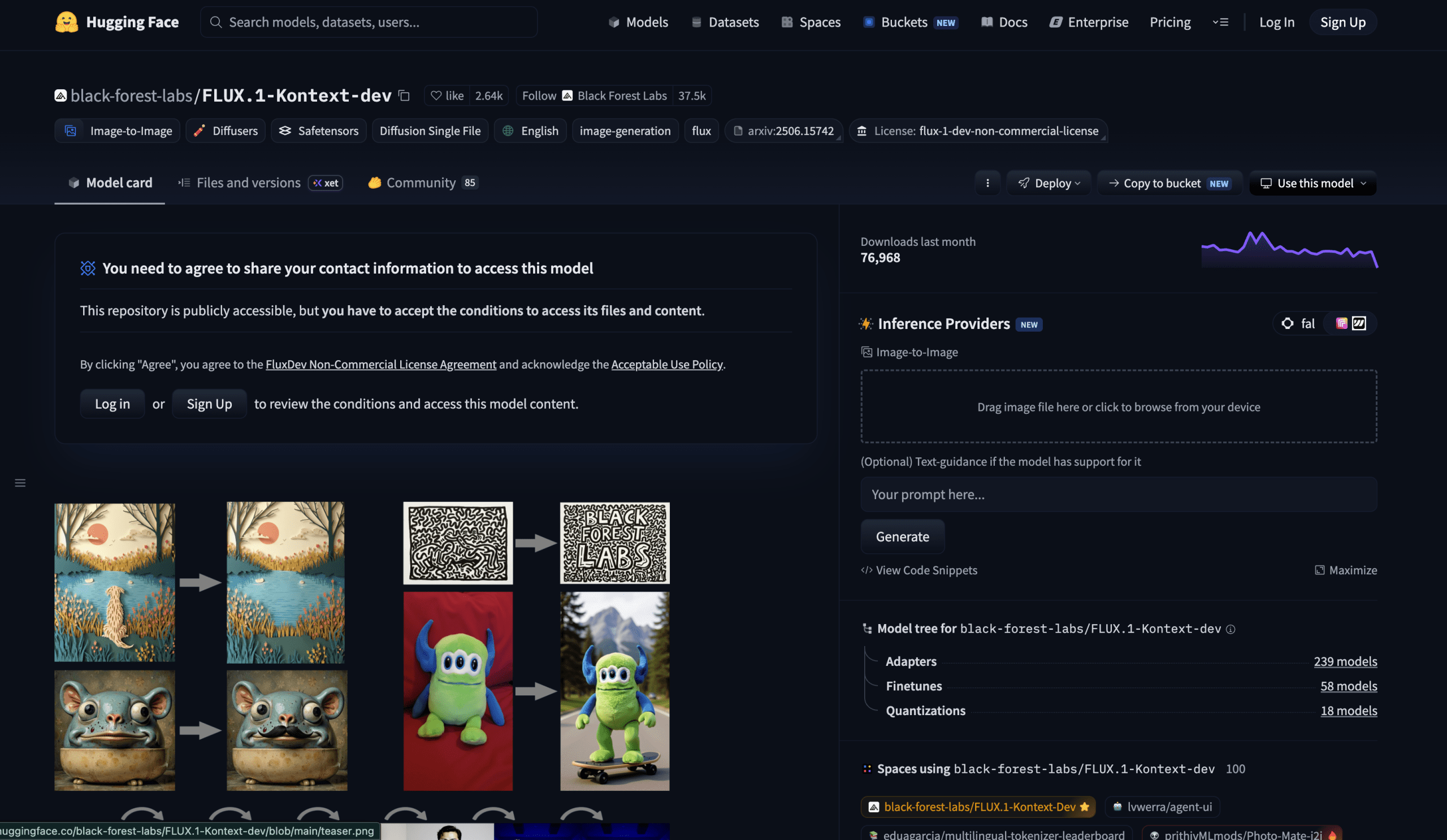
FLUX.1 Kontext Dev Dashboard | Image by Author
Every other model on this list takes a text prompt and generates from scratch. FLUX.1 Kontext Dev takes an existing image and changes it based on a text instruction.
FLUX.1 Kontext Dev is capable of editing images based on text instructions, supporting character, style, and object reference without any fine-tuning. Robust consistency allows users to refine an image through multiple successive edits with minimal visual drift. That last point is the technically hard part. Most image editing models drift — make three consecutive edits, and the character looks like a different person by the third iteration. Kontext maintains identity across successive edits with a stability that was not possible in open-source models before this architecture.
The practical workflow this unlocks: generate a character, product, or scene once, then iterate — “add sunglasses,” “change the background to a mountain at sunset,” “make the jacket red,” “add motion blur” — and the core visual identity stays intact throughout. For product photography, character design, and any workflow involving iteration, this is a qualitative shift in what free open-source tools can do.
The Space demo is straightforward: upload an image, type an instruction, adjust guidance strength and seed. The interface at huggingface.co/spaces/black-forest-labs/FLUX.1-Kontext-Dev also supports image-to-image generation without a source image for pure text-to-image use.

Stable Diffusion 3.5 Large Dashboard | Image by Author
Stable Diffusion 3.5 is available under a permissive community license, is customizable, runs on consumer hardware, and comes with full inference code on GitHub. But the license and the download numbers are not the main reason it is on this list.
The reason SD 3.5 matters is what exists around it. Thousands of fine-tuned models on Hugging Face, hundreds of LoRAs trained on specific styles and subjects, ControlNet variants for guided generation (canny edges, depth maps, pose control), and a tooling ecosystem — AUTOMATIC1111, ComfyUI, and Forge — that has been built and refined over years. No other model architecture has that depth of community infrastructure yet.
SD 3.5 Medium is also worth noting: the smaller variant fits more comfortably on 8–10 GB VRAM and generates faster, trading peak quality for accessibility. Both are free. For anyone who wants to fine-tune a model on their own data, build custom ControlNet workflows, or access the widest library of community art styles, Stable Diffusion 3.5 is the architecture to use.
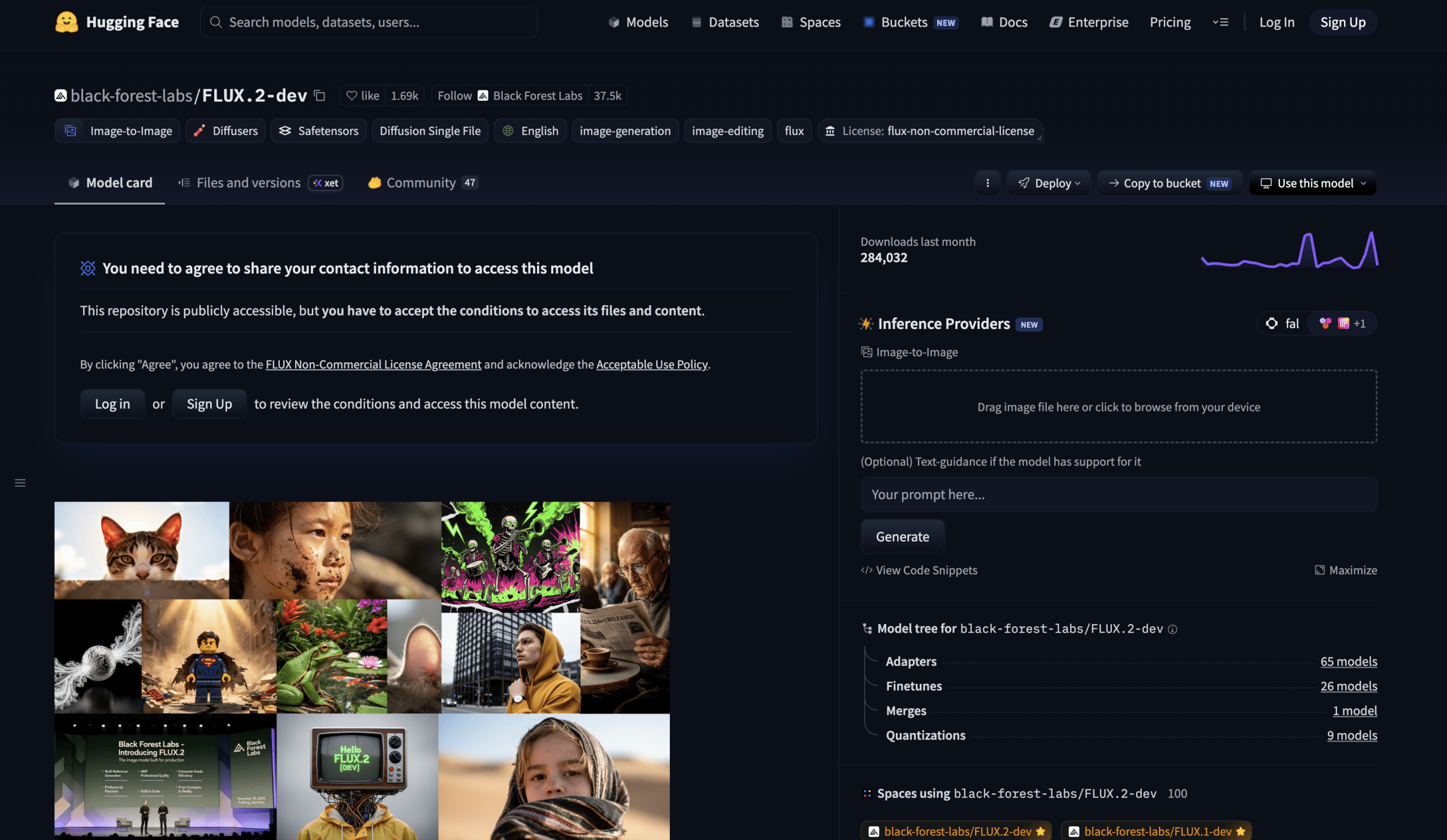
FLUX.2 Dev Dashboard | Image by Author
Released in November 2025 by Black Forest Labs, FLUX.2 marks a major leap from experimental image generation toward true production-grade visual creation. The 2026 iteration supports native 4-megapixel resolution and introduces a significantly improved diffusion transformer (DiT) backbone. A standout feature is built-in multi-reference support — the ability to reference multiple input images simultaneously during generation.
The hardware requirement is the honest caveat here. The full FLUX.2 Dev model requires considerable VRAM — an H100-class GPU for the 32B variant. Black Forest Labs has partnered with Hugging Face to make quantized versions that run on consumer hardware, including configurations for an RTX 4090 with a remote text encoder. The 4B variants with Apache 2.0 licensing are the realistic entry point for most developers without datacenter hardware.

Playground v2.5 Dashboard | Image by Author
FLUX models win on photorealism and prompt adherence. Playground v2.5 wins on something different — outputs that look artistically intentional rather than technically generated.
It was specifically trained for aesthetic quality: human figures rendered with natural proportions, compositions that follow visual design principles, and color grading that reads as deliberate rather than arbitrary. If you are generating reference images for creative projects, mood boards, character art, or anything where “looks beautiful” is the primary criterion, Playground v2.5 consistently produces results that are harder to distinguish from intentional design work than from a prompted generation.
The community license permits commercial use under specific terms — read the full license on the model card before shipping. The model runs on SDXL infrastructure, which means it is compatible with the broad ecosystem of SDXL fine-tunes and tools.

Kolors | Image by Author
Kolors is a large-scale text-to-image generation model trained on billions of text-image pairs. It exhibits significant advantages in visual quality, complex semantic accuracy, and text rendering for both Chinese and English characters. It is built upon the General Language Model (GLM), which enhances comprehension of both languages.
The GLM backbone is what makes it different. Most Western open-source models use T5 or CLIP as their text encoder — architectures that were not designed with deep Chinese language understanding. Kolors was built with native Chinese-English bilingual capability from the ground up, which produces meaningfully better results when prompting in Chinese or generating content that involves Chinese text, cultural context, or mixed-language scenes.
The text-rendering capability is also notably strong. Generating readable text inside images is a longstanding weakness of diffusion models. The Apache 2.0 license means zero restrictions for commercial use. If your product or content involves Chinese-English audiences, this is the model that actually handles your use case well.
The choice is not about which model is “best” — it is about which one fits your specific situation.
If you need Apache 2.0 commercial freedom and fast generation, FLUX.1 Schnell is the obvious answer. It is the only flagship-tier model with fully unrestricted commercial rights.
If quality ceiling is the only variable and you are doing personal or research work, FLUX.1 Dev produces the best output per prompt in the non-commercial space. The Space demo will show you immediately whether its quality level is worth the non-commercial license terms for your use case.
If your workflow involves editing and iterating on existing images rather than generating from scratch, FLUX.1 Kontext Dev is the model that makes that workflow viable without fine-tuning.
If you want the deepest ecosystem — fine-tunes, LoRAs, ControlNets, compatible tooling — Stable Diffusion 3.5 is what you build on. Raw model quality has moved past it at the frontier, but nothing else has the community infrastructure it does.
If your content involves Chinese-English bilingual audiences or requires readable text rendered inside the generated image, Kolors — with its Apache 2.0 license — is the purpose-built answer that most English-centric articles on this topic simply miss.
Hugging Face has become the de facto home for serious open-source image generation. The 90,000+ model count sounds overwhelming, but the models that actually matter in 2026 fit on a short list, and all of them are free. The FLUX family from Black Forest Labs now covers the full spectrum — from fully commercial Apache 2.0 generation (Schnell) to non-commercial quality ceiling (Dev) to instruction-based editing (Kontext). Stable Diffusion 3.5 anchors the community ecosystem that has been building for three years. Kolors fills the multilingual gap that Western-centric models leave open.
All seven models have Spaces you can use in a browser right now with no setup. Start with the Space URL for each model before committing to local setup. You will know within five prompts whether a model’s output style fits what you are building.
Shittu Olumide is a software engineer and technical writer passionate about leveraging cutting-edge technologies to craft compelling narratives, with a keen eye for detail and a knack for simplifying complex concepts. You can also find Shittu on Twitter.
Get the FREE ebook ‘KDnuggets Artificial Intelligence Pocket Dictionary’ along with the leading newsletter on Data Science, Machine Learning, AI & Analytics straight to your inbox.
By subscribing you accept KDnuggets Privacy Policy
Get the FREE ebook ‘KDnuggets Artificial Intelligence Pocket Dictionary’ along with the leading newsletter on Data Science, Machine Learning, AI & Analytics straight to your inbox.
By subscribing you accept KDnuggets Privacy Policy
Get the FREE ebook ‘KDnuggets Artificial Intelligence Pocket Dictionary’ along with the leading newsletter on Data Science, Machine Learning, AI & Analytics straight to your inbox.
By subscribing you accept KDnuggets Privacy Policy
Leave a Reply