Opinion
As part of a collaboration between The Fulcrum's NextGen initiative and Made By Us, The Fulcrum is publishing Letters to America, a series created through the Youth250 project that invites Gen Z to reflect on the nation’s past, present, and future as the United States approaches its 250th anniversary.
America is built on values. Its first official texts announce the importance of life, liberty, and the pursuit of happiness. Those three things might have slightly different meanings to individual people. But our understanding of life, liberty, and the pursuit of happiness isn’t so different that we miss the larger picture.
Most of us can agree what these three things aren’t: selling American lives for oil, allowing government officials to invade private spaces to selectively enforce immigration rules, or forcing women to have risky C-sections.
My parents are immigrants, and came to the U.S. as adults. They made the choice, willingly and joyfully, to pledge allegiance to this country. Nowhere is perfect, but my parents were happy that here, they had free access for their daughters to decent schools, economic opportunities, and free speech. My sisters and I were all born in the same hospital and raised in the same small city, and all we know is America. It is our country: my sister works for the government, my dad served his community in healthcare for over thirty years, and I am studying to become a lawyer. Any talk of going “home” goes nowhere, because this is our home. Immigrants are the backbone of this country, and they make America special.
But some of our policies and actions, right now, make it easy to forget the bold, unified, and free vision that compelled the original Americans to accept the Constitution and its promises.
For America’s 250th birthday, I picture a recommitment to what the founders sought in the revolution and wrote in our founding texts, even when they couldn’t always live up to it. No kings; dignity and respect for individuals; economic flourishing for all, not just aristocrats.
I spend a lot of my time telling my friends and family that two things can be simultaneously true: that life and this country are much better than they were 100 years ago, and that we could still be doing much better. People are physically healthier, live longer, live in less pain, have more free time, and have more rights than before. At the same time, America is the richest country in the world, and its people, my friends and family, often feel left behind. It’s sometimes hard to feel lucky when government officials intimidate, tear gas, assault, or even kill people for doing the first thing this country promised them: the right to free speech and assembly.
No one believes in the American dream like the people who chose to be here, and the young people like me who want to see this country flourish into my old age feel the stakes in trying to keep this country great and make it better. I don’t want to repeat the generational pattern: my grandparents fled Palestine, and my parents fled Kuwait. I want my daughter to grow up in a free country that fully embodies its promises, to give her the rights to life, liberty, and the pursuit of happiness.
I choose this country, and I hope that together, we all choose it too.
Sara Abdulla, 29, Chicago, IL
As part of a collaboration between The Fulcrum's NextGen initiative and Made By Us, The Fulcrum is publishing Letters to America, a series created through the Youth250 project that invites Gen Z to reflect on the nation’s past, present, and future as the United States approaches its 250th anniversary.
America is built on values. Its first official texts announce the importance of life, liberty, and the pursuit of happiness. Those three things might have slightly different meanings to individual people. But our understanding of life, liberty, and the pursuit of happiness isn’t so different that we miss the larger picture.
Most of us can agree what these three things aren’t: selling American lives for oil, allowing government officials to invade private spaces to selectively enforce immigration rules, or forcing women to have risky C-sections.
My parents are immigrants, and came to the U.S. as adults. They made the choice, willingly and joyfully, to pledge allegiance to this country. Nowhere is perfect, but my parents were happy that here, they had free access for their daughters to decent schools, economic opportunities, and free speech. My sisters and I were all born in the same hospital and raised in the same small city, and all we know is America. It is our country: my sister works for the government, my dad served his community in healthcare for over thirty years, and I am studying to become a lawyer. Any talk of going “home” goes nowhere, because this is our home. Immigrants are the backbone of this country, and they make America special.
But some of our policies and actions, right now, make it easy to forget the bold, unified, and free vision that compelled the original Americans to accept the Constitution and its promises.
For America’s 250th birthday, I picture a recommitment to what the founders sought in the revolution and wrote in our founding texts, even when they couldn’t always live up to it. No kings; dignity and respect for individuals; economic flourishing for all, not just aristocrats.
I spend a lot of my time telling my friends and family that two things can be simultaneously true: that life and this country are much better than they were 100 years ago, and that we could still be doing much better. People are physically healthier, live longer, live in less pain, have more free time, and have more rights than before. At the same time, America is the richest country in the world, and its people, my friends and family, often feel left behind. It’s sometimes hard to feel lucky when government officials intimidate, tear gas, assault, or even kill people for doing the first thing this country promised them: the right to free speech and assembly.
No one believes in the American dream like the people who chose to be here, and the young people like me who want to see this country flourish into my old age feel the stakes in trying to keep this country great and make it better. I don’t want to repeat the generational pattern: my grandparents fled Palestine, and my parents fled Kuwait. I want my daughter to grow up in a free country that fully embodies its promises, to give her the rights to life, liberty, and the pursuit of happiness.
I choose this country, and I hope that together, we all choose it too.
Sara Abdulla, 29, Chicago, IL
Lexa Hunter
When I first became an Engaged Athlete Fellow through TheTeam, I thought civic engagement was simply about interacting with one’s community and giving back. Over the course of a year-long project built through planning, leadership, and community connection, however, I learned that true engagement is about creating spaces where people feel seen, supported, and empowered to grow together. Civic engagement goes beyond your actions and emphasizes the impact you can create.
From the beginning, I understood that completing a successful civic engagement project was the desired outcome of my time as a fellow. Between the first day I began drafting my plans and now, reflecting on all that I’ve been able to accomplish, I realized I gained so much more. The Team helped me recognize the opportunity not only to uplift my community but also to create real, intentional change. Even further, with the support of this organization, the path was paved to establish lasting change — the kind that seeps into the hearts of others and inspires them to do the same for years to come.
I believe this passion for impact resonates deeply with my character because of the life I’ve been blessed to live, especially thanks to my parents. They made it their mission to ensure that my younger brother and I had every opportunity to live the lives we WANT to live, not HAVE to live. Throughout my years as a student, athlete, friend, and colleague, I have interacted with people from many different backgrounds. Those experiences allowed me to understand the importance of education, opportunity, equity, and access — and, even more importantly, the detrimental impact of not having access to those things.
Having the ability to use my platform to create meaningful impact beyond my sport, particularly by empowering youth and strengthening my community, is no easy feat — but choosing TheTeam as an outlet to do so was the easiest part. Their initiatives focus on developing teammates, inspiring leaders, and empowering citizens, making civic engagement joyful and accessible. Although this was only the third cohort of Engaged Athlete Fellows, the fellowship has already created meaningful success and connections among student-athletes nationwide.
What makes TheTeam unique is that it unites athletes around a shared mission while still allowing each teammate to personalize their approach and create something authentic to themselves. Throughout the year, I never felt alone. Their network, resources, and support-centered staff served as a constant safety net. My mentors and advisors were always one call or text away, and the program's structure ensured I was always moving in a positive direction. As a Division I athlete, balancing fellowships, internships, and leadership opportunities alongside athletics can often feel overwhelming. Under The Team, however, I never had to sacrifice one commitment at the expense of another. Their support is truly what carried me to the finish line with my year-long civic engagement project.
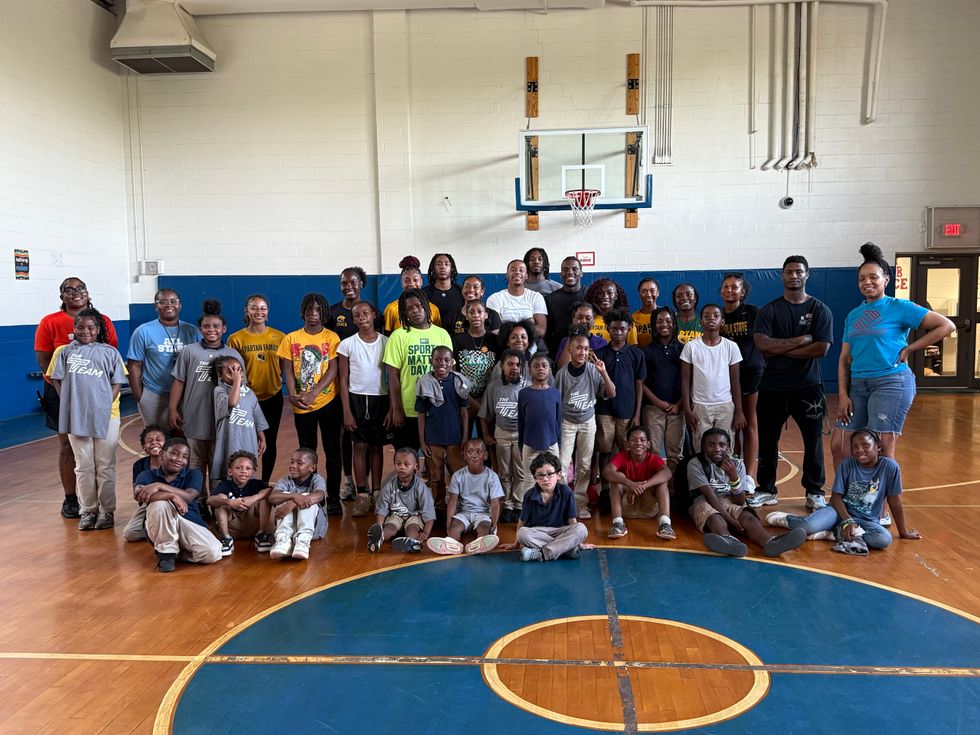
Over the course of the year, I planned and executed a civic engagement initiative centered around community empowerment, youth development, educational advocacy, and civic awareness. Through collaborative programs and outreach efforts, my project aimed to encourage meaningful engagement on campus and throughout the Norfolk community, emphasizing leadership, service, and access to resources.
One of the major highlights of the initiative was hosting an interactive “Spartans Vote” Game Zone during Norfolk State University’s Homecoming in partnership with the “All Vote No Play Day” campaign. This event promoted voter awareness and civic participation in an engaging and accessible environment for students and attendees. Civic awareness efforts also extended to social media advocacy, where members of my Track & Field team participated in Election Day awareness campaigns during local elections to encourage informed voting and community involvement.
Throughout the year, I also participated in and organized volunteer opportunities through the Robert C. Nusbaum Honors College and the Student-Athlete Advisory Board, reinforcing the importance of servant leadership and collective community impact. In addition, I coordinated a mentorship-focused event within the Honors College designed to foster guidance, connection, and support among students navigating academic and personal growth.
Financial literacy and educational empowerment also became central components of the project. Through a collaborative event involving the Honors College, the National Association of Black Accountants, and King In You organizations, students were provided with resources and opportunities for conversations centered on financial responsibility, professional development, and long-term success.
To conclude the fellowship experience, I collaborated with SAAC and various athletic teams to organize a Youth Literacy Sports Camp with the Boys & Girls Clubs of America at the Grandy Village location. This final initiative combined athletics, mentorship, and literacy engagement to foster a positive, encouraging environment for local youth. The camp reflected the overall mission of my project: using leadership, education, and community connections to inspire and uplift others.
Standing in front of each event I had spent months planning, watching people engage with something that once existed only as an idea in my notebook, I realized how much this fellowship had changed me. What began as a civic engagement project became a lesson in leadership, service, and the power of intentional community impact. Through this experience, I gained a deeper understanding of civic engagement as not only service but impact rooted in collaboration, accessibility, and genuine care for one’s community.
Now that I’ve had a glimpse of what it truly means to remove myself from complacency and act, I want to continue educating the youth in my community, particularly through literacy advocacy
and mentorship. I also hope to encourage athletes, both within and beyond my own circle, to find themselves in the vast realm of civic engagement and continue changing the world one win at a time. My aspiration to attend law school after receiving my Bachelor’s degree is rooted in my desire to address critical issues, including educational inequity, financial and political literacy, and the need for stronger support systems within underserved communities.
From the bottom of my heart, I want to thank everyone involved with TheTeam for giving me the opportunity not only to find myself, but to experience finding myself through this year-long journey of impact and influence.
Lexa Hunter is a business intelligence and data analytics honors scholar from Chesapeake, Virginia, whose passion for civic engagement is rooted in mentorship, education, and community empowerment. She is a Division I track and field athlete at Norfolk State University, using her platform to create meaningful impact beyond her sport.
The Team, a nonprofit that integrates civic engagement into college sports, describes its mission as developing “teammates, leaders, and citizens” through award‑winning programming that connects athletics with civic responsibility.
The Bridge Alliance, the sponsor of the Fulcrum, is a partner of The Team.
The 50: Florida
JACKSONVILLE, Florida — The St. Johns River is more than a body of water in Jacksonville — it’s a memory keeper. It carries the stories of shrimpers and shipbuilders, of families who grew up fishing from wooden docks, of neighborhoods shaped by tides and storms. It is the quiet force that binds the city’s past to its future. But the river is also a mirror. It reflects the inequities, pressures, and possibilities of the communities along its banks. And in Jacksonville, a growing coalition of residents and organizations is stepping forward to protect it — not just as an ecosystem, but as a shared civic inheritance.
– YouTube youtu.be
The river faces a familiar but urgent list of threats: polluted runoff, wetland loss, industrial expansion, and climate‑driven flooding. For decades, these challenges were treated as technical problems — issues for scientists, regulators, and agencies. But in Jacksonville’s neighborhoods, the river’s decline has never been abstract. Floodwaters rise into yards. Storm drains back up. Trash collects in creeks. Fish kills appear after summer storms. Residents see the river’s health in real time, and they feel its consequences. That lived experience is reshaping who leads the fight for the river.
"So to me, the river is home," said Soraya Aidinejad, the Ecological Science Director for St. Johns Riverkeeper. "There's like this peaceful aspect to being on the river or just seeing the river." When Aidinejad stands on the riverbank, she doesn’t think about data first — she draws from a lifelong connection to the Jacksonville community, reflecting on the profound personal significance of the local waterway: The fisherman who can’t cast where he used to. The grandmother whose street floods every king tide. The students who learn that their river is both beautiful and vulnerable. Riverkeeper’s work blends science with civic action: monitoring water quality, challenging harmful development, educating neighborhoods, and mobilizing volunteers. Their message is simple: the river belongs to everyone, and everyone has a role in protecting it.
Local Initiatives Support Corporation (LISC) is known nationally for housing and economic development, but in Jacksonville, its work increasingly intersects with environmental resilience. In neighborhoods along the Trout River and Ribault River, LISC helps residents secure funding for stormwater improvements, build green infrastructure, and lead their own planning processes. LISC’s approach reframes environmental protection as a justice issue. Flooding, pollution, and poor drainage don’t hit every neighborhood equally — and LISC helps communities organize to change that.
Kristopher Smith. LISC's Senior Community Development Program Officer explains how work brings him into constant conversation with residents whose ties to the Ribault and Trout River corridors stretch back generations. He sees the river not just as an environmental asset, but as a cultural one — a place where identity, memory, and resilience meet. "In the Ribault area, a neighborhood of historic African Americans and folks who have lived in legacy neighborhoods like Sherwood Forest, you've got Harborview, Lake Forest, and Ribault, and they have been living there over decades," Smith said. "These are places where folks have built homes, sent their kids to school, and had opportunities to build a relationship with the waterway. The waterway has been one for active community events, and for fishing, boating, and, in recent times, the St. Johns River dredging has caused some concern in the Ribault River tributary, and that's been raised because of the quality of the water. So what we're looking to do is understand the water quality and what can be done to improve it so the folks who are living there can still access that water and enjoy the benefits of it."
In Riverview, a historic, predominantly Black neighborhood bordered by the Trout River, residents have long felt overlooked in conversations about flooding and environmental investment. The Riverview Collective Community Organization (RCCO) is changing that. They host creek cleanups, organize neighborhood meetings, and push for infrastructure improvements. They partner with Riverkeeper and LISC, but they also build their own leadership — rooted in the belief that the people who live closest to the river should have the strongest voice in its future. Their work is a reminder that environmental stewardship is not just about ecosystems — it’s about dignity, representation, and belonging.
For Marshiray Wellington, the work of the RCCO is about creating moments where neighbors can learn, organize, and imagine a different future together. "We are using Oysterfest to bring the community together to educate them around the challenges that our community is facing and then strategies that we as a community can put in place to respond to that, Wellington said. "We're also trying to bring the attention of the city to our neighborhood… so that hopefully we can get more to join our efforts in revitalizing our neighborhood. The goal is to kind of restore us back to a thriving neighborhood."
In Lake Forest Hills, just west of the Trout River, the Lake Forest Hills Next Door Community Network has become a lifeline. Residents use it to report flooding, organize cleanups, share environmental alerts, and support seniors during storms. It’s not a formal nonprofit. It’s neighbors talking to neighbors — and that’s exactly why it works. Their hyper‑local vigilance fills gaps that agencies can’t always reach. When a storm drain clogs, a creek overflows, or illegal dumping occurs, the community responds first. They are the river’s eyes and ears.
From her kitchen window overlooking the Ribault River, Antoinette Wells, chairperson of the Lake Forest Hills Nextdoor community network, describes her mission in the neighborhood with unmistakable clarity. "My slogan is helping the neighborhood one house at a time. And those neighbors that need minimal, like small repairs under 500, helping them with neighborhood beautification competitions and contests, just so they can develop some pride that just because we're on the north side, it's important that we keep our yard and keep our property just as nice as the other sides of town," said Wells. "That's what I want to encourage: a pride, some sort of pride. Let's make our neighborhood just as beautiful as the other sides of town."
What ties these groups together is not a shared structure — it’s a shared belief: the health of the St. Johns River is inseparable from the health of the communities along it. Riverkeeper brings science and advocacy. LISC brings resources and planning. Riverview Collective Community Organization brings grassroots leadership. Lake Forest Hills brings hyper‑local action. Together, they form a civic ecosystem as interconnected as the river system they protect.
The St. Johns River has shaped Jacksonville for centuries. Now, Jacksonville’s residents are shaping the river’s future. Their work is not glamorous. It’s not always visible. But it is powerful — and it is growing. In a city defined by water, these are the voices rising to protect it. Not as experts or activists alone, but as neighbors, storytellers, and stewards of a river that holds their history and their hope.
Hugo Balta is the executive editor of The Fulcrum and the publisher of the Latino News Network.
The 50 is an award-winning documentary series. The four-year multimedia initiative led by The Fulcrum, travels to communities in every state to uncover what motivated Americans to vote in the 2024 presidential election. Through in-depth storytelling, the project examines how the Donald Trump administration is responding to those hopes and concerns—and highlights civic-focused organizations that inform, educate, and empower the public to take action.
Earlier this year I found myself doing something I'm not proud of: posting angry screeds on LinkedIn about the state of our democracy. The posts felt good to write. They changed nothing.
Then I noticed my feed filling up with similar posts from similarly frustrated professionals – lawyers, executives, consultants, educators – and it hit me: anger without organization is just noise. And noise doesn't move people.
So I took a deep breath and asked myself: what was I actually trying to accomplish?
The answer was clear. I believed that many of our business leaders were badly misjudging the level of concern among the people around them. Shielded by a professional culture that discourages political expression, they were interpreting silence as acceptance. And that silence, our silence, was making it easier for them to look away as democratic norms eroded around us.
The problem wasn't that professionals didn't care. It was that we had no appropriate way to show it.
I thought about the millions of Americans who had shown up at rallies to express their concern. That kind of visible, organized expression of shared values is how norms shift and how leaders are moved to act. But rallies don't speak the language of the professional class; LinkedIn does. And yet LinkedIn, the one platform where business and civic leaders actually pay attention, remained oddly quiet.
So a small group of like-minded professionals and I built something.
It's called We Are Alert. The initiative asks professionals to do one thing: add a WeAreAlert.org frame to their LinkedIn profile photo. No petition. No donation. No party affiliation. Just a visible signal, in the most professional context we inhabit, that we are paying attention.
The hardest part of building it wasn't technical. It was figuring out how to create something genuinely non-partisan in this uniquely polarized moment in American history.
I'll be transparent: our founding group’s political views are mostly left of center. We say that openly because we believe these principles belong to everyone, and because an initiative like this only means something if it grows beyond the people who started it. The We Are Alert statement takes deliberate care to avoid targeting any party, policy, or leader. We are not here to fight a partisan battle. We are here because democratic norms – honest leadership, equal application of the law, the peaceful transfer of power – are not liberal or conservative values. They are the foundation on which our democracy and prosperity are built.
The theory behind We Are Alert is simple: when enough professionals make their values visible in the spaces where their leaders actually pay attention, it shifts norms. The #MeToo movement showed what happens when silence breaks in professional spaces. The Business Roundtable's 2019 statement on stakeholder capitalism showed that when enough business leaders signal a shift in values, it changes the conversation. Visible, organized professional expression matters.
We are not naive about what a LinkedIn frame can and cannot do. It will not by itself restore democratic norms. But it can help break the silence that makes those norms easier to erode. It can signal to business and civic leaders that their employees, colleagues, constituents, and peers are paying attention. And it can create the kind of visible clustering that makes the concern impossible to ignore.
That is the modest but meaningful ambition of We Are Alert.
We launched last week at wearealert.org. The response so far has been what you'd expect from any early-stage civic initiative: a small but growing group of professionals willing to make their concern visible, and a much larger group who are interested but hesitating.
That hesitation is itself worth examining. It reflects something real about the professional culture we've built: one that has so thoroughly separated work from civic life that even the most basic expression of civic concern feels risky. We have normalized a silence that serves no one except those who benefit from it.
Democratic norms are not self-enforcing. They depend on enough people being willing to defend them: visibly, consistently, and in the spaces where it counts.
We are professionals from across the political spectrum who believe those norms are under serious threat. We choose not to be silent.
Stand with us. Be alert.
Gary Forman is a retired speechwriter, communications consultant, and creative director based in New York. He is a cofounder (with Lin Shearer) of We Are Alert, a non-partisan civic visibility initiative for professionals at wearealert.org.
WASHINGTON –More than 2,000 law enforcement officers from across the country rode into the nation’s capital last Tuesday for the annual Police Unity Tour, marking one of many events taking place during National Police Week.
The event, held at the National Law Enforcement Officers Memorial, honors officers who lost their lives in the line of duty and brings together law enforcement officers and surviving families for a multi-day bicycle ride into the memorial.
According to the FBI, 107 officers died in the line of duty, including 43 felonious killings and 43 accidental deaths. More than 24,000 officers have died in the line of duty throughout U.S. history. The National Law Enforcement Officers Memorial honors the names of all of them.
The Police Unity Tour’s origins date back to 1997, when New Jersey police officer Patrick Montoure organized a four-day fundraising bike ride to raise awareness and support for fallen officers. What began with just 18 riders has since grown into a nationwide movement.
Today, the organization has eight chapters across New Jersey, Virginia, California, Florida, and Delaware. While each chapter begins at a different starting point, they all come together in Washington, D.C., for one final ride into the memorial.
For many riders, the journey was deeply personal. New Jersey State Trooper Oluteju Ishola said this was his first time participating in the event and that he rode in honor of his partner, who passed away on January 7.
“It was challenges, some days were challenges. Some days, you know, you had to push through it, you know, early mornings…late nights,” said Ishola.
But he said the support from communities along the route is what kept him going.
Other riders said the event also highlights the realities and dangers of law enforcement work, but reminds surviving families that their loved ones’ sacrifices will never be forgotten.
Kaitlin Bender-Thomas is a graduate journalism student at Northwestern University and a reporter for the Medill News Service.
Leave a Reply