
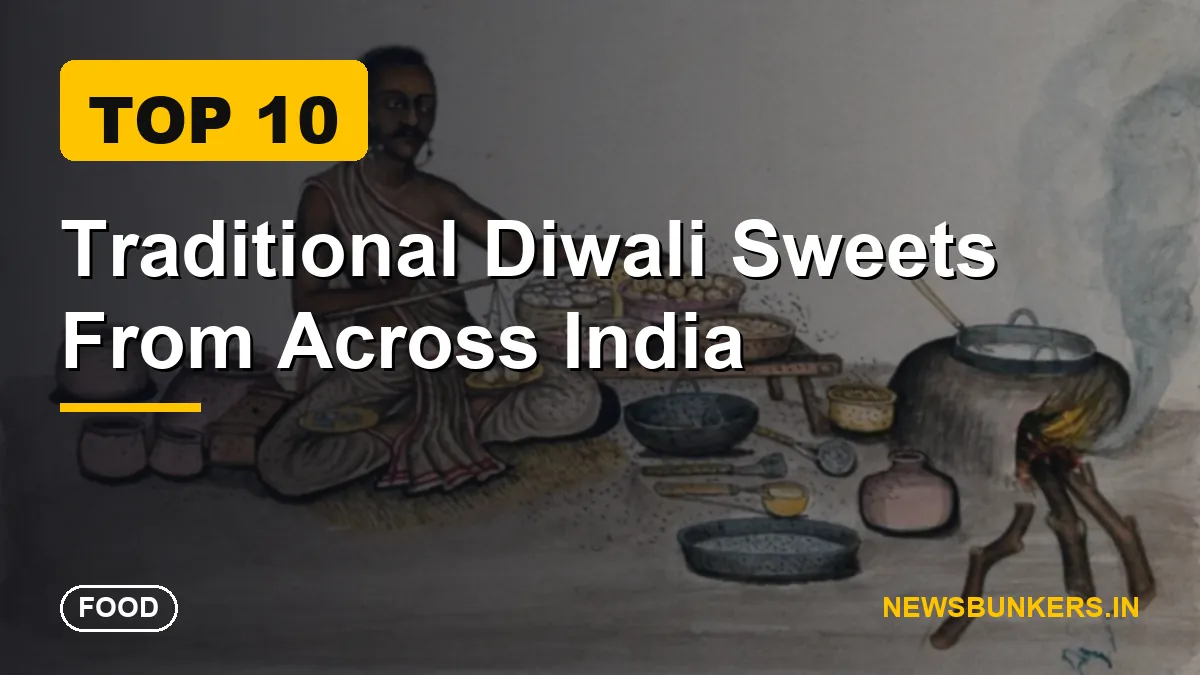
Every Indian home has that one steel dabba that appears only during Diwali. You open it, and the whole festival smells like ghee, cardamom and roasted besan. Then the doorbell rings, a neighbour hands over a box of mithai, and the dabba gets even fuller.
If you are planning your Diwali sweets this year, for your own plate, for gifting, or for the puja thali, this list is for you. We picked the top 10 traditional Diwali sweets from across India, from Bengal’s rasgulla to Tamil Nadu’s adhirasam, and explain what each one is, where it comes from, and who will love it most.
Quick Answer: The Top 10 at a Glance
- Kaju Katli: the cashew diamond that tops almost every gift box.
- Motichoor Ladoo: tiny “crushed pearl” boondi, the classic puja sweet.
- Besan Ladoo: roasted gram flour and ghee, the easiest homemade favourite.
- Gulab Jamun: soft, syrupy and loved by every age group.
- Soan Papdi: flaky, light and the most-gifted (and most-joked-about) box.
- Karanji / Gujiya: crisp half-moon pastry stuffed with coconut or khoya.
- Anarsa: rice, jaggery and poppy seeds, a Diwali staple in Maharashtra and Bihar.
- Mysore Pak: Karnataka’s ghee-rich royal sweet.
- Adhirasam: Tamil Nadu’s deep-fried rice and jaggery Deepavali must-have.
- Rasgulla: spongy chenna balls in syrup, with two GI-tagged versions.
Diwali Sweets Compared: Region, Base and Best Use
| Sweet | Linked region | Main base | Best for |
|---|---|---|---|
| Kaju Katli | Pan-India | Cashew, sugar | Corporate and family gifting |
| Motichoor Ladoo | North India | Besan boondi, ghee | Lakshmi puja prasad |
| Besan Ladoo | Pan-India | Gram flour, ghee | First-time home cooks |
| Gulab Jamun | Pan-India | Khoya, sugar syrup | Diwali dinner dessert |
| Soan Papdi | North and West India | Besan, flour, sugar | Bulk gifting |
| Karanji / Gujiya | Maharashtra, North India | Maida pastry, coconut or khoya | Faral plates |
| Anarsa | Maharashtra, Bihar | Rice, jaggery, poppy seeds | Traditional faral |
| Mysore Pak | Karnataka | Besan, ghee, sugar | Ghee lovers |
| Adhirasam | Tamil Nadu | Rice flour, jaggery | Deepavali morning |
| Rasgulla | West Bengal, Odisha | Chenna, sugar syrup | Light, less-oily option |
1. Kaju Katli: The King of the Gift Box
If a Diwali box has only one sweet, odds are it is kaju katli. The name is simple: “kaju” means cashew and “katli” means a thin slice. Ground cashews are cooked with sugar into a smooth dough, rolled flat and cut into those famous diamonds, often topped with a sheet of silver varq.
Its origin story is disputed. One popular account credits a cook named Bhimrao in the Deccan region, while other writers place it in Mughal kitchens. Nobody can prove either, and honestly, nobody at your Diwali party will ask.
Why it is on the list: it is not too sweet, it is not sticky, and it travels well, which makes it the safest pick for office colleagues and relatives in another city.
- Best for: gifting to people whose taste you do not know.
- Good to know: it is usually among the pricier mithai because cashews are costly, so cheap kaju katli deserves a second look.
2. Motichoor Ladoo: The Puja Thali Classic
Motichoor literally means “crushed pearls”, and that is exactly what it looks like. Very fine boondi made from gram flour batter is fried in ghee or oil, soaked in sugar syrup and pressed into bright orange balls, sometimes with melon seeds or pistachio on top.
In many North Indian homes, Lakshmi puja feels incomplete without a plate of motichoor ladoos as prasad. They are soft, they melt quickly, and even kids who refuse most mithai will happily eat one.
Why it is on the list: it is one of the most widely available festive sweets in the country, from small halwais in Lucknow to big chains in Mumbai, and it fits almost every ritual.
- Pros: soft texture, festive colour, easy to share.
- Cons: that very bright orange can come from added colour, so buy from a trusted shop.
3. Besan Ladoo: The Easiest Homemade Diwali Sweet
Besan ladoo is the sweet most of us first made with our mothers or grandmothers. You only need three basics: gram flour, ghee and powdered sugar, plus cardamom and some chopped nuts if you like.
The trick is patience. Besan is roasted slowly in ghee on a low flame until it turns golden and smells nutty. Rush it and the ladoos taste raw. Get it right and the whole house smells like Diwali.
Why it is on the list: many Diwali guides call besan ke ladoo one of the most popular festive sweets, and it shows up on Maharashtrian faral lists as well as North Indian thalis. It also has no khoya, which means fewer worries about adulterated dairy.
- Best for: anyone who wants to make at least one sweet at home this year.
- Good to know: since it does not use fresh milk products, it generally keeps better than khoya sweets, though homemade batches are still best eaten within a few days.
4. Gulab Jamun: Everyone’s Favourite Dessert
Put out a bowl of warm gulab jamuns after Diwali dinner and watch it vanish. These are small balls of khoya (milk solids), usually mixed with a little flour, fried until dark brown and then soaked in sugar syrup flavoured with cardamom and sometimes rose water.
It is a sweet that crosses every border inside India. You will find it at Punjabi weddings, Bengali sweet shops, South Indian restaurants and in the instant-mix aisle of every supermarket.
Why it is on the list: no other mithai is liked by such a wide range of people, from toddlers to grandparents. Served warm with a scoop of vanilla ice cream, it also turns into a quick party dessert.
- Pros: soft, rich, works hot or cold.
- Cons: khoya is one of the products FSSAI watches most closely for adulteration during the festive season, so the source matters.
5. Soan Papdi: The Most-Gifted Box in India
Yes, the memes are true. A soan papdi box often gets passed from one house to the next during Diwali. But there is a reason it keeps coming back: it is light, flaky and melts in your mouth like sweet threads.
It is made by pulling cooked sugar syrup with roasted gram flour and flour until it forms fine layers, then setting it into cubes. Its origin is not settled. Some trace it to Maharashtra, others to the Punjabi sweet patisa, and some point to a similar Persian sweet called pashmak.
Why it is on the list: it is one of the most widely sold packaged Diwali sweets, it is usually cheaper than cashew or dry fruit sweets, and it travels without breaking easily.
- Best for: bulk gifting to staff, building helpers and large families.
- Good to know: since it is mostly sold packed, check the label for the FSSAI licence number and expiry date.
6. Karanji / Gujiya: The Crispy Half-Moon
Karanji and gujiya are close cousins: a thin pastry shell, folded into a half-moon, crimped at the edges and fried. In North India, gujiya is most famous during Holi. In Maharashtra, karanji is a star of the Diwali faral plate.
The filling is where they differ. Maharashtrian karanji is usually stuffed with grated coconut, sugar and dry fruits. North Indian gujiya often uses khoya and nuts. Both get that satisfying crunch on the first bite.
Why it is on the list: it is one of the few Diwali sweets that is crisp rather than soft, which makes a mixed mithai plate far more interesting. It is also a great family project, because shaping and crimping goes faster with more hands.
- Pros: crunchy texture, flexible fillings, fun to make together.
- Cons: deep-fried, so one or two is plenty.
7. Anarsa: The Old-School Faral Favourite
Anarsa is the sweet your aaji or dadi insisted on making, even though it takes days. It is made from soaked and ground rice mixed with jaggery, shaped, coated in poppy seeds and fried in ghee.
It is closely tied to Diwali in both Maharashtra and Bihar, but it looks different in each. The Maharashtrian anarse is flatter, while the Bihari version tends to be rounder and ball-shaped.
Why it is on the list: it uses jaggery and rice instead of khoya and refined sugar, and it carries a deep regional tradition that many families still guard. If you have only ever eaten shop-bought kaju katli, this is a fresh taste of Diwali.
- Best for: people who like caramel-like jaggery flavours.
- Good to know: it is tricky for beginners, since the dough can fall apart in hot oil. Many people buy it from Maharashtrian sweet shops instead.
8. Mysore Pak: Karnataka’s Royal Ghee Sweet
Mysore Pak is pure indulgence: gram flour, sugar and a generous amount of ghee. Depending on the shop, it can be dense and crumbly or soft and almost fudge-like.
Tradition says it was first made in the kitchen of Mysore Palace by a cook named Kakasura Madappa during the rule of Krishna Raja Wadiyar IV. When the king asked its name, the sweet was called “Mysuru paka”, with “paka” referring to the sugar syrup. Historians treat this as a popular tradition rather than a documented fact, but it is a lovely one.
Why it is on the list: it is the best-known sweet from South India and a Deepavali regular in Bengaluru, Chennai and beyond. It gives a North-heavy mithai box some real variety.
- Pros: rich, aromatic, a little goes a long way.
- Cons: very high in ghee, so not ideal for anyone watching fat intake.
9. Adhirasam: Tamil Nadu’s Deepavali Must-Have
In many Tamil homes, Deepavali morning starts with an oil bath, new clothes, crackers and a plate that has adhirasam on it. It is a dark brown disc made from rice flour and jaggery syrup, flavoured with cardamom and sometimes sesame, then deep-fried.
The jaggery syrup has to reach just the right stage, and the dough is often rested before frying. That is why families treat a good adhirasam recipe like a secret. It is also offered at temples and shared with relatives during festivals.
Why it is on the list: it is one of the most traditional Deepavali sweets in South India, and it is close to sweets found in other states under different names, such as ariselu in Andhra Pradesh and kajjaya in Karnataka.
- Best for: anyone who wants to try a sweet beyond the usual North Indian box.
- Good to know: texture depends heavily on the rice flour and syrup, so do not lose heart if your first batch is hard.
10. Rasgulla: The Sweet With Two GI Tags
Soft, spongy balls of chenna (fresh cottage cheese) cooked in light sugar syrup: rasgulla is the go-to sweet for anyone who finds ghee-heavy mithai too much.
It also has one of the most famous food rivalries in India. West Bengal got a GI tag for “Banglar Rasogolla” in November 2017, with its story tied to confectioner Nobin Chandra Das in the 1860s. Odisha, which links the sweet to Puri, received its own GI tag for “Odisha Rasagola” in July 2019. The Odisha version is softer and light brown, while the Bengal version is white and creamy.
Why it is on the list: it is not fried, it is lighter than most mithai, and both GI-tagged versions are part of Diwali and Kali Puja celebrations in the east.
- Pros: light, not oily, easy to serve chilled.
- Cons: fresh chenna sweets spoil quickly, so they are not great for long-distance gifting unless canned.
How We Picked This List
We did not run a taste test, and we will not pretend we did. This list is based on research from food histories, regional recipe writers, government and state pages, and news reports on GI tags and food safety rules.
We looked at four things: how closely each sweet is linked to Diwali, how widely it is eaten or gifted, whether it represents a different region of India, and whether it offers a different texture or base, such as cashew, besan, khoya, rice or chenna. Where origin stories are disputed, we have said so instead of picking a side.
Buying Diwali Sweets Safely: 6 Mistakes to Avoid
Demand for milk products shoots up around Diwali, and FSSAI runs special drives against adulterated khoya, paneer and sweets almost every festive season. A few simple habits help.
- Ignoring the “best before” date on loose sweets. Since 1 October 2020, FSSAI has required sweet shops to display a “best before” date on trays of loose, non-packaged sweets. If a shop does not show it, ask.
- Buying from unlicensed stalls. Look for the FSSAI logo and licence number on the shop or the box.
- Trusting very bright colours. Neon orange ladoos or unnaturally green barfi can mean too much added colour.
- Not checking the silver varq. A common home check: real silver leaf crumbles to powder between your fingers, while aluminium foil tears into shreds and feels thicker.
- Stocking up too early. Khoya, chenna and milk sweets are best eaten within a few days. Buy those last and keep them refrigerated.
- Forgetting diabetic guests. Keep a small plate of dry fruits or a sugar-free option for elders who cannot have regular mithai.
Honourable Mentions
Ten is never enough for India. Kalakand, coconut barfi, shakarpara, jalebi, sandesh, kaju roll, chhena poda and dry fruit barfi all have a strong case. And on the Maharashtrian faral plate, savoury chakli and chivda deserve as much love as the sweets.
Our Take
If you can buy only one box this Diwali, make it kaju katli. It suits almost everyone, it keeps well, and it looks great on a gift tray. If you want to make one thing at home, go for besan ladoo, because it is forgiving and fills the house with that unmistakable festive smell.
Our honest wish, though? Add one regional sweet you have never tried, like adhirasam or anarsa. That is what makes Diwali sweets across India so special: every state brings something different to the plate.
FAQs
Which is the most popular Diwali sweet in India?
Kaju katli, motichoor ladoo, besan ladoo, gulab jamun and soan papdi are among the most commonly bought and gifted Diwali sweets across India. Popularity changes by region, with Mysore Pak and adhirasam more common in the South and rasgulla in the East.
Which Diwali sweets last the longest?
Sweets without fresh milk products, such as besan ladoo, soan papdi, kaju katli and Mysore Pak, generally keep longer than khoya or chenna sweets. Always check the “best before” date the shop displays.
What is the easiest Diwali sweet to make at home?
Besan ladoo is one of the easiest. You need gram flour, ghee and powdered sugar, and the main skill is roasting the besan slowly on a low flame until golden.
How can I check if Diwali sweets are adulterated?
Buy from FSSAI-licensed shops, check the licence number and dates, avoid unusually bright colours, and test silver varq by rubbing it between your fingers. For a serious concern, you can report it to your local food safety officer.
Which state does rasgulla belong to?
Both. West Bengal holds a GI tag for “Banglar Rasogolla” (2017) and Odisha holds one for “Odisha Rasagola” (2019). The tags cover each state’s own version, not the sweet in general.
Sources and disclaimer: This list is based on published food histories, regional recipe sources, GI registry reports and FSSAI notices. Origin stories for many Indian sweets are traditional accounts, not documented history. This is general information, not dietary or medical advice; people with diabetes or allergies should check ingredients before eating. Read more on Karnataka’s Mysore Pak page.







Leave a Reply