Scan to Download
AI Podcast
Samsung Electronics (KRX: 005930) is trading at ₩339,500 following an 8.86% correction from its June 19, 2026, all-time high. The company maintains a strong competitive position as the first to mass-produce HBM4, offering 11.7 Gbps performance. Market outlook remains positive, supported by Micron’s robust growth and a 34% upside potential according to analyst consensus. Q3 2026 revenue is projected to reach ₩169 trillion, with results due July 23, 2026. Despite recent volatility, the stock holds key technical support levels, while investors monitor upcoming core PCE data and long-term AI infrastructure investment cycles for sustained momentum.
TradingKey – Samsung Electronics (KRX: 005930, all prices in Korean won) is trading at ₩339,500 KRW, down from an all-time high of ₩374,500 seen on June 19, 2026. A week ago the stock shed 8.86% in the wake of a broader KOSPI pullback, part of a market correction that has been taking a toll on the tech sector. There are two key fundamentals investors can rely on as they enter the June 30 week.
First, Samsung has become the industry’s first player to ramp up mass production of HBM4 and deliver its commercial products to customers; its processing speed clocked in at 11.7 Gbps vs. the industry’s 8 Gbps standard, offering a 46% performance leap at the time of the launch.
Then there’s last week’s fiscal third-quarter 2026 report from Micron, where revenue came to $41.46B, an increase of 346% on a yearly comparison, and fourth-quarter guidance was set at $50B with a margin of 86%. That report solidified the structural reality of the HBM demand surge, which is relevant for Samsung, who was on the HBM4 first-mover spot. Next on the docket is July 23, 2026 earnings.
When Samsung said it’s in the mass production phase of HBM4 and delivering its commercial products to customers, it was the biggest boost to its semiconductor competitive landscape since the beginning of the AI memory supercycle. Samsung’s 6th-generation 10nm-class DRAM process (1c) enabled it to achieve stable yield and performance without extra revisions, as first-mover production without reworks often means genuine production capability versus an engineering prototype phase.
The speed of 11.7 Gbps represents a 46% performance gain over 8 Gbps, a benchmark established by industry standard bodies like the Verband der Elektrotechnik (VDE). Samsung is now qualified and shipping into NVIDIA’s Vera Rubin platform, competing directly with Micron and SK Hynix for a slice of the market’s most critical 2026 compute deployment. SK Hynix has dominated the HBM category since HBM3E, shipping first to Nvidia’s H100 and H200, with Micron already ramping HBM4 production for its lead customer and shipping sample parts to some others. Samsung’s move on HBM4 mass production fills in the competitive landscape.
This is no longer a market where one or two suppliers determine whether or not Nvidia, AMD and other AI accelerator makers have enough parts to meet demand. For Samsung, HBM4 volume will show up in Q3 2026 results, and ramp over the course of 2027. The July 23 call will be the first quarter where HBM4 is a major revenue contributor, rather than a line-item in the making.
Samsung just posted its Q1 results, reported on April 30, with KRW133.90 trillion in sales to a consensus expectation of KRW126.29 trillion, beating by 6%. EPS of KRW7,120 beat expectations of KRW6,150 by 15.78% over. The next quarter is expected to post revenue at KRW169.02 trillion, an increase of some 26% sequentially from a strong prior quarter as HBM4 volumes ramp, enterprise DRAM strength sustains, and as AI infrastructure demand confirmed by Micron is still “no line of sight to balance” for supply-demand.
Consensus calls Samsung a Strong Buy from 37 analysts for a 12-month average price target of KRW454,326, representing 34% upside from the current price of KRW339,500. Samsung also declared a quarterly dividend of KRW367 per share with an ex-date on June 29, 2026.
On the longer term capital front Samsung confirms the same structural view as the 1,000 trillion KRW (approximately $648B) in investments in AI in South Korea over the next ten years, as announced by Maeil Business Newspaper, a sum greater than the total GDP of almost all countries, and a sum indicative of Masayoshi Son-like conviction in the duration of the AI infrastructure cycle. It is also an implicit recognition of the AI memory supercycle not being a two or three year affair, but a decade long structural transition consistent with the Deutsche Bank view that NAND tightness will likely continue into 2028 or later, as well as with Micron management comments of no line of sight to balance for HBM in supply-demand terms.
On the 1H chart, Samsung is at 5,470 in chart units (per chart notation), holding on to the multi-touch ascending black trendline over the EMA200 at 5,355, with the RSI at 47.30 neutral with no strong divergence. Resistance on the upside from Fibs and channels is at 5,585 to 5,815. A hold in the ascending trendline over the 5,585 level targets 5,815 on the trendline bounce. A break down below 5,280 opens 5,025.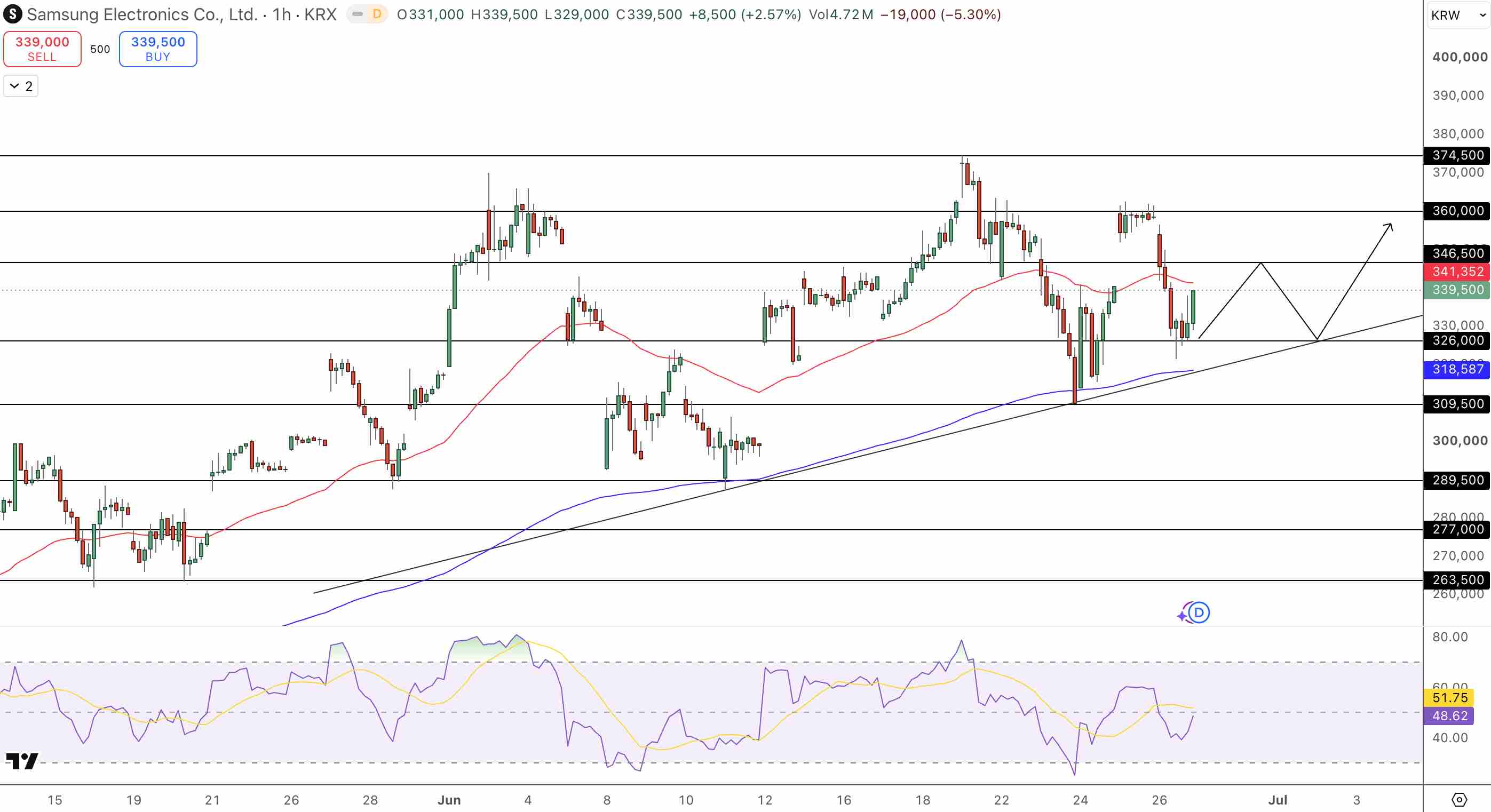
Macro catalysts for the coming week are Core PCE for May, the major macro event for global economies, with a weaker print supporting higher tech multiple valuations broadly, and the KOSPI specifically, in Korean tech. Next is the July 23 earnings.
Samsung Electronics (005930) is currently trading at 339,500 KRW, down from its 8.86% decline off of the June 19 all-time high of 374,500. The stock, as we know, has been on a strong upswing since last month when the company said its latest HBM was the best performing product in terms of speed (11.7 Gbps). This was 46% faster than the industry standard, making the product a true “first of its kind” to be shipped by a manufacturer. This, combined with the company’s Q2 performance, which saw the company beat estimates on both the revenue and EPS metrics (by 6% y/y and 15.78% y/y, respectively), bodes well for the company’s prospects in the near term. The company is currently estimated to bring in 169 trillion KRW in revenue next quarter.
The next event for investors to keep an eye on is July 23, when the company releases its Q3 2026 results. But the company is well-positioned to be a strong competitor in a rapidly growing market, with the company’s latest results from Micron, which was a 346% gain in revenue for Q3, a massive 41.46 billion, serving as a key indicator of just how fast-growing the market is and where Samsung stands in relation to its competitors.
With the analyst consensus Strong Buy and a price target of 454,326 KRW (representing a 34% upside potential), the stock seems to be holding on its trendline of 5,355 EMA200 in charts units, with the RSI hovering around neutral at this point. Next week, the core PCE release is the biggest upcoming macro event.
Click the $ button, enter the symbol, and select to link a stock, ETF, or other ticker.
Please log in to use KeyAI
Leave a Reply