Charles Monrose / 
The Pollo AI ad generator is increasingly being discussed in performance marketing circles as a tool designed to streamline video ad creation for e-commerce teams. For brands operating in fast-moving markets, the ability to produce multiple ad variations quickly has become more important than producing a single polished creative.
Pollo AI ad generator is positioned as part of a broader AI-driven content system that reduces reliance on traditional production workflows such as filming, editing, and post-production coordination. Instead, it focuses on automated generation of marketing-ready video assets that can be used for testing across platforms like TikTok, Instagram, and Facebook.
This article examines how the system works, where it performs well, and where limitations still exist for e-commerce use cases.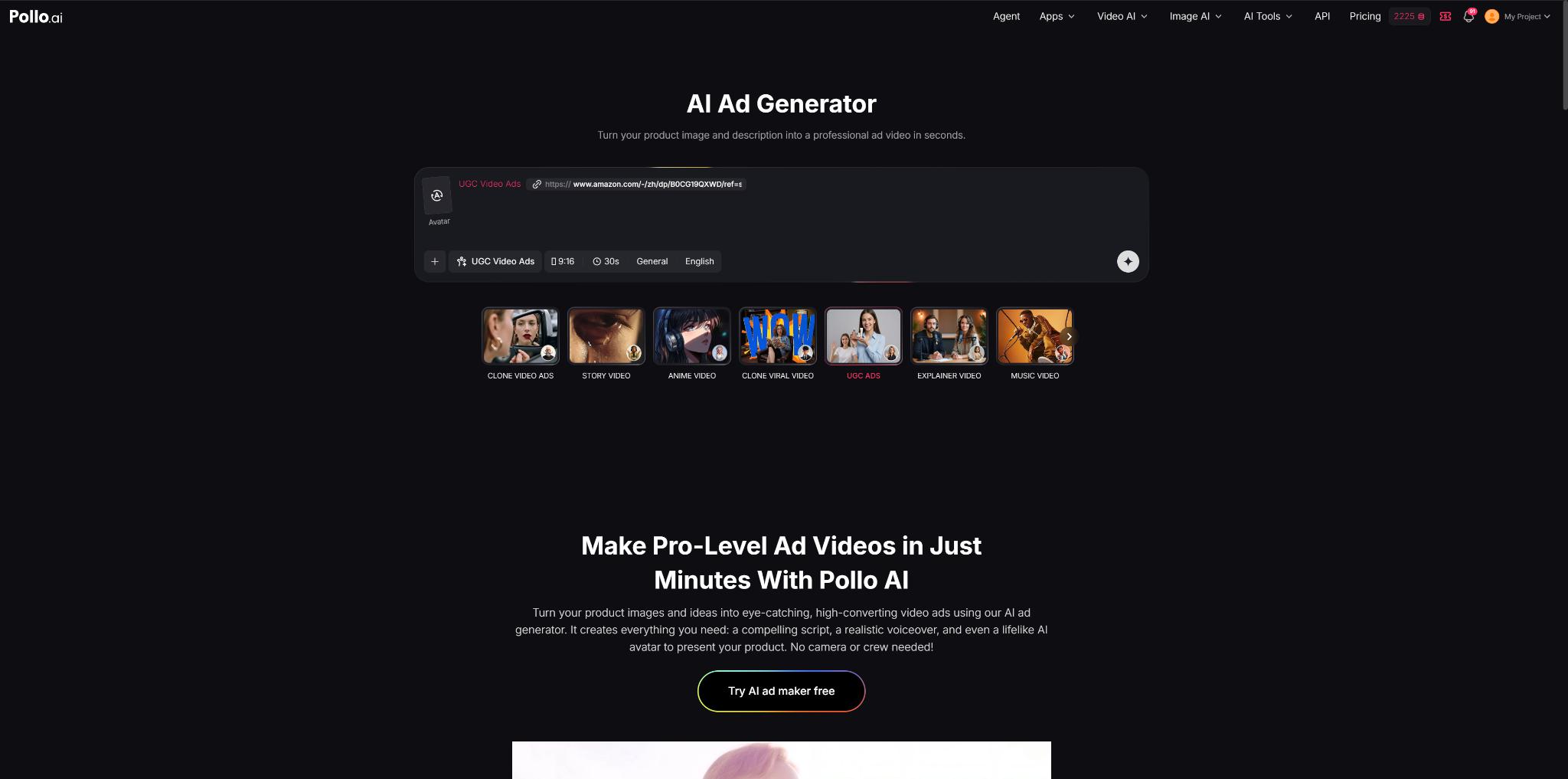
Pollo AI ad generator is an AI-based creative production tool built within the Pollo AI ecosystem. It is designed to help marketers turn basic product inputs—such as links, images, or short descriptions—into promotional video creatives without relying on traditional filming or editing processes. Instead of treating video production as a linear process, it brings generation and variation into a single automated environment.
At a structural level, the system combines an AI Agent layer with a marketing-oriented video studio. The AI Agent is responsible for interpreting product context and identifying suitable advertising patterns, while the studio layer handles the actual assembly of visual outputs. This separation allows the tool to move from raw input to usable ad creatives in a relatively short sequence, without requiring users to manage multiple production tools.
In practical use, the Pollo AI workflow is usually straightforward. A user provides a product image, a product link, or a short description of what they want to promote. From there, Pollo AI generates multiple video variations based on pre-built marketing templates and learned ad structures. These outputs are then exported and reused across different advertising campaigns, particularly in environments where testing multiple creatives is more valuable than perfecting a single version.
Another notable aspect of Pollo AI is its ability to reinterpret existing advertising formats. In some cases, it can analyze patterns from high-performing or viral-style ads and rebuild similar structures around a new product. This does not mean it simply copies content, but rather that it uses those structures as a reference point for generating new variations that follow familiar engagement patterns.
Overall, this approach fits naturally into e-commerce marketing workflows where the priority is not one polished asset, but a steady flow of variations that can be tested across audiences, platforms, and campaign objectives.
E-commerce marketing relies on rapid testing rather than single “perfect” ads. Brands need to quickly compare different hooks, messages, and visuals to find what drives performance. The Pollo AI ad generator, built within the Pollo AI ecosystem, is designed to speed up this experimentation process by turning product inputs into usable ad variations.
Instead of waiting days for traditional production involving editors or agencies, marketers can generate video ads directly from a product image, link, or short description. This shortens the gap between idea and execution, allowing campaigns to move into testing much faster.
The tool makes it easy to produce different versions of the same ad by adjusting text, pacing, messaging angle, and visual emphasis. In practice, this helps brands test whether audiences respond better to product benefits, lifestyle storytelling, or problem-solution framing, and make decisions based on real performance data.
Traditional ad scaling often requires designers, editors, and sometimes external agencies. Pollo AI reduces this dependency by automating most of the creative generation process, enabling even small teams to produce a high volume of ad creatives without expanding production capacity.
Although the output may not always be fully polished—especially for highly detailed visuals or strict brand guidelines—it is generally sufficient for testing purposes. The main advantage lies in speed and iteration, allowing brands to identify winning directions early before investing in higher-end production.
The Pollo AI ad generator, as shown on the official Pollo AI platform, is designed to turn basic product inputs into complete marketing video ads without requiring traditional production tools. In practice, it is not just a simple video generator but a broader system built around ad creation for marketing use cases.
From a functional perspective, it can generate ad videos directly from product images, links, or text descriptions. It also helps produce supporting elements such as ad scripts, voiceovers, and basic visual scenes within the same workflow. This makes it easier for marketing teams to go from product information to a usable ad without switching between multiple tools.
It also supports different ad formats, including UGC-style videos, product showcase clips, and short-form ads tailored for platforms like TikTok, Instagram, and Facebook. This flexibility allows e-commerce teams to adapt creatives to different campaign channels instead of relying on a single video format.
In daily use, the Pollo AI ad generator follows a simple workflow based on the official Pollo AI platform.
Users enter a product link, image, or short description. The system uses this to understand the product and its basic positioning.
Users select the ad style, tone, and format depending on the campaign goal, such as product ads or social media creatives.
The system produces a complete ad with visuals, script, and voiceover based on the input and selected direction.
Users preview the result, make small adjustments if needed, and export the final video for use on platforms like TikTok, Instagram, or Facebook Ads.
In real testing scenarios across different product categories, the Pollo AI ad generator shows clear strengths in speed and idea execution, while performance quality varies depending on product complexity. Overall, it is more consistent as a rapid ad testing tool than a precision-focused production tool.
Across multiple tests, the system generally performs well in interpreting simple and commercially oriented prompts. For example, when testing skincare products, it correctly emphasized benefits such as hydration, skin clarity, and “before vs after” style messaging without requiring detailed instructions. For earphones, it naturally shifted toward sound quality, daily use, and lifestyle positioning.
However, when prompts became more detailed—such as requiring exact camera angles or strict brand tone control—the output sometimes drifted slightly from the original instruction. This was more noticeable in water bottle ads where specific functional details (e.g., insulation claims or material focus) were not always consistently highlighted.
In terms of speed, the system consistently produced results within a short time frame, making it suitable for high-volume testing workflows. Across all tested categories—including building blocks, skincare items, and consumer electronics—multiple ad variations could be generated in minutes rather than hours.
This speed advantage becomes more noticeable when creating multiple versions for A/B testing. Instead of rebuilding assets from scratch, users can quickly iterate on different hooks or visual directions, which is particularly useful for fast-moving e-commerce campaigns.
The quality of generated videos varies depending on the type of product being used.
For skincare products, the system performed relatively well in creating clean, lifestyle-oriented visuals, with acceptable representation of packaging and general product appearance. The overall tone aligned well with beauty and self-care advertising styles.
For earphones, the results were also strong in terms of lifestyle integration, with realistic usage scenes such as commuting or working environments. However, fine product details like branding on the device were not always perfectly accurate.
For water bottles, the system occasionally struggled with material realism, especially with transparent or reflective surfaces. While the overall ad structure was solid, the product texture sometimes appeared slightly artificial.
For building blocks, the tool was able to generate playful and colorful scenes effectively, but small structural details were not always accurately reconstructed, especially in close-up shots.
Across all tested categories, the Pollo AI ad generator is best understood as a tool optimized for speed, variation, and testing volume rather than high-end visual precision. It works well when the goal is to quickly explore different ad directions and identify what performs in real campaigns.
For e-commerce teams, especially those running skincare, lifestyle accessories, or consumer electronics ads, it provides enough quality for performance testing. However, for brands that rely on strict product accuracy or cinematic-level visuals, additional refinement or hybrid production workflows are still necessary.
The Pollo AI ad generator, as part of the broader Pollo AI ecosystem, is primarily designed for speed, scalability, and testing efficiency in e-commerce marketing environments.
For brands focused on performance marketing, especially those running frequent A/B tests with limited budgets, it offers a practical way to produce large volumes of ad creatives without traditional production overhead. Its strengths lie in speed and flexibility rather than cinematic precision.
However, limitations such as visual inconsistencies and credit-based scaling mean it is not a complete replacement for high-end video production workflows.
Overall, its value depends on the brand’s priorities: rapid testing and volume-driven marketing strategies benefit most, while premium branding campaigns may require supplementary tools.
Michael Harradence /
The Grand Theft Auto 6 website has been overhauled, and with it, comes a brief visual overview of Vice City!
Simon Sayers /
Slot tournaments first appeared in Las Vegas back in 1979, when the Riviera Hotel hosted what many historians regard as …
Simon Sayers /
Inside the live lobby at Dudespin Casino, players encounter both the classic roulette tables and the vibrant energy of game …
EA Sports UFC 6 (PS5 / Xbox Series X/S)
Assassin’s Creed Black Flag Resynced (PC / PS5 / Xbox Series X/S)
EA Sports College Football 27 (PC / PS5 / Xbox Series X/S)
Echoes Of Aincrad: Sword Art Online (PC / PS5 / Xbox Series X/S)
Gothic Classic (PS4 / PS5 / Xbox One / Xbox Series X/S)
Halo: Campaign Evolved (PC / PlayStation 5 / Xbox Series S/X)
Beast Of Reincarnation (PC / PS5)
Metal Gear Solid: Master Collection Vol. 2 (Nintendo Switch / Nintendo Switch 2 / PC / PS5 / Xbox Series X/S)
© 2006-2026 PlayStation Universe, All Rights Reserved.
About PSU
PSU’s YouTube
PSU’s Twitter
Privacy Policy & Terms and Conditions
Advertise on PlayStation Universe
Contact
About
Staff
News
Reviews
Leave a Reply