
$26 billion is the latest price set by the capital market for the AI programming company Cognition.
In September last year, Cognition AI just crossed the $10 billion valuation threshold. At that time, it was already enough to be like a Silicon Valley myth.
Three young Chinese founders have won a total of 5 International Olympiad in Informatics gold medals. They built the prototype of “the world’s first AI software engineer” Devin from a short – term rental house. The company’s valuation soared to $10 billion in just over two years after its establishment.
Chinese origin, Olympiad, Harvard, MIT, dropping out of school to start a business, AI Agent… Each label is eye – catching enough. Cognition can definitely be regarded as one of the most story – worthy companies in the AI programming track.
Now, this story has been pushed forward a big step by the capital market.
According to Bloomberg, Cognition AI behind Devin completed a new round of financing of over $1 billion, and its post – investment valuation reached $26 billion. This round of financing was co – led by Lux Capital, General Catalyst, and 8VC, with participation from Ribbit Capital, Atreides Management, Founders Fund, etc. Cognition officially confirmed this round of financing and the latest valuation.
That is to say, only a little over 8 months have passed since the previous round of valuation of $10.2 billion, and Cognition’s valuation has increased to 2.5 times the original.
In this round of financing, the leading capitals are quite representative.
Lux Capital is a well – recognized hard – tech fund in Silicon Valley. It has long been investing in “relatively hardcore” projects such as frontier science, deep technology, AI, robotics, aerospace, national defense, and computing infrastructure. On its own investment page, Cognition is classified in the direction of “improving productivity efficiency + infrastructure + computer science”.
It can be said that Lux Capital’s investment in Cognition is based on the possibility that Cognition can turn AI Agent into software engineering infrastructure.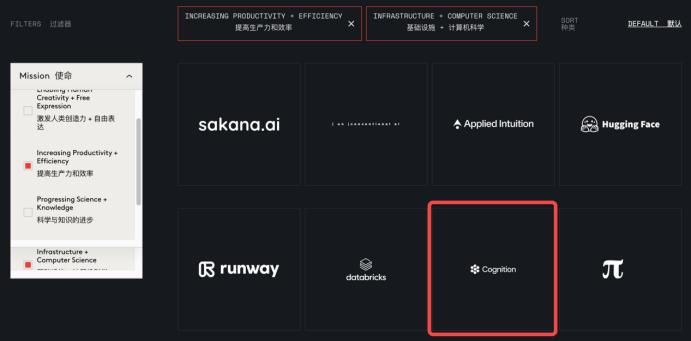
General Catalyst focuses on the opportunities for AI to transform business processes. This company is not just a traditional VC. It calls itself a “global investment and transformation company” on its official website. In recent years, it has emphasized transformation, that is, using capital, operations, and corporate relationships to promote the transformation of traditional industries and large – scale institutions.
In addition to Cognition, General Catalyst is also doubling down on Anthropic. In the past year, it has continuously participated in multiple rounds of huge – scale financing of Anthropic.
8VC, another leading investment company, brings the imagination of government and large – scale enterprise deployment. This company has long been betting on “enterprise software infrastructure in complex organizations”, and the customer list of Cognition already includes customers with strong government or public – sector characteristics such as the US Army, the US Navy, and NASA. 8VC’s participation in leading the investment has affirmed Cognition’s narrative.
In addition to the three leading investment companies, Cognition’s old shareholder, Founders Fund, is also increasing its investment. In 2025, Founders Fund led a financing round of about $400 million, and the post – investment valuation was about $10.2 billion. This company was co – founded by Peter Thiel and has an always – radical investment style, preferring technology companies that may reshape the industrial structure, such as SpaceX, Palantir, Anduril, Stripe, OpenAI, etc.
Lux Capital has long been betting on hard – tech and frontier computing, General Catalyst is good at enterprise software and large – scale institution transformation, 8VC has the genes of enterprise software and the government market, and Founders Fund is one of Cognition’s old shareholders. The simultaneous appearance of these types of capital in Cognition’s financing list is sufficient to show that investors no longer just regard Cognition as a developer tool company, but as a candidate for the next – generation software engineering infrastructure.
The post – investment valuation of $26 billion fully demonstrates the market’s confidence, and the most direct reason for the capital to continue to drive up the price is growth.
Cognition has presented very solid commercialization data. The enterprise usage has increased by more than 10 times since the beginning of this year, and the revenue run – rate has jumped from $37 million in May last year to the current $492 million. The enterprise – side usage of Devin has maintained a 50% month – on – month growth in the past 6 months.
Although $492 million is not the confirmed annual revenue, but only the annualized run – rate calculated according to the current revenue rhythm. Even so, this curve is quite astonishing. Investors can already see that enterprise customers are really paying and using, and the usage is still rising rapidly. This is a legend for a company founded in 2023.
The AI programming track is indeed booming. Code, issues, testing, PR, and documentation are originally highly digital work objects; whether a task is completed can be verified through testing, code review, and online results.
For enterprises, software teams always have endless work, and each task is time – consuming and expensive (at least the hourly wage of senior engineers is high). If an AI Agent can stably take over some clear, repetitive, and verifiable software engineering tasks, it will become an engineering production capacity that enterprises are willing to pay for.
Behind the $26 billion, what the capital really buys is actually a judgment: Software development is becoming the earliest work scenario for large – scale enterprise procurement of AI Agents.
Cognition first became well – known through an extremely bold imagination at that time.
Before Devin, most AI programming tools were still in the position of “assistants”. GitHub Copilot helps programmers complete code, ChatGPT and Claude can explain error reports and generate functions, and Cursor puts AI into the editor, allowing developers to modify code while writing.
But Devin took a big step forward. It is directly defined by Cognition as an “AI software engineer”. Users only need to describe their requirements in natural language, such as developing a website, building an application function, or fixing problems in the code library. Devin will then disassemble the tasks, write code, and fix bugs by itself until the project can run.
In March 2024, when Cognition released the Devin demonstration, the entire developer community was ignited. It was promoted as the world’s first AI programmer and, to some extent, became one of the iconic products that really made the vibe coding wave well – known.
The founders of this company also have their own stories. The three founders, Scott Wu, Steve Hao, and Walden Yan, are all Chinese and all come from the informatics competition circle. The three of them have won a total of 5 IOI gold medals. They are not traditional business – type founders but more like a group of young people who are good at writing code and are trying to train another thing that can write code.
After the release of Devin, the company quickly received support from top – tier venture capital firms such as Founders Fund, Khosla Ventures, and Bain Capital Ventures, and the capital lineup was quickly formed. Enterprise customers also began to appear, and names such as Goldman Sachs, Citigroup, and Ramp were successively associated with Devin.
In July 2025, when Goldman Sachs introduced Devin, the title of Fast Company even directly stated that “Goldman Sachs’ new AI software engineer never sleeps”. This refers to the point that an Agent can most easily impress enterprises: it can operate 24/7 without shift scheduling and will not stop due to nights, weekends, or time differences.
That was Cognition’s earliest moment of glory. A young team, a group of Chinese founders from the informatics competition, an AI Agent that claims to be able to complete software development tasks end – to – end, plus the endorsement of top – tier venture capital and large customers. All these elements together almost form a standard beginning of a Silicon Valley AI myth.
As the saying goes, “A tree that stands out in the forest will be destroyed by the wind.” When the story is told too beautifully, problems will follow.
In the early stage, Devin’s popularity was largely based on the company’s demo. When external developers began to review the demo frame by frame and have real – life trials, doubts also emerged. Some people believe that Devin’s demonstration was carefully edited, omitting some processes that would make it seem less perfect. For example, there were parts in the demonstration that were suspected of Devin creating bugs by itself and then fixing them, but the presented effect was more like it smoothly completed the task all the way.
Devin thus fell into a period of “fraud” controversy – its promotional tone was too close to the idea that AI could handle everything independently, but the real engineering environment is far more complex than the demo.
Software development is never just about writing code. It includes requirement understanding, architecture judgment, context memory, team norms, etc., and there are also a large number of implicit constraints not written in the issues. Just because an Agent can run does not mean it will always run in the right direction; just because it can generate code does not mean the code is worth merging.
After Devin was officially launched, the gap became more obvious.
Its early price was very high, starting at $500 per month. But its performance did not seem to match such a high price: Answer.AI tested Devin continuously for a month and assigned it 20 real – world engineering tasks. As a result, only 3 out of the 20 tasks were successful, 14 failed, and the other 3 were uncertain.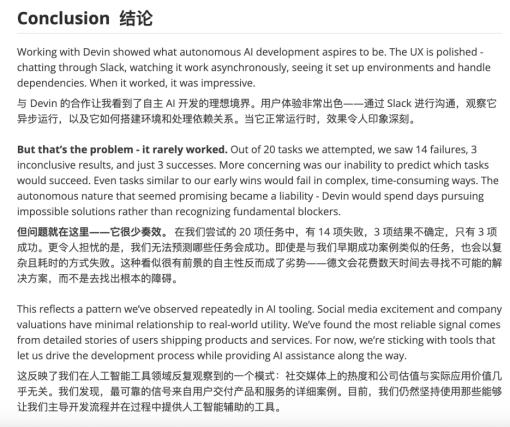
The biggest problem is not just the high failure rate, but also the unpredictability of failure.
Some tasks don’t seem very complicated, but Devin will get stuck; some tasks are infeasible, but it still keeps trying; sometimes it will generate overly complex and difficult – to – maintain code, which finally makes engineers spend more time reviewing and cleaning up.
Moreover, it is so expensive.
Cognition also realized that the monthly threshold of $500 was too high. In April 2025, Cognition launched Devin 2.0, reducing the starting price from $500 per month to $20 and introducing a more flexible pay – as – you – go (pay according to usage) model.
But price reduction is not a panacea. A tool designed for efficiency improvement finally makes people waste more time and energy, which is really unreasonable.
This is also the core contradiction of autonomous Agents in the early stage: the more an AI is like an independent engineer, the more users need to trust it. But the more it runs in a black – box manner, the more troublesome it will be if it goes off – track.
Devin promises to “leave the task to me”, but many real – world engineering tasks are not suitable to be completely handed over so early. It sounds very advanced for an Agent to run for a long time and then hand you a PR, but if the quality of the PR is unstable, the review cost for engineers will be even higher.
Interestingly, in this contrast, it was Cursor that got the first wave of real developer dividends.
Because Cursor didn’t promise to replace programmers from the beginning, its logic is more gentle and more in line with the real – world workflow: AI helps modify code, explain errors, refactor files, and generate tests beside the developer, but the developer still stays in the editor. It’s like a driving school coach car, and you can at least brake when you find something wrong.
If Cognition’s story ended here, it might become another “traffic” company that was lifted up by the AI boom and then pulled back to reality by the real – world usage experience, and there would be no more follow – up events.
But as mentioned before, reality is often more complex, and the AI programming track itself has not stood still.
After Devin ignited the imagination of “AI software engineers” and Cursor proved that developers still need a sense of control, foundation model giants such as OpenAI, Google, and Anthropic also began to accelerate integrating coding capabilities into their own products and platforms.
On one hand, the more controllable IDE route is expanding rapidly; on the other hand, model giants are moving down to the application layer. If Cognition wants to survive, it must make some changes.
Just then, it “picked up” the treasure left by Windsurf.
The battle for Windsurf can be regarded as one of the most dramatic events in the AI coding tool field in 2025.
At that time, Windsurf was already a very popular company in the AI IDE track. It was originally favored by OpenAI, and the two sides had long – term acquisition talks. The outside world once thought that this deal was a done deal.
However, this deal did not happen in the end. One of the important reasons was the complex cooperation relationship between OpenAI and Microsoft. At that time, Microsoft had extensive authorization for OpenAI’s technology and products, and Microsoft also had GitHub Copilot, an important competitor in the AI programming track. Windsurf was worried that once it was acquired by OpenAI, its technology and products might be involved in the authorization framework between OpenAI and Microsoft and indirectly flow to potential competitors.
Just as OpenAI returned empty – handed, Google quickly stepped in.
Google obtained a non – exclusive license for Windsurf’s technology for $2.4 billion. At the same time, it took Windsurf’s CEO Varun Mohan, co – founder Douglas Chen, and several core R & D personnel to Google DeepMind.
It was a Friday, and things happened very quickly. Google took away the founder and partial core technology authorization. OpenAI failed to complete the acquisition, and Windsurf’s original company entity, products, brand, customers, and 250 employees were left in a very awkward position.
Just at this time, Cognition made a stunning appearance.
What happened on Friday, it announced on Monday that it had acquired the remaining assets of Windsurf, including the Windsurf IDE product itself, intellectual property, trademarks, brand, enterprise customer base, user data, and most of the remaining team members.
This step was almost the key for Cognition to get back on the table later. It filled the gap that Devin lacked the most: the developer entry.
该文观点仅代表作者本人,36氪平台仅提供信息存储空间服务。
36kr Europe (eu.36kr.com) delivers global business and markets news, data, analysis, and video to the world, dedicated to building value and providing business service for companies’ global expansion.
© 2024 36kr.com. All rights reserved.









Leave a Reply